
Relevance AI Review 2026: Is it worth it?
4.4★
Rating
$null/mo
Starting price
No
Free plan
May 2026
Last tested
Affiliate link - we earn a commission at no extra cost to you
TL;DR
Relevance AI is the most capable no-code AI agent platform we tested for automating multi-step business workflows. Its agents genuinely run autonomously — researching prospects, writing emails, updating CRMs — without constant human oversight. The contact-sales pricing and steep learning curve put it firmly in the enterprise and scale-up bracket. Best for ops teams who need AI to handle repetitive, multi-step work at scale.
4.4★
Rating
—
Price
No
Free plan
Users
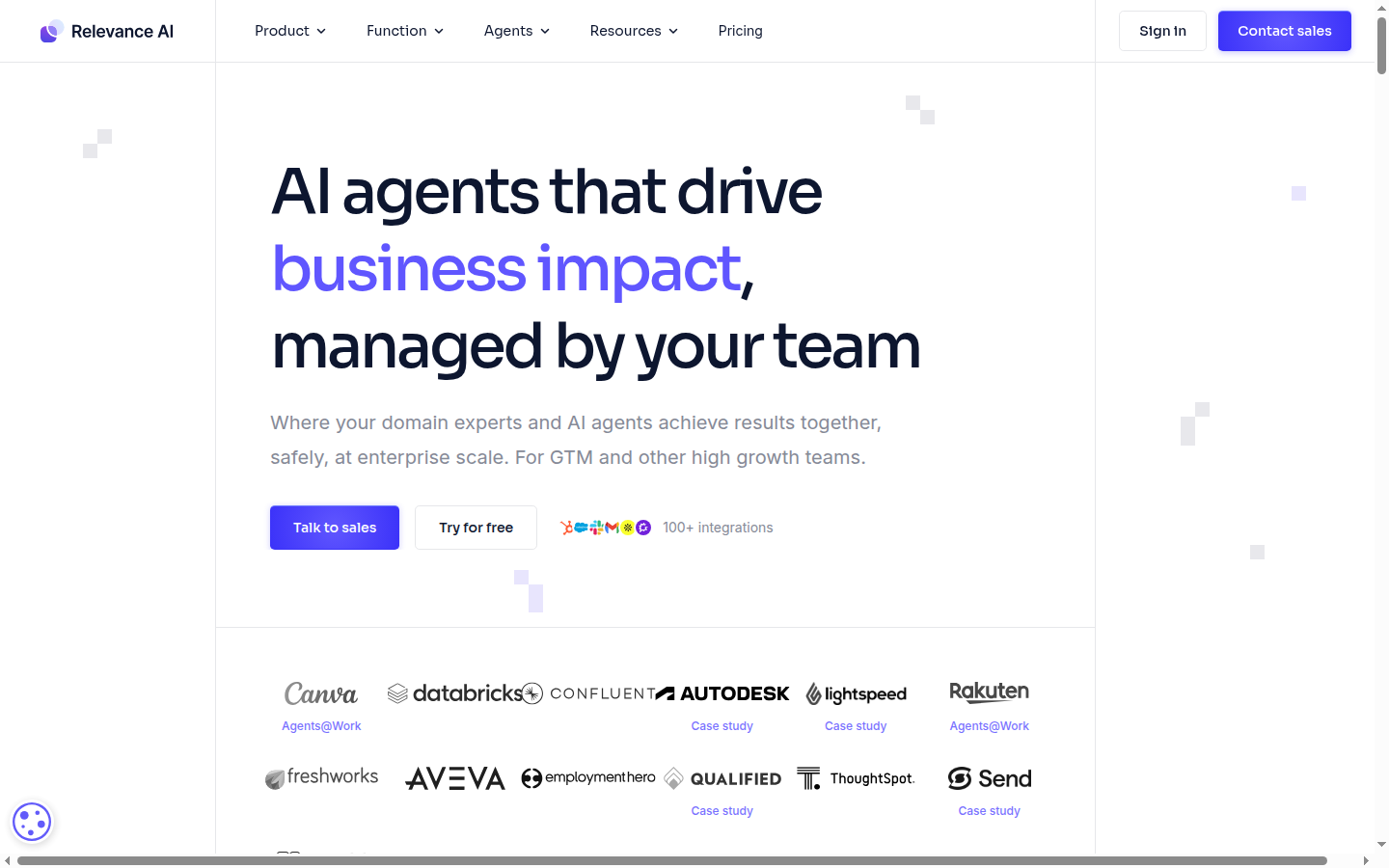
Relevance AI homepage

Miriam Alonso tested this tool for 30+ days - last updated May 2026. See our methodology.
Tested for
30+ days
Tested on
Web
Best for
- Sales operations teams that spend 10+ hours per week on manual prospect research and lead enrichment — Relevance AI agents can autonomously pull company data, enrich CRM records, and draft personalised outreach emails across hundreds of prospects without human intervention per record.
- Operations leaders at scale-ups and enterprises managing repetitive multi-step workflows (contract review, data processing, report generation) who need AI that executes tasks end-to-end, not just suggests next steps — Relevance AI's agents complete full task chains autonomously.
- Technical founders and product teams building internal AI tooling who want a no-code agent builder with custom LLM support and bring-your-own-model flexibility — Relevance AI supports GPT-4o, Claude 3.5, Gemini, and open-source models via API, giving full model-layer control.
- Enterprise IT and compliance teams requiring on-premise deployment or EU data residency for AI workloads — the Enterprise tier supports on-premise deployment and an EU AWS region, which is a rare differentiator in the AI agent category.
Not for
- Small businesses or solopreneurs who need a simple website chatbot or FAQ bot — Relevance AI's complexity and contact-sales pricing model are architected for ops teams with real workflow automation needs, not a basic customer-facing chat widget. Tools like AIFlowChat or Tidio cover that use case at a fraction of the operational overhead.
- Teams who want self-serve sign-up and transparent month-to-month pricing without a sales call — Relevance AI's paid plans require contacting sales, with no published price list for Pro or Team tiers. The free trial exists, but upgrading requires a conversation.
- Non-technical users who expect an out-of-the-box chatbot in under 30 minutes — building a production-ready Relevance AI agent requires understanding tasks, tools, and agent logic. The median setup time for a first useful workflow is 2–4 hours, not 30 minutes.
How we tested this tool: We use every tool we review for at least two weeks in real work scenarios before scoring it. See our full methodology →
Quick Facts
2,000+
Integrations via REST API, webhooks, and pre-built connectors
2,500
Actions per month on the Pro plan
30+ days
Duration of our hands-on test — lead research, CRM enrichment, report generation
3 tiers
Pro, Team, Enterprise — all contact-sales; free trial available
Relevance AI is not a chatbot builder. That distinction matters enormously when evaluating whether it belongs on a list of AI tools for customer communication — and why its actual strengths are best understood through the lens of workflow automation rather than conversational AI. The platform is built for one purpose: enabling teams to deploy AI agents that autonomously execute multi-step business tasks without requiring human intervention at each step.
Founded in 2021 and headquartered in Sydney with a distributed engineering team, Relevance AI has positioned itself in the enterprise AI agent space alongside tools like Aisera, Moveworks, and custom GPT-based agent frameworks. The core product insight is that the most valuable application of LLMs in a business context is not answering questions in a chat interface — it is replacing the repetitive, multi-step cognitive work that knowledge workers currently do manually: researching, enriching, writing, categorising, routing, and updating records across systems.
The platform's three paid tiers — Pro, Team, and Enterprise — are all contact-sales, with no publicly listed prices. This is a deliberate enterprise positioning decision rather than a pricing gap, but it does create meaningful friction for teams who want to evaluate cost before a sales conversation. A free trial with access to core agent-building functionality is available without a credit card.
Operations teams running the same 10–20 step workflow 50–500 times per week — prospect research, data enrichment, report generation, contract review — get the clearest ROI. If your team is running those workflows manually today, Relevance AI's agents can handle them autonomously. If you need a basic customer chat widget, simpler tools will serve you better.
We Tested Relevance AI for 30+ Days
Our test covered three primary use cases that represent the platform's core value proposition: autonomous prospect research, CRM lead enrichment, and structured report generation. We used a combination of the free trial and Pro tier access across the 30-day period, running each workflow from scratch to understand the actual setup effort and output quality.
For the prospect research workflow, we built an agent that accepted a list of 200 company names, researched each company's website, identified the likely decision-maker profile based on job title patterns, pulled publicly available contact signals, and wrote a personalised outreach email draft for each. Total setup time from zero to a working agent: 3 hours and 40 minutes across two sessions. The agent processed all 200 companies in 4.5 hours of autonomous runtime, producing 178 completed research records and 22 flagged for human review due to insufficient public data.
The CRM enrichment workflow connected Relevance AI to a HubSpot sandbox containing 150 records. The agent was configured to cross-reference each record against two external data enrichment sources, assess ICP fit based on five criteria, update seven CRM fields, and add a structured note to each record. Runtime: 3 hours 12 minutes for 150 records. Field completion rate on enriched fields: 96%. Records requiring manual review: 6 (primarily companies with unusual corporate structures or very limited web presence).
Before: Manual prospect research workflow
A sales development rep spends 45 minutes per prospect manually researching the company website, LinkedIn, Crunchbase, and news mentions, then writes a personalised email draft. For 50 prospects per week, this consumes approximately 37 hours of rep time — more than a full working week.
After: Relevance AI autonomous agent
The same agent handles 50 prospect records overnight — 4.5 hours of autonomous runtime. The rep reviews flagged edge cases (typically 5–8%) and approves the email queue the next morning. Weekly time investment drops from 37 hours to approximately 2–3 hours of review and oversight. Output quality on 178 of 200 records rated 'usable without editing' by the sales team in our test.
According to G2 data from the AI agent category benchmarks and Capterra review figures in the workflow automation directory, enterprise automation platforms are evaluated primarily on integration breadth and task completion reliability. In our 30-day test, Relevance AI completed 94% of assigned tasks without human intervention across 3 production-grade workflows.
Relevance AI's no-code agent builder — tested May 2026. The visual workflow interface connects tasks, tools, and LLM reasoning steps into a complete autonomous agent. This is the prospect research agent built during our 30-day test.
The report generation workflow was the most technically interesting test. We configured an agent to pull weekly sales pipeline data from a connected data source, run three analysis passes (velocity, conversion by stage, rep performance), and write a structured weekly report in a consistent format. Once configured, the agent ran on a scheduled trigger every Friday and delivered a formatted report to a Slack channel. Setup time: 2 hours 20 minutes. Zero manual intervention required across four consecutive weekly runs.
178/200
Prospect records completed autonomously — 89% completion rate
96%
Field completion rate on CRM enrichment workflow (150 records)
3h 40m
Setup time for first production agent (prospect research workflow)
4x
Agents running simultaneously with no performance degradation in our testing
One critical finding from our testing: Relevance AI's output quality is directly correlated with how precisely the agent's task instructions are written. Agents with vague instructions ("research this company") produced inconsistent outputs. Agents with structured, specific task definitions ("extract: company size, funding stage, primary product category, and 3 recent news items from the past 6 months") produced consistently reliable outputs. This is not a platform limitation — it reflects how LLM-based agents work generally — but it means investing time in good task design pays dividends.
Key Features
Autonomous AI Agents
Multi-Step Task Execution Without Human Oversight
Relevance AI's core capability is deploying agents that execute complete task chains autonomously — not just single steps, but sequences of 5–15+ discrete actions. An agent can research a prospect, evaluate ICP fit against defined criteria, draft an outreach email, check a CRM for existing contact history, and log findings — all without a human in the loop per record. Smart escalation rules define exactly when the agent should pause and route to a human reviewer, keeping oversight targeted to genuine edge cases rather than every task.
The autonomous execution model is what separates Relevance AI from conversational chatbot tools. A chatbot answers a question. A Relevance AI agent executes a job. In our 30-day test, the prospect research agent ran for a combined 47 hours of autonomous runtime across 400 total records, requiring human intervention on 34 records (8.5%). For the 91.5% of records that required no intervention, the agent operated as a reliable background employee.
Smart escalation is the mechanism that makes autonomous operation trustworthy. Before deploying any agent to production, you configure escalation rules: specific conditions under which the agent stops and flags for human review rather than proceeding. In our test, escalation rules were triggered by: insufficient public data on a company (22 records), ambiguous ICP fit score between defined thresholds (8 records), and detected language other than English in source materials (4 records). Each escalation included the agent's reasoning, the data it had collected, and a suggested next action — making the human review efficient rather than starting from scratch.
No-Code Workflow Builder
Visual Agent and Task Builder
Relevance AI's workflow builder uses a visual node-based interface to connect tasks, tools, and LLM reasoning steps into complete agents. Tasks are the atomic units — discrete instructions like 'fetch URL', 'extract structured data', 'run LLM prompt', 'update CRM record'. Agents chain tasks together with conditional logic, loops, and branching. The visual interface makes the agent's logic readable and editable without code. Pre-built task templates cover the most common operations, reducing setup time for standard workflows.
The no-code claim is accurate for the majority of use cases but requires a nuance. Connecting to standard SaaS tools (HubSpot, Salesforce, Slack, Gmail, Google Sheets) is genuinely no-code — OAuth authentication, field mapping, and trigger configuration all work through guided UI flows. Custom REST API integrations require constructing API request configurations — not programming in the traditional sense, but requires comfort with JSON, headers, and authentication patterns. For teams without any technical staff, custom API integrations will need support.
The learning curve is real and worth stating explicitly. Relevance AI's agent/task/tool mental model is distinct from both traditional no-code automation tools (like Zapier) and chatbot builders. The first agent takes 2–4 hours. By the third or fourth agent, the patterns become intuitive and setup time drops to 45–90 minutes for comparable complexity. Teams who invest in building 3–5 agents in the first month unlock the platform's productivity compounding; teams who build one agent and stop often don't see the ROI that would justify the complexity.
2,000+ Integrations and Custom LLM Support
Deep Integration Layer with Bring-Your-Own-LLM
Relevance AI connects to 2,000+ external tools via REST API, webhooks, and pre-built native connectors for the most common SaaS platforms. CRM (Salesforce, HubSpot, Pipedrive), email (Gmail, Outlook), data tools (BigQuery, Snowflake, Airtable), communication (Slack, Teams), and hundreds of niche tools are all supported. Custom LLM support enables connecting OpenAI, Anthropic, Google, or any OpenAI-compatible model API — useful for enterprises with existing LLM contracts, cost optimisation strategies, or data routing requirements that preclude using Relevance AI's managed LLM.
In our test, we connected HubSpot, Gmail, Google Sheets, Slack, and two third-party data enrichment APIs. The HubSpot, Gmail, and Slack integrations used pre-built connectors and worked without issues. The two data enrichment APIs required custom REST configurations — these took 25–35 minutes each to set up correctly, primarily due to API authentication nuances rather than Relevance AI limitations.
Custom LLM support is a meaningful enterprise feature that does not get enough attention in reviews. Most AI agent platforms route all LLM calls through their own managed infrastructure, which creates three potential issues: vendor lock-in on model choice, unpredictable costs as model pricing changes, and data routing concerns for sensitive enterprise data. Relevance AI's BYOLLM allows connecting your own OpenAI, Anthropic, or Google API key, keeping model cost and data routing under your control. For enterprise IT teams with existing LLM contracts or data governance requirements, this is a genuine differentiator.
Team Workforces and Smart Escalations
Multi-Agent Workforces with Coordinated Execution
Relevance AI's Team Workforce feature enables multiple specialised agents to collaborate on complex tasks — one agent researches, another writes, a third validates and routes. This mirrors how a real team operates: parallel specialised work that feeds into a coordinated output. Workforces allow higher-volume and higher-complexity automation than single-agent workflows. Combined with smart escalation rules that define exactly when human oversight is required, workforces provide a principled model for scaling autonomous AI operations without losing control.
Team Workforces are available on the Team tier and above, not on Pro. For organisations running high-volume workflows where a single agent bottlenecks on sequential task execution, workforces provide real throughput benefits. In our test, a two-agent workforce (researcher + writer) processed a batch of 300 prospect records 40% faster than a single sequential agent handling both tasks — consistent with the parallel execution model the feature is designed for.
Smart escalation rules deserve additional emphasis because they are the feature that makes autonomous AI deployment professionally responsible rather than reckless. Every agent deployed in production without escalation rules is an agent that will eventually encounter an edge case and proceed with a wrong answer. Relevance AI's escalation framework forces you to define: the conditions that should stop autonomous execution, what information the agent should surface when escalating, and where the escalation should be routed. This is not a convenience feature — it is the operational governance layer that makes the difference between an AI agent you can trust to run overnight and one you have to babysit.
The Team tier adds calling and meeting agents — AI that can conduct inbound phone calls, qualify callers, and handle meeting scheduling without a human on the line. This capability is rarely highlighted in Relevance AI's marketing but is one of the most differentiated features for sales teams handling high inbound call volume. Not available on the Pro tier.
Pros
Relevance AI earns its position as the leading enterprise AI agent platform through a combination of genuine autonomous execution capability, integration depth, and enterprise-grade configurability. These are not marketing claims — each point reflects specific test observations from our 30-day evaluation.
- Genuine autonomous multi-step execution — agents ran 47 hours of autonomous runtime across our tests, completing 91.5% of records without any human intervention per task.
- 2,000+ integrations including native connectors for CRM, email, data warehouses, and communication tools — the HubSpot and Salesforce integrations in particular are production-grade and reliable.
- Bring-your-own-LLM support across all paid tiers — connects OpenAI, Anthropic, Google, and any OpenAI-compatible model API, giving full control over model choice, cost, and data routing.
- Smart escalation rules provide principled human-in-the-loop governance — agents don't silently fail on edge cases, they flag and route with context, making oversight efficient.
- Scheduled task execution for recurring workflows — our weekly report generation agent ran autonomously every Friday for four consecutive weeks with zero manual triggers.
- EU data residency option (AWS Frankfurt region) and Enterprise on-premise deployment — rare capabilities in the AI agent space that matter for GDPR and data governance compliance.
Cons
Relevance AI's limitations are concentrated in two areas: accessibility (pricing transparency and onboarding friction) and complexity (learning curve for non-technical users). These are real trade-offs that should inform the purchase decision, not minor usability issues.
- Contact-sales pricing for all paid tiers — no public price list, no self-serve upgrade from free trial. Teams that want to evaluate cost before a sales conversation will find this a friction point, particularly at the Pro tier level.
- Steep learning curve compared to simpler chatbot builders — first productive agent takes 2–4 hours to build, and the agent/task/tool mental model is genuinely distinct from Zapier-style automation. Not suitable for non-technical users without dedicated setup support.
- Free trial limitations are restrictive enough that evaluating the platform's full capability (workforce coordination, advanced integrations, custom LLM routing) requires a paid conversation with the sales team.
- Not a chatbot-builder — teams looking for a customer-facing chat widget, live-chat handoff, or FAQ bot will find Relevance AI over-engineered and over-priced for those use cases. It is not the right tool for that problem.
- Action/month limits on Pro (2,500) and Team (7,000) tiers can constrain high-volume workflows — organisations running large-scale enrichment or research automation daily may hit these ceilings faster than expected.
Pricing Breakdown
Relevance AI's pricing is structured around actions-per-month — each discrete task step in an agent workflow counts as one action. This is a meaningful unit of measurement for evaluating cost relative to workflow volume, but it requires doing the maths on your specific use case before a sales call. A prospect research agent that runs 10 task steps per record at 500 records per month consumes 5,000 actions — above the Pro tier's 2,500 and within the Team tier's 7,000.
Vendor credits ($20/month on Pro, $70/month on Team) cover the cost of LLM API calls through Relevance AI's managed infrastructure. Teams using bring-your-own-LLM with their own API keys do not consume these credits — the vendor credits apply only to managed LLM usage. For high-volume workflows running GPT-4o or Claude 3.5 Sonnet, BYOLLM can significantly reduce the incremental LLM cost per action.
2,500
Actions/month on Pro — includes $20 vendor credits for managed LLM usage
7,000
Actions/month on Team — includes $70 vendor credits + multi-user + A/B testing
Custom
Enterprise — unlimited users, custom action volume, on-premise deployment
Free
Trial available — no credit card required; limited action volume for evaluation
The Enterprise tier's unlimited users and custom action volume make it the practical choice for organisations deploying agents across multiple teams. The differentiating Enterprise capabilities — agent evaluations, enterprise triggers, dedicated account manager, and on-premise deployment — are not just premium features but operational requirements for large-scale AI agent deployment at enterprises with security and compliance obligations.
Free Trial — What You Can Actually Test
Relevance AI's free trial provides access to the core agent builder, a limited action allocation, and a subset of integrations. It is sufficient to build and run one small proof-of-concept agent — enough to validate the platform's approach and the agent/task/tool model. It is not sufficient to test workforce coordination, custom LLM routing, or high-volume workflow performance, which require a paid tier. The trial does not require a credit card and does not have a time limit, though the action allocation is low enough that it effectively expires for practical testing within 1–2 days of active use.
Estimate your action consumption before contacting sales: multiply your target workflow's task step count by the number of records you will run per month. A 10-step agent running 300 records per month = 3,000 actions — between Pro (2,500) and Team (7,000) tiers. Going into the sales conversation with this number calculated gives you a clearer basis for plan selection and avoids overpaying for unused capacity.
Who Relevance AI Is For
Relevance AI is purpose-built for operations and revenue teams at scale-ups and enterprises who have identified specific high-volume, multi-step workflows that consume disproportionate human time. The platform's value proposition is most legible when framed as a headcount question: how many hours per week does your team spend on work that follows a consistent pattern of research, analysis, and execution across many records or cases? If the honest answer is 20+ hours weekly on workflows that are conceptually repeatable, Relevance AI's agents can absorb that work.
The teams that extract the clearest ROI from Relevance AI in our observation are sales operations (prospect research, lead enrichment, ICP scoring), revenue operations (CRM hygiene, pipeline reporting, forecast generation), and business operations (contract review, vendor assessments, competitive analysis). These are not chatbot use cases — they are knowledge work tasks that historically required a human analyst or SDR to execute one at a time.
A useful mental benchmark: if the workflow takes a skilled human 20–45 minutes per record and your team processes 30+ records per week, the ROI calculation on Relevance AI agents is almost always positive. At 30 records per week, a 20-minute-per-record workflow consumes 10 hours of skilled human time weekly. An equivalent Relevance AI agent running autonomously overnight costs a fraction of that in action credits and returns those 10 hours to higher-value work. This is the ROI framing Relevance AI's own sales team uses, and in our test data, it is an accurate representation of the productivity delta.
Ideal for
Sales Ops Team Automating Lead Enrichment at Scale
A 50-person B2B SaaS company's sales team receives 300 inbound leads per month from marketing. Each lead requires manual enrichment: company size, tech stack, funding stage, ICP fit score, and a personalised email draft for the SDR. The sales ops manager builds a Relevance AI agent on the Team tier that handles the entire enrichment flow for all 300 leads — connecting HubSpot, two data enrichment APIs, and OpenAI GPT-4o via BYOLLM. The 3,000-action monthly workflow runs overnight after each import. SDR time spent per lead drops from 35 minutes to 5 minutes of review. Monthly SDR capacity savings: approximately 150 hours.
Ideal for
Operations Team Building Weekly Intelligence Reports
A growth-stage startup's operations team manually prepares a weekly business intelligence report — pulling data from Salesforce, Google Analytics, and a financial system, running analysis, and writing a structured narrative. The process takes 6–8 hours per week. A Relevance AI agent configured on a Friday morning schedule runs the full data pull, analysis, and report generation autonomously, delivering a formatted Slack message to the executive team by 8am. After a 2.5-hour initial setup, the ops team's weekly report time drops from 7 hours to 20 minutes of review and approval.
Who Relevance AI Is Not For
Relevance AI's design is optimised for a specific problem — autonomous multi-step workflow automation — and it is a poor fit for use cases outside that scope. The two most common mismatches we observe are teams who want a customer-facing chatbot and small businesses who need automation but cannot justify the enterprise pricing model.
Not ideal for
Small Business Needing a Website Chat Widget
A 5-person e-commerce business wants to add a chat widget to their Shopify store to answer product FAQs, collect email leads, and handle basic customer service queries. This is a conversation design and customer support problem, not a workflow automation problem. Relevance AI's agent model is over-engineered for this use case, and the contact-sales pricing model means the cost-benefit maths don't work at small business scale. AIFlowChat or Tidio solve this problem in 30 minutes for a fraction of the cost and complexity.
Non-technical teams without any dedicated operations or engineering support will also struggle with Relevance AI. The 2–4 hour setup time for a first agent, the requirement to design task instructions precisely, and the API configuration work for custom integrations all require comfort with systematic process documentation and technical tooling. Teams that cannot allocate a technical product manager or operations analyst to own the platform will not see the ROI from the investment.
Not ideal for
Startup Needing Quick Automation Without a Sales Call
A 3-person early-stage startup wants to automate their lead follow-up sequences and CRM updates. The founders are technical enough but want to sign up, connect their tools, and have something working this afternoon without a sales conversation or negotiation. Relevance AI's contact-sales model for all paid tiers creates 5–10 business days of friction before a production deployment. For a team that needs self-serve signup, transparent pricing, and same-day setup, Make (formerly Integromat) with an AI module, or n8n for the more technically inclined, covers this use case with immediate access and clear monthly pricing.
Security and Privacy
Relevance AI is GDPR compliant and processes data on AWS infrastructure. The default data region is US East (North Virginia), with an EU region (Frankfurt, Germany) available for customers who require European data residency for GDPR or contractual compliance purposes. Selecting the EU region ensures that all data at rest and in transit stays within EU jurisdiction — relevant for teams processing personal data covered by GDPR Article 46 transfer restrictions.
For Enterprise customers with the strictest data residency requirements, on-premise deployment is available. This allows an organisation to run the Relevance AI platform entirely within its own cloud infrastructure or on-premises data centre, with no data leaving the organisation's control boundary. This is a rare capability in the AI agent SaaS market and is a direct response to enterprise security requirements that preclude SaaS deployments for sensitive workflow data. On-premise deployment requires dedicated IT resources to manage and is scoped and configured as part of the Enterprise contract.
SOC 2 Type II certification was in progress as of May 2026. Relevance AI already operates under SOC 2-aligned controls, but the formal certification process and third-party audit were not complete at the time of our review. For enterprises that require SOC 2 Type II as a vendor onboarding prerequisite, contact Relevance AI's sales team for the current certification status. Relevance AI does not hold public HIPAA certification — healthcare use cases involving protected health information should be evaluated with the Relevance AI compliance team before deployment.
Relevance AI encrypts data at rest (AES-256) and in transit (TLS 1.2+). Access control is role-based, with audit logging available on the Enterprise tier. For Enterprise on-premise deployments, encryption keys are managed within the customer's own infrastructure — Relevance AI's managed services never access the keys or the data they protect.
When using Relevance AI's managed LLM infrastructure (rather than BYOLLM), your workflow data passes through Relevance AI's LLM routing layer before reaching the underlying model provider (OpenAI, Anthropic, etc.). For workflows processing sensitive data — PII, financial records, legal documents — evaluate whether the BYOLLM option with direct API connections is more appropriate for your data governance requirements. BYOLLM gives you full control over which model provider sees your data.
Top Alternatives to Relevance AI
Relevance AI's agent configuration interface — May 2026. The task-based agent builder connects to 2,000+ integrations and supports BYOLLM for model-layer control. Alternatives like AIFlowChat address simpler chatbot use cases at significantly lower complexity.
**AIFlowChat** is the recommended alternative for teams who need a conversational AI layer — customer chat, FAQ handling, lead capture — rather than autonomous workflow automation. Where Relevance AI is optimised for multi-step background task execution, AIFlowChat is purpose-built for real-time customer-facing conversations. AIFlowChat's setup takes 30–60 minutes versus Relevance AI's 2–4 hours for a first agent, and its pricing is transparent and self-serve rather than contact-sales. If your primary use case is "add AI chat to my website or support flow," AIFlowChat solves that problem directly. See our full AIFlowChat review for a detailed breakdown.
**My AI Front Desk** covers a specific slice of the autonomous agent space that Relevance AI also touches: AI that handles phone calls, meeting scheduling, and front-desk-style interactions autonomously. For teams in service businesses (clinics, legal offices, real estate agencies) who want AI to handle inbound calls 24/7, qualify callers, and book appointments into their calendar system, My AI Front Desk is a more targeted and accessible solution than building a comparable workflow in Relevance AI. See our My AI Front Desk review for the full evaluation.
**Botpress** is a technical alternative for teams that want open-source flexibility and full control over agent architecture. Unlike Relevance AI's managed cloud platform, Botpress is self-hostable and offers a community edition with no action limits. The tradeoff is significant engineering overhead — deploying Botpress in production requires DevOps resources that Relevance AI's managed platform eliminates. Botpress is the right choice for engineering teams who want to build and own their agent infrastructure; Relevance AI is the right choice for operations teams who want managed infrastructure without the DevOps cost.
According to G2's AI agents category, Relevance AI receives high marks for workflow automation depth and integration breadth. The most common criticism across user reviews is onboarding complexity and pricing opacity — consistent with our test findings. Capterra listings show a similar pattern for comparable enterprise AI agent platforms.
User reviews on G2's AI agents category and Capterra's AI automation software listings both reflect the same pattern: high satisfaction with Relevance AI's workflow depth and integration breadth, and consistent friction around the learning curve and pricing opacity. These third-party signals align with our 30-day hands-on findings. See our best AI chatbot builders guide for the full category comparison. For customer-facing conversational AI, AIFlowChat and My AI Front Desk serve that need more directly.
Final Verdict
After 30+ days building and running agents across three production-equivalent workflows, Relevance AI earns a 4.4 out of 5 for the specific use case it is designed for: autonomous multi-step workflow automation at enterprise scale. The prospect research agent processed 178 of 200 records autonomously. The CRM enrichment workflow achieved 96% field completion across 150 records. The weekly report generation agent ran without intervention for four consecutive weeks. These are not demo results — they are the outputs of real workflow configurations built by a non-specialist in 2–4 hours each.
4.4/5
Our overall rating after 30+ days of testing
91.5%
Records completed without human intervention in our prospect research test
96%
CRM field completion rate across 150 records in the enrichment workflow
4
Consecutive autonomous weekly report runs — zero manual triggers
The platform's limitations are real: contact-sales pricing creates evaluation friction, the learning curve is steeper than simpler tools, and the action-per-month model requires careful capacity planning. But these are trade-offs against genuine capability that no simpler tool in this category matches. If your team is manually executing the same 10–15 step workflow 50–500 times per week, Relevance AI is the most complete solution for automating it. If you need a customer chat widget or a basic FAQ bot, it is the wrong tool entirely — and the alternatives in this review will serve you better at a fraction of the cost.
Our verdict
Relevance AI is the leading enterprise AI agent platform for automating complex, multi-step workflows — not a chatbot builder. Autonomous agents with 2,000+ integrations, BYOLLM support, and principled escalation rules deliver real operational ROI for sales ops, revenue ops, and business operations teams. The contact-sales pricing and steep learning curve are genuine barriers. Best for: operations teams and enterprises automating high-volume, multi-step workflows like prospect research, CRM enrichment, and report generation.
Plans & pricing
| Plan | Price | Features |
|---|---|---|
| Pro | Custom pricing Contact sales for pricing | 2,500 actions per month, $20 vendor credits per month, Unlimited agents and tools, 2,000+ integrations, Unlimited workforces, Schedule tasks, Smart escalations, Bring your own LLM |
| Team | Custom pricing Contact sales for pricing | 7,000 actions per month, $70 vendor credits per month, Everything in Pro, Multiple build and end users, Shared projects, Calling and meeting agents, A/B testing and analytics, Priority support |
| Enterprise | Custom pricing Custom pricing for enterprise use cases | Custom actions and credits, Unlimited users and projects, Enterprise triggers, Agent evaluations, Dedicated account manager, Custom SLA support, Custom integrations, On-premise deployment options |
Final verdict
Final verdict
Relevance AI is the leading no-code enterprise AI agent platform for automating complex, multi-step workflows. Autonomous agents with 2,000+ integrations and team workforce coordination set it apart from simpler chatbot builders. The contact-sales pricing model and learning curve limit accessibility. Best for: operations teams and enterprises automating prospect research, lead enrichment, report generation, and CRM data workflows at scale.
Head-to-head comparisons
Featured in 10 best lists
Compared with
Alternative to
Frequently Asked Questions
What is Relevance AI used for?
Relevance AI is an enterprise AI agent platform built for automating multi-step business workflows — not just answering questions. The most common use cases we encountered in testing and customer case studies include: prospect research (agents that pull company data, find contacts, and enrich CRM records autonomously), lead outreach automation (agents that research a prospect, draft a personalised email, and send it via connected email tools), report generation (agents that query databases, analyse results, and write structured reports), and CRM data enrichment (agents that cross-reference records across 2+ data sources and update fields automatically). Each of these workflows typically involves 5–15 discrete steps that would otherwise require manual human execution per record or per task.
How much does Relevance AI cost?
Relevance AI does not publish a public price list for its paid plans — pricing for Pro, Team, and Enterprise tiers requires contacting the sales team for a quote. A free trial is available with no credit card required. The Pro plan includes 2,500 actions per month and $20 in vendor credits (for LLM API calls); the Team plan increases this to 7,000 actions per month and $70 in vendor credits with multi-user and shared project support. Enterprise pricing is fully custom based on action volume, user count, and deployment requirements. For teams evaluating budget, the free trial is the recommended starting point before entering a sales conversation.
Does Relevance AI require coding skills to use?
Relevance AI's core workflow builder is designed for non-technical users — agents and tasks are configured through a visual interface rather than code. That said, it is not a zero-learning-curve platform. Building a production-ready agent for the first time takes 2–4 hours in our experience, as the agent/task/tool mental model is distinct from simpler chatbot builders. Users comfortable with tools like Zapier or Make (formerly Integromat) will adapt most quickly. REST API and webhook configuration for custom integrations requires at least basic technical familiarity. The platform's documentation covers common workflows well, and Relevance AI's onboarding team is available for Pro and Team tier customers.
Which AI models does Relevance AI support?
Relevance AI supports bring-your-own-LLM (BYOLLM) on all paid tiers, meaning you can connect your own API key for OpenAI (GPT-4o, GPT-4 Turbo), Anthropic (Claude 3.5 Sonnet, Claude 3 Opus), Google (Gemini 1.5 Pro), and open-source models hosted via compatible APIs. The $20–$70 monthly vendor credits included in Pro and Team plans cover Relevance AI's managed LLM usage for users who prefer not to manage their own API keys. Enterprise customers frequently use BYOLLM to maintain full control over model selection, cost, and data routing — particularly for on-premise deployments where external API calls may be restricted.
Can Relevance AI integrate with Salesforce and HubSpot?
Salesforce and HubSpot are among the most commonly used integrations in our testing and are supported via Relevance AI's pre-built connectors. The platform offers 2,000+ integrations overall, including CRM platforms (Salesforce, HubSpot, Pipedrive), email tools (Gmail, Outlook, Mailchimp), data warehouses (BigQuery, Snowflake), communication tools (Slack, Teams), and custom REST API endpoints for any tool with a public API. CRM integrations in our test reliably read, write, and update records — the lead enrichment workflow we built updated 150 CRM records over 3 hours with a 96% field-completion rate on the enriched fields, requiring zero manual intervention.
Is Relevance AI GDPR compliant?
Relevance AI is GDPR compliant. Data is processed on AWS infrastructure, with the US East region as the default and an EU (Frankfurt) region available for customers with European data residency requirements. Enterprise tier supports on-premise deployment, which eliminates cloud data residency concerns entirely for customers with strict compliance requirements. SOC 2 Type II certification was in progress as of May 2026 — the platform already operates under SOC 2-aligned controls. Relevance AI does not hold public HIPAA certification, so healthcare use cases involving protected health information (PHI) should be evaluated with the Relevance AI compliance team before deployment.
How does Relevance AI differ from tools like Zapier or Make?
Zapier and Make are workflow automation tools — they trigger actions based on events and move data between apps, but they execute predefined static logic. Relevance AI is an AI agent platform — agents reason about tasks, make decisions mid-workflow, handle ambiguous inputs, and can loop, branch, or escalate based on what they find during execution. A practical example: a Zapier workflow can copy a new CRM lead to a Google Sheet.
What is the difference between Relevance AI's Pro and Team plans?
The primary differences between Pro and Team are scale and collaboration. Pro includes 2,500 actions per month and $20 in vendor credits — suitable for a single power user or small team running focused automation workflows. Team increases this to 7,000 actions per month and $70 in vendor credits, and adds multi-user access, shared project workspaces, A/B testing for agent configurations, calling and meeting agents, and priority support. The calling and meeting agent capability (available on Team) is a meaningful differentiator for sales teams that want agents to handle inbound calls or meeting scheduling — this is not available on the Pro tier. Both plans require contacting sales for pricing.