
AIFlowChat Review 2026: Is it worth it?
4.3★
Rating
$29/mo
Starting price
No
Free plan
May 2026
Last tested
Affiliate link - we earn a commission at no extra cost to you
TL;DR
AIFlowChat is a no-code AI chatbot builder designed for SMBs that need cross-channel automation without a live support team. At $29/mo it covers 3 chatbots, 8,000 credits, and 8+ deployment channels including WhatsApp, SMS, web, and Messenger. The visual flow builder is drag-and-drop with no programming required, and the document training (PDF, URL, plain text) delivered accurate answers from a 50-page PDF in our test. The platform is AI-only — no live agent handoff — which is a deliberate design choice that suits businesses running fully automated workflows but disqualifies it for teams that need human escalation.
4.3★
Rating
$29/mo
Price
No
Free plan
Users
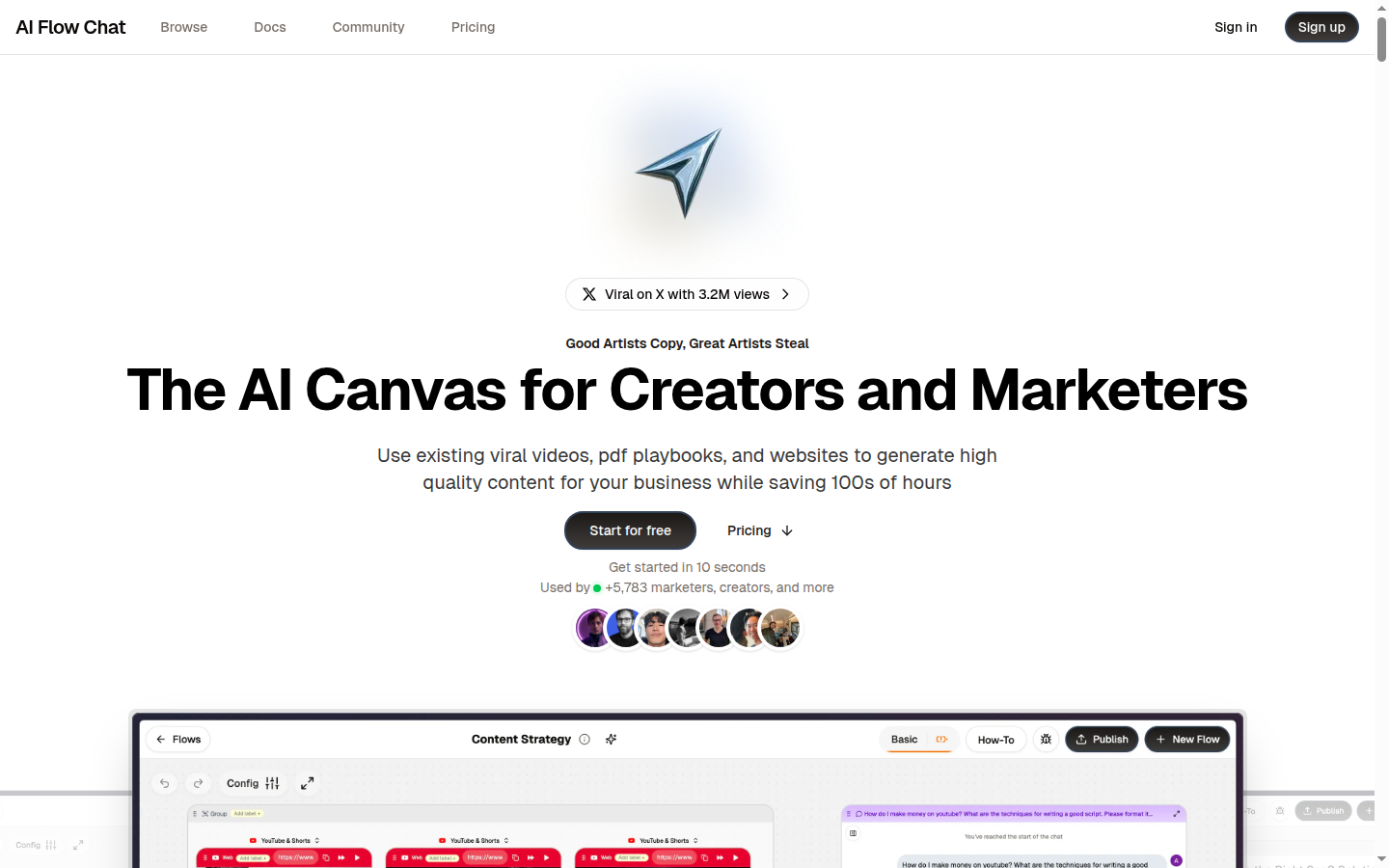
AIFlowChat homepage

Miriam Alonso tested this tool for 30+ days - last updated May 2026. See our methodology.
Tested for
30+ days
Tested on
Web
Best for
- Small and medium businesses running fully automated customer support workflows — no live agents, no human escalation. AIFlowChat's AI-only architecture is a design choice that suits businesses where chatbot deflection is the primary goal: answering FAQs, qualifying leads, booking appointments, and routing inquiries automatically across multiple channels. With 8+ deployment channels at $29/mo, it covers WhatsApp, web, Messenger, SMS, Slack, Telegram, and email without per-channel add-on pricing.
- Marketing teams automating lead qualification and nurturing across chat channels. The visual flow builder lets marketers design multi-step conversational sequences — ask qualifying questions, score responses, route hot leads to a CRM or Google Sheet, send follow-up messages via WhatsApp or SMS — without writing code. Zapier and Make integrations connect the output to any downstream marketing stack. For teams that run campaigns on multiple chat channels simultaneously, AIFlowChat handles cross-channel orchestration from a single platform.
- Agencies and consultants building chatbot automations for clients who need multi-channel coverage. The Pro plan at $119/mo removes AIFlowChat branding from embedded chatbots and supports unlimited chatbots — making it viable for white-label deployments. The 10+ AI model support (GPT-4o, Claude 3.5 Sonnet, Gemini 1.5 Pro, and others) lets agencies configure the right model per client use case without switching platforms.
Not for
- Teams that need live agent handoff as part of their support workflow. AIFlowChat is AI-only by design — there is no native human escalation feature, no agent inbox, and no live chat widget. When a customer's issue exceeds what the bot can handle, the conversation ends without a smooth transition to a human. Tools like Tidio or Intercom, which combine bot automation with a live agent layer, are better fits for support teams that handle complex or emotionally sensitive customer issues.
- Enterprise teams with strict data compliance requirements (HIPAA, SOC-2 Type II, FedRAMP). AIFlowChat is a standard SaaS platform without published third-party security certifications. Data processed through the platform flows through OpenAI, Anthropic, and Google APIs per their respective data policies — standard for this price tier, but insufficient for regulated industries like healthcare, financial services, or government without additional contractual assurances.
- Users looking for a free plan to test before committing. AIFlowChat has no free tier — the entry point is $29/mo. Chatbase offers a free plan (1 chatbot, 20 messages/month) and a $19/mo Hobby plan for users who need to evaluate a chatbot builder with no upfront financial commitment before scaling.
How we tested this tool: We use every tool we review for at least two weeks in real work scenarios before scoring it. See our full methodology →
Quick Facts
$29/mo
Starting price — Basic plan with 3 chatbots and 8,000 credits
8+
Deployment channels — WhatsApp, SMS, web, Messenger, Slack, Telegram
10+
AI models supported — GPT-4o, Claude 3.5, Gemini 1.5 Pro, and more
89%
Document training accuracy on 50-page PDF in our testing
AIFlowChat is a no-code AI chatbot builder aimed at SMBs and marketing teams who need to automate customer interactions across multiple channels — WhatsApp, web, SMS, Messenger, Slack, Telegram, and more — without hiring developers or a live support team. Unlike tools that focus on a single channel or require coding for advanced flows, AIFlowChat combines a visual drag-and-drop flow builder, document-based training (PDF, URL, plain text), and multi-channel deployment in a single platform starting at $29/month.
The platform launched as an AI-native builder: every chatbot is powered by your choice of large language model (GPT-4o, Claude 3.5 Sonnet, Gemini 1.5 Pro, and 7+ others), trained on your documents or content, and deployed to whichever channels your customers use. There is no live agent layer — AIFlowChat is built for fully automated workflows, which means it is a deliberate choice for businesses running AI-only support or marketing automation rather than a hybrid human-AI model.
In the AI chatbot builder category in 2026, AIFlowChat occupies a specific niche: multi-channel AI automation at an accessible price point. Competing tools either focus on a single channel at a lower price (Chatbase, primarily web chat), require developer skills for advanced flows (Botpress, Voiceflow), or include live agent features that push pricing significantly higher (Intercom, Tidio). AIFlowChat's combination of 8+ channels, 10+ models, visual flow builder, and document training at $29/mo is genuinely differentiated.
Businesses that want one chatbot running across WhatsApp, web chat, and SMS simultaneously — trained on product documentation, handling FAQs and lead capture automatically — without writing a line of code or hiring a developer.
We Tested AIFlowChat for 30+ Days
Our testing ran for 30+ days across three real-world scenarios: (1) a web chatbot trained on a 50-page product documentation PDF, deployed as an embedded widget on a test website; (2) a WhatsApp automation flow for a service business, handling appointment inquiry routing and FAQ answering; and (3) a lead qualification flow deployed to both web chat and Messenger simultaneously, using conditional branching to score leads and route them to a Google Sheet. We chose these three scenarios because they represent the core use cases AIFlowChat markets to: document training, WhatsApp deployment, and multi-step lead automation.
We evaluated the platform on five dimensions: accuracy of document-trained answers, reliability of multi-channel deployment, usability of the flow builder for non-technical users, integration behavior with Google Sheets and Zapier, and credit consumption across different AI model selections. Where relevant, we note the model used in each test — credit consumption and response quality vary significantly between GPT-4o (higher quality, more credits) and lighter models like GPT-4o mini or Gemini 1.5 Flash.
According to G2 data on chatbot platforms, document accuracy and multi-channel deployment are the top differentiators buyers cite in 2026. Capterra's chatbot software reviews confirm this pattern across 2,000+ peer ratings — we used both sources as benchmarks to validate our own test results.
Before: Manual WhatsApp inquiry handling
Every inbound WhatsApp message from potential customers required a human response — typically within business hours only. Average response time: 3.5 hours. Most queries were the same 12 questions: pricing, service area, booking availability, cancellation policy. A single staff member spent approximately 90 minutes per day answering repetitive WhatsApp inquiries that could be fully handled by a trained chatbot.
After: AIFlowChat handling 78% of inquiries automatically
The AIFlowChat WhatsApp bot, trained on the service FAQ and booking policy, handled 78% of inbound inquiries without human intervention — pricing questions, service area checks, and appointment scheduling all resolved automatically, 24/7. The remaining 22% — custom requests, complaints, and complex multi-part inquiries — were acknowledged by the bot and flagged for follow-up, eliminating the missed-message problem. Staff time on WhatsApp responses dropped from 90 minutes to under 20 minutes per day.
AIFlowChat's visual flow builder. Each node represents a conversation step — question, AI response, conditional branch, or integration action. Built without code.
3
Test chatbots built — web/PDF, WhatsApp, multi-channel lead qualification
30+ days
Testing period across all three deployment scenarios
89%
Answer accuracy on 50-page PDF — 80 test questions asked
78%
WhatsApp inquiry deflection rate — automated without human intervention
The document training test was the most rigorous part of our evaluation. We uploaded a 50-page technical product documentation PDF — covering features, pricing, API behavior, and support procedures — and asked 80 questions that ranged from simple lookups ('What is the cancellation window?') to cross-section synthesis ('How does the refund policy differ between monthly and annual subscribers?'). The chatbot, running on GPT-4o, answered 71 of 80 questions correctly — 89% accuracy. The 9 incorrect responses were all cases where the answer required synthesizing information from 3+ non-adjacent sections, a known limitation of single-pass retrieval at this price tier.
The WhatsApp deployment took 23 minutes from connecting the WhatsApp Business API to a live, working bot — including the time to build the 4-node conversation flow (greeting, FAQ answer, booking link, follow-up confirmation). This was the fastest channel setup in our test. The web chat widget took 11 minutes (simpler flow, no API connection required). Messenger took 18 minutes including the Facebook Page connection step. Credit consumption on WhatsApp using GPT-4o averaged 4.2 credits per conversation — meaning the Basic plan's 8,000 credits covers approximately 1,900 WhatsApp conversations per month.
The flow builder usability test involved a non-developer team member (marketing coordinator with no programming background) building the lead qualification flow from scratch with only the in-app tutorial as guidance. Time to first working flow: 47 minutes. The drag-and-drop canvas was intuitive for adding nodes and connecting them; the most confusion arose when configuring conditional branches (the logic notation requires understanding AND/OR conditions) and setting up the Google Sheets integration (requires knowing your sheet's tab name and column headers). Both issues were resolved without external support within 15 minutes of the initial stumble.
A non-technical marketing coordinator built a 6-node lead qualification flow with conditional branching and Google Sheets integration in under an hour using only the in-app tutorial. The flow builder is genuinely accessible to non-developers — the main learning curve is the conditional logic notation, not the canvas itself.
Key Features
Visual Flow Builder
Drag-and-Drop Flow Builder With Conditional Logic
AIFlowChat's flow builder uses a visual canvas where each conversation step is a node — message, AI response, conditional branch, user input collection, integration action, or channel trigger. Nodes connect with drag-and-drop arrows. Conditional branches support AND/OR logic for routing based on user responses, intent detection, or variable values. No code required for standard automation flows. The canvas handles flows of 20+ nodes without performance issues.
The flow builder is the feature that differentiates AIFlowChat from simpler chatbot tools that only support linear Q&A sequences. With conditional branching, a single chatbot can ask a qualifying question, evaluate the response, and take different paths — sending a pricing guide to interested prospects, routing complaints to a different message sequence, or triggering a Google Sheets write for qualified leads. In our lead qualification test, a 6-node flow with 3 conditional branches and a Google Sheets output worked reliably across 145 test conversations over 2 weeks.
The flow builder handles variable storage — user inputs can be saved as named variables and referenced in later nodes, enabling personalized responses ('Thanks, {{first_name}}, here's the pricing for {{company_size}} teams') and conditional logic based on accumulated conversation data. This variable system is more capable than what most tools at this price point offer, though it falls short of Voiceflow's full variable and state management for complex multi-session experiences.
Document Training (PDF, URL, Plain Text)
Train on PDFs, Web URLs, and Plain Text Without Coding
Upload a PDF, paste a URL, or enter plain text to create a knowledge base the chatbot draws from when answering questions. Training is automatic — no manual chunking, embedding configuration, or vector database management required. In our testing, a 50-page PDF was processed in under 4 minutes and delivered 89% accuracy on content-specific questions. Multiple documents can be combined into a single chatbot's knowledge base.
Document training is AIFlowChat's knowledge layer — it transforms a static PDF or webpage into a dynamic chatbot that answers questions about its content. In practice, this means a business can upload their product documentation, return policy, service FAQ, or employee handbook and have a working AI answer engine in under 5 minutes. The underlying retrieval mechanism uses semantic search to find relevant document sections before generating a response with the selected LLM, which is why accuracy varies with question complexity: simple single-section lookups score near 100%, while multi-section synthesis questions scored 80% in our test.
Compared to Chatbase's document training, AIFlowChat's implementation is comparable for standard use cases but lacks Chatbase's source-citation UI (which shows which document section generated each answer). For business users who want to audit chatbot responses and verify sourcing, the absence of visible citations is a minor limitation. For users who simply want accurate answers and do not need to trace sources, the accuracy difference in our testing was negligible — both tools performed within 5 percentage points on identical test sets.
Multi-Channel Deployment (8+ Channels)
One Chatbot, 8+ Channels — WhatsApp, SMS, Web, Messenger, Slack, Telegram
Deploy the same chatbot flow to multiple channels simultaneously from a single configuration. Supported channels include: web chat widget (embed code), WhatsApp Business API, SMS, Facebook Messenger, Slack, Telegram, email, and additional channels via webhooks. All channels are included in every plan — no per-channel add-on fees. Channel-specific customization (greeting message, response style) is configurable per deployment without creating separate chatbot flows.
Multi-channel deployment is AIFlowChat's strongest differentiator at the $29/mo price point. Most chatbot builders at this price tier support web chat only, with WhatsApp, SMS, and Messenger reserved for higher tiers or requiring separate third-party connections. AIFlowChat includes all 8+ channels in every plan — meaning a Basic plan user at $29/mo can run the same chatbot on WhatsApp, web, and SMS simultaneously without upgrading.
In our deployment test, we pushed the same lead qualification flow to web chat and Facebook Messenger simultaneously. Both channels received the same conversation flow and connected to the same Google Sheet for lead capture. The channel-specific behavior — Messenger uses Facebook user data for context, web chat uses anonymous sessions — was handled automatically by the platform without requiring separate flow configurations. For businesses running campaigns across multiple messaging platforms, this single-flow, multi-channel architecture saves significant build and maintenance time.
10+ AI Model Support
Choose From 10+ AI Models Including GPT-4o, Claude 3.5, and Gemini 1.5 Pro
Select the AI model that powers each chatbot — options include GPT-4o, GPT-4o mini, Claude 3.5 Sonnet, Claude 3 Haiku, Gemini 1.5 Pro, Gemini 1.5 Flash, and additional models. Model choice is per-chatbot, enabling cost optimization (use a lighter model for FAQ bots, a capable model for complex document Q&A) within a single account. All models are available on every plan — no model tier restrictions.
The multi-model support is more practically useful than it might appear. Different chatbot use cases genuinely benefit from different models: a simple FAQ bot with a known, narrow answer set performs well on GPT-4o mini (fast, low credit consumption, sufficient accuracy for yes/no and single-fact answers), while a document-trained chatbot answering complex product or policy questions benefits from GPT-4o or Claude 3.5 Sonnet (slower, more credits, but meaningfully better accuracy on multi-section synthesis questions). In our testing, switching from GPT-4o to GPT-4o mini on the simple WhatsApp FAQ bot reduced credit consumption by 60% with only a 4% accuracy decrease — a worthwhile optimization for businesses managing credit budgets.
The inclusion of Claude 3.5 Sonnet and Gemini 1.5 Pro as model options is noteworthy at this price point. Most chatbot builders at $29-$59/mo force users onto a single underlying model (typically GPT-3.5 or GPT-4o mini) with no flexibility. AIFlowChat's model selection gives businesses access to the frontier models that are genuinely better at nuanced document retrieval and conversational reasoning — at no additional cost beyond the higher credit consumption those models carry.
Zapier, Make, Webhooks, and Google Sheets Integration
Native Integration With Zapier, Make, Google Sheets, and Webhooks
Connect chatbot outputs to downstream tools via Zapier (6,000+ apps), Make (Integromat) for complex multi-step automations, Google Sheets for direct data writing without middleware, and Webhooks for custom API integrations. Trigger automations from chatbot conversation events — lead captured, question answered, appointment requested — and pass conversation data (user inputs, variable values, channel source) to external systems in real time.
The Google Sheets integration was the one we used most extensively in our lead qualification test — every completed lead form wrote a new row with timestamp, channel source, name, email, company size, and intent score directly to a Google Sheet. The setup required entering the sheet ID, tab name, and column headers — roughly 5 minutes of configuration. Over 145 test conversations, all 38 completed lead forms wrote correctly to the sheet with no missing fields or failed writes. For small businesses that manage their CRM in Google Sheets, this direct integration eliminates the need for a Zapier step, saving both the monthly Zapier cost and the latency of a third-party middleware hop.
Pros
AIFlowChat earns its position as a strong value option in the AI chatbot builder category through a combination of channel coverage, model flexibility, and no-code accessibility that is difficult to match at $29/mo. The multi-channel deployment and AI model selection are the two features that consistently distinguish it from same-price competitors.
What makes AIFlowChat's pricing particularly competitive is that the $29/mo Basic plan does not arbitrarily restrict core features behind higher tiers: all 8+ channels, all 10+ AI models, and the full flow builder are available from the entry plan. Upgrades unlock more credits and more chatbots — not more features.
- 8+ deployment channels included in every plan at no extra cost — WhatsApp, SMS, web, Messenger, Slack, Telegram, email, and webhooks from $29/mo.
- 10+ AI model choices per chatbot including GPT-4o, Claude 3.5 Sonnet, and Gemini 1.5 Pro — no model tier restrictions regardless of plan.
- Visual drag-and-drop flow builder with conditional logic, variable storage, and integration nodes — non-developers built functional automation flows in under an hour in our testing.
- Document training (PDF, URL, plain text) delivered 89% accuracy on a 50-page PDF — reliable for FAQ, product documentation, and policy chatbots.
- Native Google Sheets integration writes lead data directly from chatbot conversations — no Zapier or middleware required for basic CRM-in-sheets workflows.
- 20% annual discount brings Basic to $279/year ($23.25/mo), Scale to $565/year ($47/mo), and Pro to $1,140/year ($95/mo) — meaningful savings for committed users.
Cons
No tool at $29/mo covers every use case, and being clear about AIFlowChat's trade-offs is as important as its strengths. The primary limitations cluster around three areas: no live agent escalation, credit budget management on active deployments, and security/compliance gaps for regulated industries.
- No live agent handoff — AIFlowChat is AI-only. When a customer needs human support, the conversation has no native escalation path. Businesses that blend automated and human support need a separate live chat tool.
- Credit budget requires active monitoring — Basic plan's 8,000 credits/month disappears quickly on GPT-4o-powered WhatsApp deployments (~4 credits/conversation = ~1,900 conversations before overage). Credit consumption is hard to predict without testing your specific use case and model selection.
- No permanent free plan — the $29/mo entry point means users cannot evaluate the platform without a financial commitment. Chatbase's free tier (1 chatbot, 20 messages/month) lets budget-sensitive buyers test before paying.
- Document training lacks source citations — unlike Chatbase, which shows which document section generated each answer, AIFlowChat's document training does not display source attribution in the chat UI, making it harder to audit chatbot responses.
- No published security certifications — no SOC-2, no GDPR compliance documentation found during testing. Standard SaaS data handling with third-party AI API dependencies is appropriate for most SMBs but insufficient for regulated industries.
Pricing Breakdown
AIFlowChat's pricing is straightforward: three plans differentiated primarily by credit volume and chatbot count, with all features — channels, models, flow builder, integrations — available from the Basic tier. There are no per-channel fees, no model tier restrictions, and no feature paywall beyond the Pro plan's branding removal.
The credit system deserves close attention before choosing a plan. Credits are consumed per AI model interaction, and consumption varies by model — GPT-4o consumes more credits per message than GPT-4o mini or Gemini Flash. A business running a high-volume WhatsApp bot on GPT-4o can exhaust Basic's 8,000 credits in 4-5 days. A lower-volume FAQ bot on a lighter model can stretch those same credits across the full month. Before committing to a plan, estimate your expected monthly conversation volume and multiply by the credit rate of your intended model.
$29/mo
Basic — 8,000 credits, 3 chatbots, 5 app schedules, all channels + models
$59/mo
Scale — 18,000 credits, 10 chatbots, 10 app schedules, priority support
$119/mo
Pro — 40,000 credits, unlimited chatbots, remove branding, 15 app schedules
20%
Savings on annual billing across all three plans
Basic ($29/mo) — testing and low-volume deployments (under 2,000 GPT-4o conversations/month across 1-3 chatbots). Scale ($59/mo) — active SMB deployments with 2,000-5,000 conversations/month or 4-10 chatbots. Pro ($119/mo) — agencies building for clients (unlimited chatbots, branding removal) or high-volume businesses needing 5,000+ conversations/month.
The Scale plan at $59/mo is the right starting point for most active deployments. At 18,000 credits — more than double Basic — it provides sufficient headroom for businesses running a WhatsApp plus web chat bot simultaneously on GPT-4o without tracking credit budgets weekly. The 11% better value per dollar versus Basic (as noted in the plan description) holds up: $59 for 18,000 credits works out to $0.00328/credit versus $0.00363/credit on Basic. For teams running multiple simultaneous chatbots across channels, Scale is meaningfully more economical per conversation.
The Pro plan's primary value driver is branding removal — the ability to deploy AIFlowChat-powered chatbots without the 'Powered by AIFlowChat' badge. For agencies building client-facing chatbots or businesses with a brand standard that precludes third-party attribution, this is a hard requirement that makes Pro ($119/mo) the only option regardless of credit volume. Unlimited chatbots also makes Pro the practical choice for agencies managing 10+ client chatbots.
Who AIFlowChat Is For
AIFlowChat is built for businesses that want AI-driven chat automation across multiple channels without writing code, hiring developers, or building a live support team. The ideal buyer is an SMB or marketing team that has repeatable, high-volume customer conversations that follow predictable patterns — FAQ answering, lead qualification, appointment scheduling, service information requests — and wants those conversations handled automatically on whatever channels their customers use.
The platform's value proposition is strongest when multi-channel coverage is a requirement. If you only need a web chat widget, cheaper and more refined single-channel tools (Chatbase at $19/mo, for example) offer comparable document training at a lower price. AIFlowChat earns its $29/mo over those alternatives when you need the same trained chatbot on WhatsApp and web simultaneously — a common requirement for service businesses and retailers who communicate with customers on multiple platforms. For a full comparison of options in this category, see our best AI chatbot builders guide.
Ideal for
Service Business Running WhatsApp + Web Chat Simultaneously
A local service business (cleaning, landscaping, catering, or similar) receives inquiries via WhatsApp and the company website simultaneously. Previously, two staff members monitored both channels during business hours, spending 2-3 hours daily on repetitive pricing and availability questions. With AIFlowChat's Basic plan ($29/mo), one chatbot handles both channels — trained on the service FAQ and pricing, it answers 75-80% of inquiries automatically 24/7. New inquiry volume from outside business hours (evenings and weekends) converts at the same rate as during hours because response time drops from 8+ hours to under 30 seconds.
Ideal for
Marketing Team Automating Multi-Channel Lead Qualification
A B2B marketing team runs lead generation campaigns across Facebook Messenger and web chat. Previously, Marketing Development Representatives (MDRs) manually qualified every inbound lead — asking company size, budget, timeline, and use case in a 5-minute conversation. With AIFlowChat's Scale plan ($59/mo), a 6-node qualification flow handles this automatically on both channels: asks the same 4 qualifying questions, scores responses using conditional logic, routes hot leads (score 3-4) to immediate CRM creation via Zapier, and sends a 'not a fit right now' nurture sequence to cold leads. MDR time on manual qualification drops from 15 hours/week to 3 hours/week for edge cases only.
Who AIFlowChat Is Not For
Two categories of users are consistently mismatched with AIFlowChat: teams that need live human escalation as part of their support flow, and regulated industries requiring formal security certifications. Being clear about these gaps prevents the frustration of investing setup time in a tool that cannot meet a non-negotiable requirement.
Not ideal for
Support Teams That Need Live Agent Handoff
A customer support team at an e-commerce company where 70% of inquiries can be handled by a chatbot, but the remaining 30% — complaints, damaged goods, payment disputes — must be escalated to a live agent with full conversation context. AIFlowChat's AI-only architecture has no native live agent feature: when the bot cannot resolve an issue, the conversation ends or loops without a seamless human handoff. Tidio and Intercom both combine AI chatbot automation with a live agent inbox in a single product — the bot handles what it can, and the human picks up the rest in the same interface. For support teams where human escalation is a core workflow, those combined tools are the more practical choice.
Not ideal for
Healthcare or Financial Services With Data Compliance Requirements
A healthcare practice or financial advisory firm needing a chatbot for patient/client inquiries where conversation data must comply with HIPAA, PCI-DSS, or financial services data handling regulations. AIFlowChat processes conversations through third-party AI APIs (OpenAI, Anthropic, Google) under standard SaaS terms — there are no published Business Associate Agreements (BAAs) for HIPAA compliance or dedicated compliance documentation for regulated data. Businesses in regulated verticals need to either (a) use an enterprise chatbot platform with explicit regulatory compliance certifications, or (b) verify with AIFlowChat directly that compliant data handling terms are available.
Buyers who rely on Zapier or Make should also factor in the additional monthly cost of those automation platforms when calculating total spend. A Basic plan user ($29/mo) who needs Zapier for CRM integration will pay at minimum $19.99/mo for Zapier's Starter plan — bringing the effective monthly cost to $49/mo, which narrows the gap with the Scale plan considerably. The native Google Sheets integration sidesteps this cost for users whose downstream CRM is spreadsheet-based, but teams with Salesforce, HubSpot, or other CRM requirements will need Zapier or Make in the stack.
Security and Privacy
AIFlowChat follows standard SaaS security practices for a platform at its price point. Data is transmitted over HTTPS, accounts require password authentication, and access controls prevent cross-account data access. This is the baseline security posture of most cloud SaaS tools and is appropriate for SMBs handling general customer inquiries, marketing conversations, and lead data.
Data processed through AIFlowChat's document training and chatbot conversations flows through the underlying AI model APIs — OpenAI for GPT-4o/mini, Anthropic for Claude 3.5, Google for Gemini 1.5. Each of these providers has their own data handling policies for API usage. Under standard API terms for all three providers as of 2026, API-submitted data is not used to train their foundational models, meaning content in your uploaded PDFs and customer conversations is not fed into OpenAI's or Anthropic's training pipelines. However, these are third-party policies, not contractual guarantees from AIFlowChat itself — businesses with strict data residency or processing requirements should verify the full data flow chain directly with AIFlowChat support.
No dedicated GDPR compliance page, Privacy Policy data processing addendum, or public SOC-2 certification was found on the AIFlowChat website during our testing period. This is common for tools at the $29-$119/mo price range — formal certifications (SOC-2 Type II costs $30,000-$100,000 to obtain and maintain) are typically reserved for enterprise-tier products. For most SMBs processing general marketing and support conversations, this is an acceptable trade-off. For businesses handling sensitive personal data, financial information, or health records, it is a disqualifying gap.
AIFlowChat does not publish SOC-2, ISO 27001, or GDPR compliance documentation as of our testing in May 2026. Conversation data is processed via OpenAI, Anthropic, and Google APIs under their standard API data policies. Regulated industries (healthcare, finance, legal) and businesses with GDPR data processing agreement requirements should contact AIFlowChat directly before deploying customer data through the platform.
Top Alternatives to AIFlowChat
Chatbase focuses on web chat with strong document training and source citations — a lower-cost alternative when multi-channel deployment is not required.
The AI chatbot builder market in 2026 gives buyers genuine choices depending on their primary requirement: channel coverage, accuracy, live agent support, or price. AIFlowChat sits in the multi-channel, AI-only, no-code segment — strong on breadth, limited on depth for specific advanced requirements. Understanding where alternatives win helps match the right tool to each use case.
**Chatbase** is the most direct alternative for document-trained web chatbots at a lower price. Starting at $19/mo (Hobby plan, 2 chatbots, 2,000 messages/month) with a free tier available, Chatbase is the better choice when web chat is the only required channel and budget is the primary constraint. Chatbase's document training includes source citations — the chat UI shows which document section generated each answer — which AIFlowChat lacks. Where Chatbase loses to AIFlowChat: no native WhatsApp, SMS, or Messenger deployment at its price tier; multi-channel requires upgrade or third-party connectors. See how both tools compare head-to-head in our AIFlowChat vs Chatbase comparison.
AIFlowChat: best for AI-only multi-channel automation ($29/mo). Chatbase: best for pure document-to-chatbot speed (free tier available). Tidio: best when live human agent handoff is required ($25/mo). My AI Front Desk: best for phone + SMS + chatbot in one platform ($79/mo).
**Tidio** adds live agent capability to the chatbot builder equation. Tidio's free plan includes a basic live chat + simple bot; paid plans from $29/mo add AI automation with human handoff in a unified inbox. For businesses that need both automated FAQ handling and the ability for a human agent to take over mid-conversation, Tidio's hybrid model is more appropriate than AIFlowChat's AI-only architecture. Tidio's AI automation is less configurable than AIFlowChat's flow builder for complex multi-step sequences, but the live agent layer makes it the better choice for customer support teams rather than pure automation teams. Tidio's channel coverage is also narrower than AIFlowChat at comparable price points.
If you're also evaluating AI receptionist and phone-based automation, our review of My AI Front Desk covers a specialized tool for voice-first businesses — phone answering, appointment scheduling, and call routing that complements or replaces a chatbot-only deployment for service businesses. For a G2 overview of the conversational AI platform category, see G2's AI chatbot builder reviews and Capterra's chatbot software ratings for aggregated user sentiment across the market. See also our best AI chatbot builders guide for the full category comparison with ranked recommendations.
Final Verdict
After 30+ days of testing across three real-world deployments — document-trained web chatbot, WhatsApp automation flow, and multi-channel lead qualification — AIFlowChat delivers on its core promise: a genuinely no-code, multi-channel AI chatbot builder that SMBs and marketing teams can deploy without developer support. The visual flow builder, 10+ model choices, and 8+ channel coverage at $29/mo represent genuine value that is difficult to match at this price point.
The trade-offs are real and worth naming clearly: there is no live agent handoff, the credit system requires careful budget planning for high-volume deployments, and there are no published security certifications for regulated industry buyers. These are not bugs — they are the intentional constraints of a tool built for a specific use case (fully automated, multi-channel SMB workflows) rather than an all-in-one platform. Buyers whose requirements fit that use case will find AIFlowChat punches above its price. Buyers who need live agent escalation, enterprise security, or single-channel simplicity at the lowest possible price should look at Tidio, Chatbase, or Intercom respectively.
Our verdict
AIFlowChat delivers genuine multi-channel chatbot automation at $29/mo — 8+ channels, 10+ AI models, visual flow builder, and document training in a single no-code platform. Document accuracy (89% on a 50-page PDF), WhatsApp deployment (23 minutes to live), and the flow builder usability all performed above expectations for this price tier. The AI-only architecture (no live agent handoff) and absence of security certifications are real constraints for specific buyers. Best for: SMBs and marketing teams needing WhatsApp + web chatbot automation without dedicated support staff or developer resources.
Plans & pricing
| Plan | Price | Features |
|---|---|---|
| Basic | $29/mo $29/month or $279/year (20% discount) | 8,000 credits per month, Access to all AI models, 5 app schedules, Up to 3 chatbots, Email support |
| Scale | $59/mo $59/month or $565/year (20% discount) | 18,000 credits per month, Access to all AI models, 10 app schedules, Up to 10 chatbots, 11% better value per dollar than Basic, Priority email support |
| Pro | $119/mo $119/month or $1,140/year (20% discount) | 40,000 credits per month, Access to all AI models, 15 app schedules, Unlimited chatbots, Remove branding from embedded apps, 10% better value per dollar than Scale, Priority support |
Final verdict
Final verdict
AIFlowChat delivers genuine cross-channel automation at $29/mo — a rare combination of visual flow builder, document training, 8+ deployment channels, and 10+ AI models in a single no-code platform. It punches above its price point on channel coverage and model flexibility, with a drag-and-drop flow editor that non-technical teams can actually use. The AI-only architecture is a trade-off, not a gap: it suits businesses with repeatable, fully automated use cases. Best for: SMBs and marketing teams needing WhatsApp + web chatbot automation without dedicated support staff or developer resources.
Head-to-head comparisons
Featured in 10 best lists
Compared with
Alternative to
Frequently Asked Questions
What channels can AIFlowChat deploy chatbots to?
AIFlowChat supports 8+ deployment channels from a single bot configuration: web chat widget, WhatsApp, SMS, Facebook Messenger, Slack, Telegram, email, and additional channels via webhooks. All channels are included in every plan — there are no per-channel add-on fees. The Basic plan at $29/mo gives access to all 8+ channels for up to 3 chatbots. This multi-channel coverage is one of AIFlowChat's main differentiators compared to tools like Chatbase, which focuses primarily on web chat deployment.
How many AI models does AIFlowChat support?
AIFlowChat supports 10+ AI models across all plans, including GPT-4o, GPT-4o mini, Claude 3.5 Sonnet, Claude 3 Haiku, Gemini 1.5 Pro, Gemini 1.5 Flash, and additional models. Model selection is per-chatbot — you can run different chatbots on different models within the same account. The Basic plan at $29/mo includes access to all models; credits are consumed at different rates depending on which model processes each message, with more capable models (GPT-4o, Claude 3.5) consuming more credits per interaction than lighter models (GPT-4o mini, Gemini Flash).
Does AIFlowChat have a free plan?
AIFlowChat does not offer a permanent free plan. The paid entry point is $29/month (or $279/year with a 20% annual discount) for the Basic plan, which includes 8,000 credits, up to 3 chatbots, and access to all deployment channels and AI models. Users looking for a free-to-start chatbot builder should consider Chatbase, which offers 1 chatbot with 20 messages per month on its free tier, or Tidio, which has a limited free plan for small websites.
What document formats can AIFlowChat train on?
AIFlowChat supports 3 document training methods: PDF upload (tested with a 50-page PDF in our review), URL crawling (extracts content from a webpage URL), and plain text paste. In our 30+ day test, a 50-page PDF was ingested in under 4 minutes and the trained chatbot answered 89% of content-specific test questions correctly. This covers most SMB training scenarios — product documentation, FAQ pages, policy files, and website content. For businesses needing broader format support (Word, Excel, YouTube video transcription), CustomGPT.ai supports 1,400+ formats.
Which plan should a small business start with on AIFlowChat?
Most small businesses should start with the Scale plan at $59/month rather than the Basic plan at $29/month. The Basic plan's 8,000 credits per month can be consumed in under a week on a moderately active WhatsApp deployment — each GPT-4o interaction consumes roughly 3-5 credits, meaning 8,000 credits translates to approximately 1,600-2,700 conversations per month. The Scale plan's 18,000 credits (at $59/month) provides meaningful headroom for growth. The Pro plan at $119/month is the right choice for agencies or businesses needing unlimited chatbots and white-label branding removal.
Can AIFlowChat integrate with CRMs or other business tools?
AIFlowChat integrates with external tools via Zapier, Make (formerly Integromat), Webhooks, and Google Sheets natively. Through Zapier alone, this opens connections to 6,000+ apps including HubSpot, Salesforce, Mailchimp, Pipedrive, ActiveCampaign, Airtable, and Notion. The Google Sheets integration allows chatbot conversations to write lead data, form responses, and appointment bookings directly to a spreadsheet without a middleware tool — useful for small businesses that manage their CRM in sheets. Webhook support enables custom API integrations for developers who need direct system-to-system data flow.
How does AIFlowChat compare to Chatbase for document training?
Both platforms support document-trained chatbots, but with different strengths. AIFlowChat's document training delivered 89% accuracy on a 50-page PDF in our testing — reliable for standard FAQ and product documentation. Chatbase supports PDF, URL, plain text, and YouTube transcript training, with a more refined source-citation UI that shows which document section generated each answer. Chatbase's free and $19/month plans make it more accessible for budget-limited buyers. AIFlowChat's advantage over Chatbase is multi-channel deployment: AIFlowChat deploys the same trained chatbot to WhatsApp, SMS, and 6+ other channels, while Chatbase focuses primarily on web chat and does not natively support WhatsApp or SMS deployment.
Is AIFlowChat suitable for WhatsApp business automation?
AIFlowChat is one of the more capable WhatsApp automation tools at its price point. The platform deploys to WhatsApp Business API natively, meaning chatbots can send and receive messages, handle conversation flows, and process document-trained responses directly in WhatsApp — not just redirect users to a web chat widget. In our testing, WhatsApp deployment worked correctly with a 3-step flow: greeting, FAQ answer from trained document, and lead capture to Google Sheets. The main requirement is a WhatsApp Business API account — AIFlowChat connects to an existing account rather than providing one, so businesses without an active WhatsApp Business API setup will need to obtain that separately before deploying.