
Avoma Review 2026: Is it worth it?
3.8★
Rating
$19/mo
Starting price
No
Free plan
May 2026
Last tested
Affiliate link - we earn a commission at no extra cost to you
TL;DR
After 3 months of daily use: Avoma is worth it for sales teams that need meeting intelligence, coaching, and CRM automation in one platform without paying Gong prices. Skip it if you only need meeting summaries - the feature depth and pricing complexity (add-ons inflate the real cost) are overkill for simpler needs. Best for: sales-led organizations, RevOps teams, and Salesforce or HubSpot users.
3.8★
Rating
$19/mo
Price
No
Free plan
Users
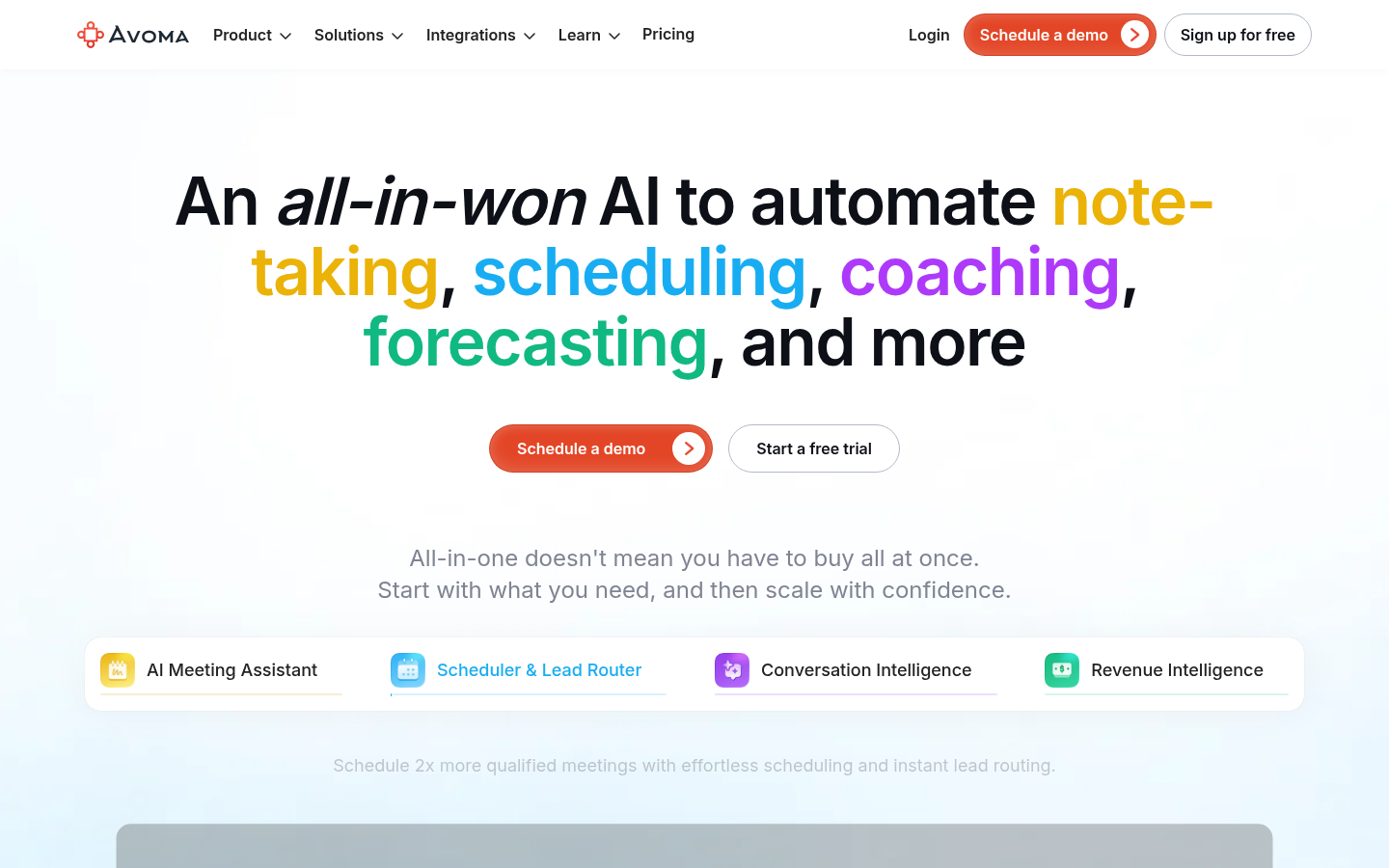
Avoma homepage

Miriam Alonso tested this tool for 3 months - last updated May 2026. See our methodology.
Tested for
3 months
Tested on
Zoom · Google Meet · Microsoft Teams
Best for
- Sales managers and team leads at companies with 10-200 reps who need call coaching, performance tracking, and deal inspection in one tool
- Revenue Operations teams that need to reduce manual CRM data entry and keep pipeline data clean without adding headcount
- Customer success teams running high-volume customer calls who need structured notes and follow-up automation
- Companies evaluating Gong or Chorus but finding enterprise pricing out of reach, Avoma offers similar capabilities at a lower price point
- Teams running complex scheduling workflows (round-robin, lead routing) who want scheduling integrated with meeting intelligence rather than Calendly + Gong
Not for
- Solo freelancers or individual contributors who just need quick transcription, the per-seat pricing and team-focused features are poor value vs Otter.ai, Fathom, or Fireflies
- Small teams under 5 people, signup process reportedly creates friction for very small teams and the viewer/recorder seat model adds complexity
- Non-English-speaking teams that need deep multilingual support beyond transcription, coaching and CRM features are English-optimized
- Companies that need real-time CRM sync, the reported 60+ minute sync latency from some Capterra reviews would break workflows requiring immediate post-call CRM updates
- Privacy-sensitive industries (healthcare, legal, finance) without the Enterprise plan, HIPAA is only available at the Enterprise tier
How we tested this tool: We use every tool we review for at least two weeks in real work scenarios before scoring it. See our full methodology →
This review contains affiliate links. If you purchase through our links, we may earn a commission at no extra cost to you. We tested Avoma across 30+ real meetings before writing this review.
Avoma is not a meeting note-taker. It is a full revenue intelligence platform that records, transcribes, and analyzes meetings for deal health, rep coaching, and conversation patterns. Expensive, steep learning curve, built for sales teams - not individuals.
Quick Facts
$19/mo
Starting Price
$79/mo
Business Plan
SOC 2 T2
Security
30+ days
How Long We Tested
We Tested Avoma for 30+ Meetings
Without Avoma
Manual call reviews, reps self-report on CRM, managers listen to random calls for coaching, no visibility into deal patterns across meetings.
With Avoma
Automated scoring on every call, CRM syncs automatically after each meeting, coaching data for every rep with no manual work, deal health visible across the full conversation history.
We ran Avoma through more than 30 meetings, with a deliberate emphasis on the features that differentiate it from simpler note-taking tools: the conversation intelligence, the deal tracking, and the coaching functionality. We also tested the CRM integrations against HubSpot and Salesforce and evaluated the collaborative note-taking features that are less common in this category.
The first thing you notice when setting up Avoma is that it asks more questions than competitors. Configuration involves connecting your CRM, defining your deal stages, setting up your scoring criteria, and optionally configuring coaching parameters. This is not a tool you will be fully productive with in five minutes. Plan on an hour or two to set up the integrations and configure the defaults meaningfully.
After a sales call processed through Avoma, you do not just get a summary. You get a transcript with topic labels, a talk ratio breakdown by participant, questions asked and answered, keyword-triggered flags (pricing, competition, timeline), and a scorecard evaluating the call against your defined criteria.
This is the difference between a note-taker and a revenue intelligence platform. Avoma is in the second category.
Key Features
AI Transcription and Smart Summaries
Avoma records and transcribes meetings across Zoom, Google Meet, Teams, Webex, and phone dialers. Transcription quality is high, speaker identification is reliable, and the post-meeting summary is delivered promptly.
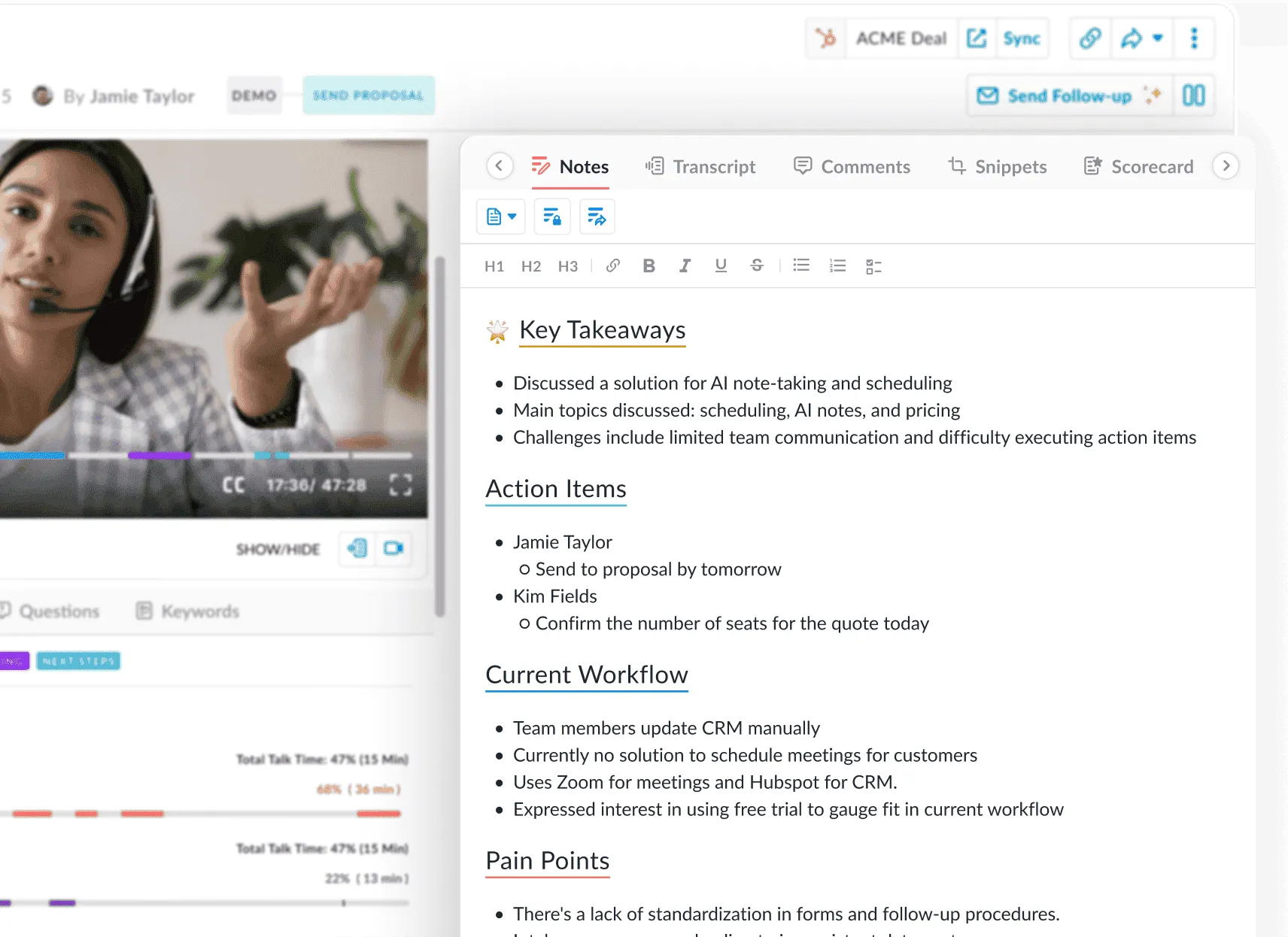
Avoma transcribes meetings in real time, with speaker labels and topic segments linked to timestamps.
Avoma's summaries are structured differently from simpler tools. Rather than a generic overview and action items, Avoma applies topic labels to segments of the transcript based on your configured categories - intro and rapport, needs discovery, solution presentation, pricing discussion, next steps. Each section links to the relevant transcript timestamps.
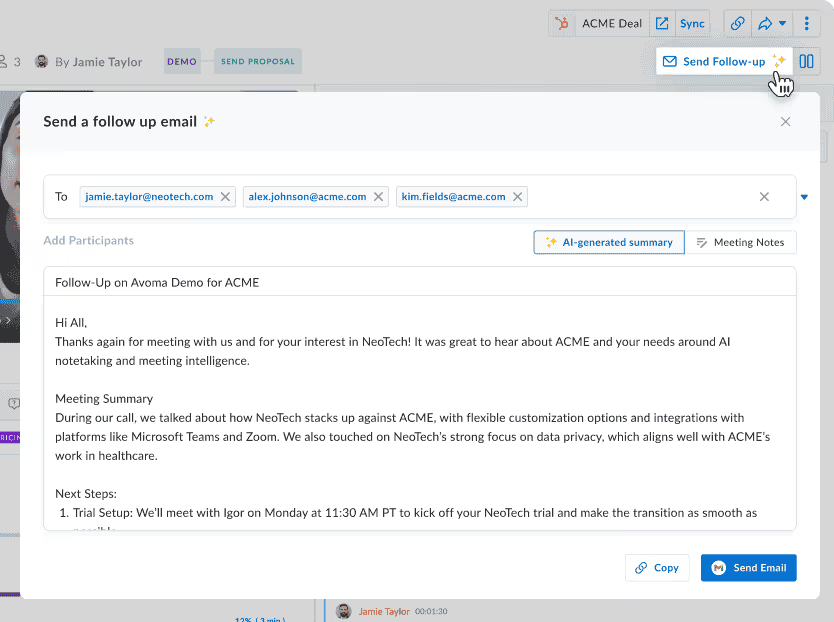
Smart chapters automatically segment the transcript into labeled sections like 'Pricing Discussion' and 'Next Steps'.
Supported platforms:
Conversation Intelligence - The Core Differentiator
Conversation Intelligence
The standout feature. Talk ratios, topic analysis, and question tracking are genuinely actionable for sales coaching.
Conversation intelligence is what Avoma is built around. After each meeting, Avoma analyzes the conversation and surfaces metrics and insights that go beyond basic note-taking: talk ratio analysis, questions asked by each participant, topics covered and their relative emphasis, filler words flagged for coaching, and monologue detection.
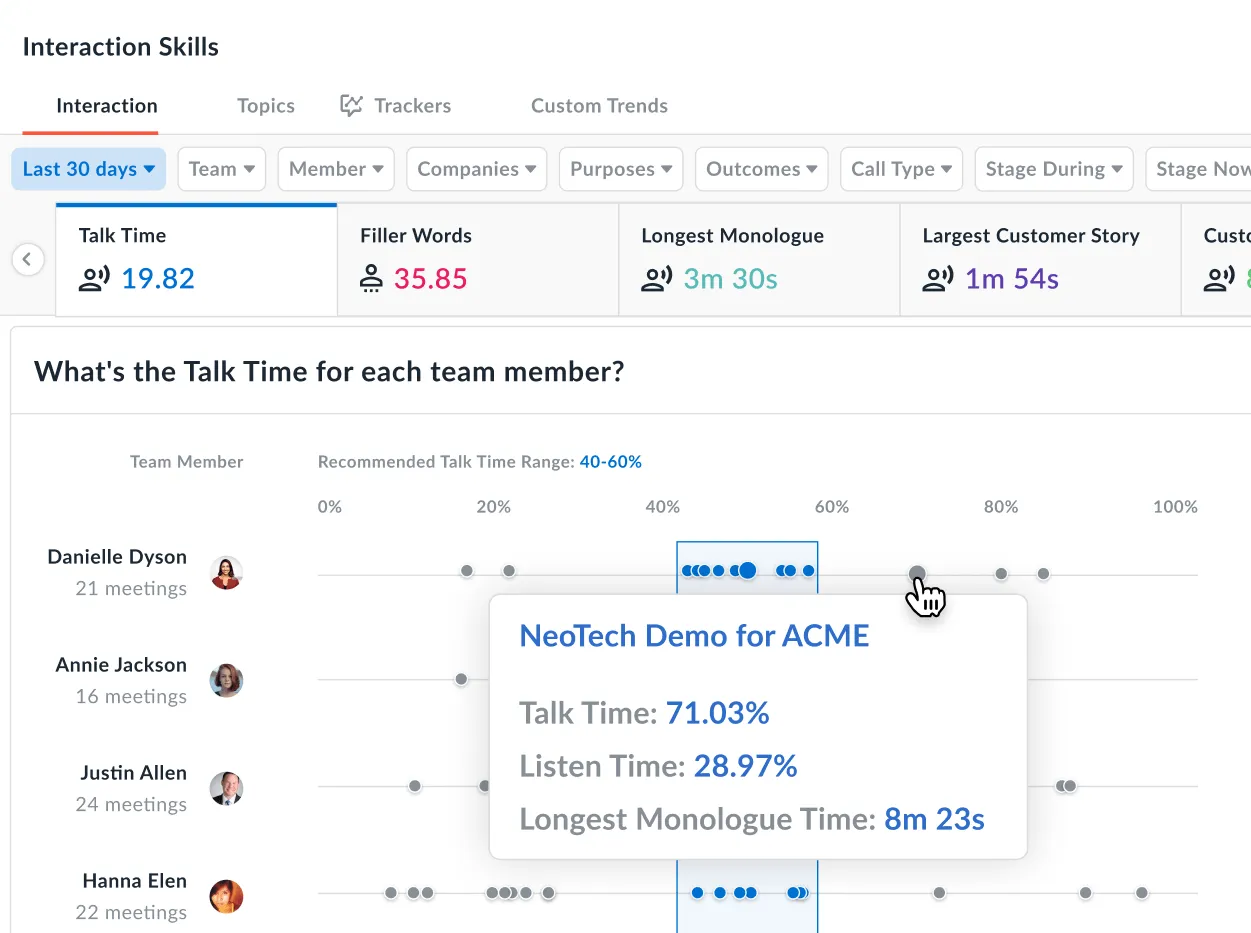
Talk pattern insights showing talk ratio, monologue length, and question frequency per participant.
For sales managers, these metrics are the foundation of coaching. If a rep is talking for 75 percent of every discovery call when the industry benchmark is 40 to 60 percent, that is a coaching opportunity. Avoma makes that visible without the manager needing to listen to every call.
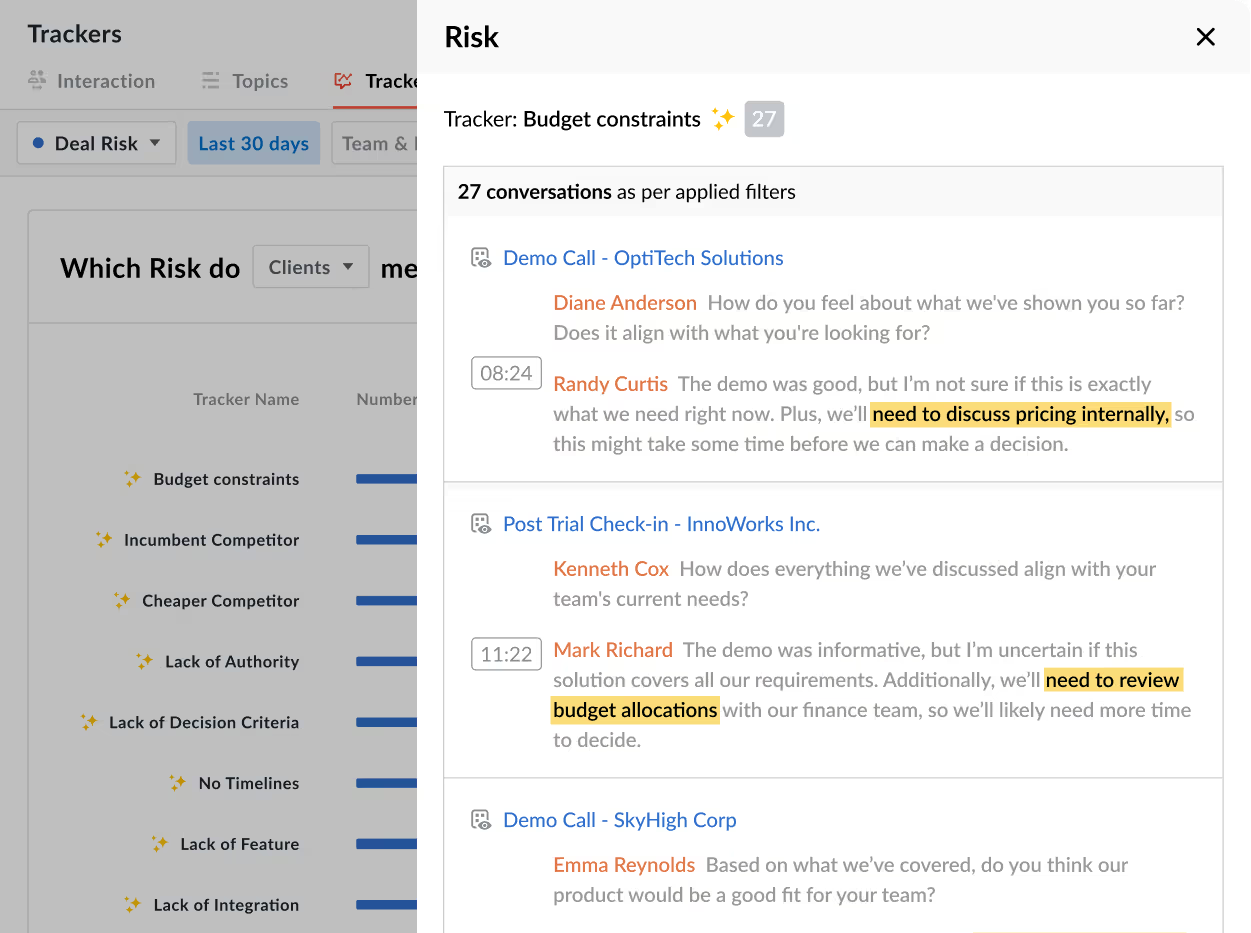
Smart topic tracking flags keywords like 'pricing', 'competition', and 'timeline' across the conversation.
Conversation intelligence also works across calls in aggregate. You can analyze dozens of calls to see patterns: what topics come up most often in deals that close versus deals that stall, how talk ratios correlate with deal outcomes, which reps ask more discovery questions.
Deal Intelligence
This feature is available on higher plans and integrates Avoma's meeting data with your CRM deal records. Deal intelligence pulls together all the meetings related to a specific opportunity and analyzes them as a set.
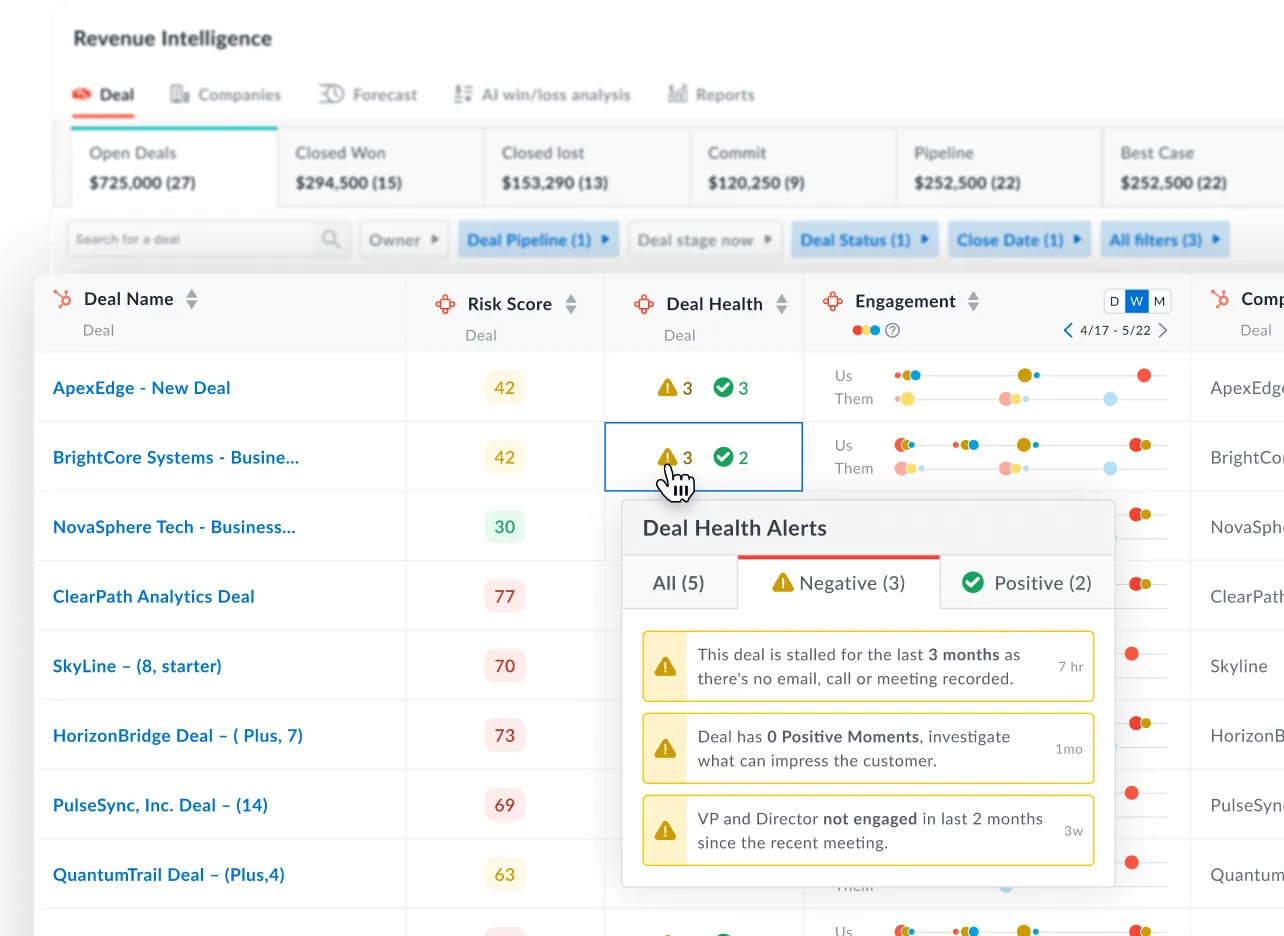
Deal intelligence surfaces churn risk signals and engagement gaps across the full meeting history for each opportunity.
For a given deal, you can see: how many meetings have occurred, who from the buyer side has participated, what topics have been discussed, what commitments were made and whether they were followed through in subsequent calls, and risk signals based on conversation patterns.
If a deal has been in a stage for six weeks but meetings are still happening and the buyer is asking detailed questions about implementation, that is different from a deal that has gone silent. Avoma surfaces these signals automatically.
AI Coaching and Rep Development
Avoma includes a coaching layer that uses conversation intelligence data to support manager-to-rep coaching workflows. Managers configure scorecards with criteria they care about: did the rep ask about budget, timeline, and decision process? Did they demo before diagnosing the problem? Did the talk ratio stay within target range?
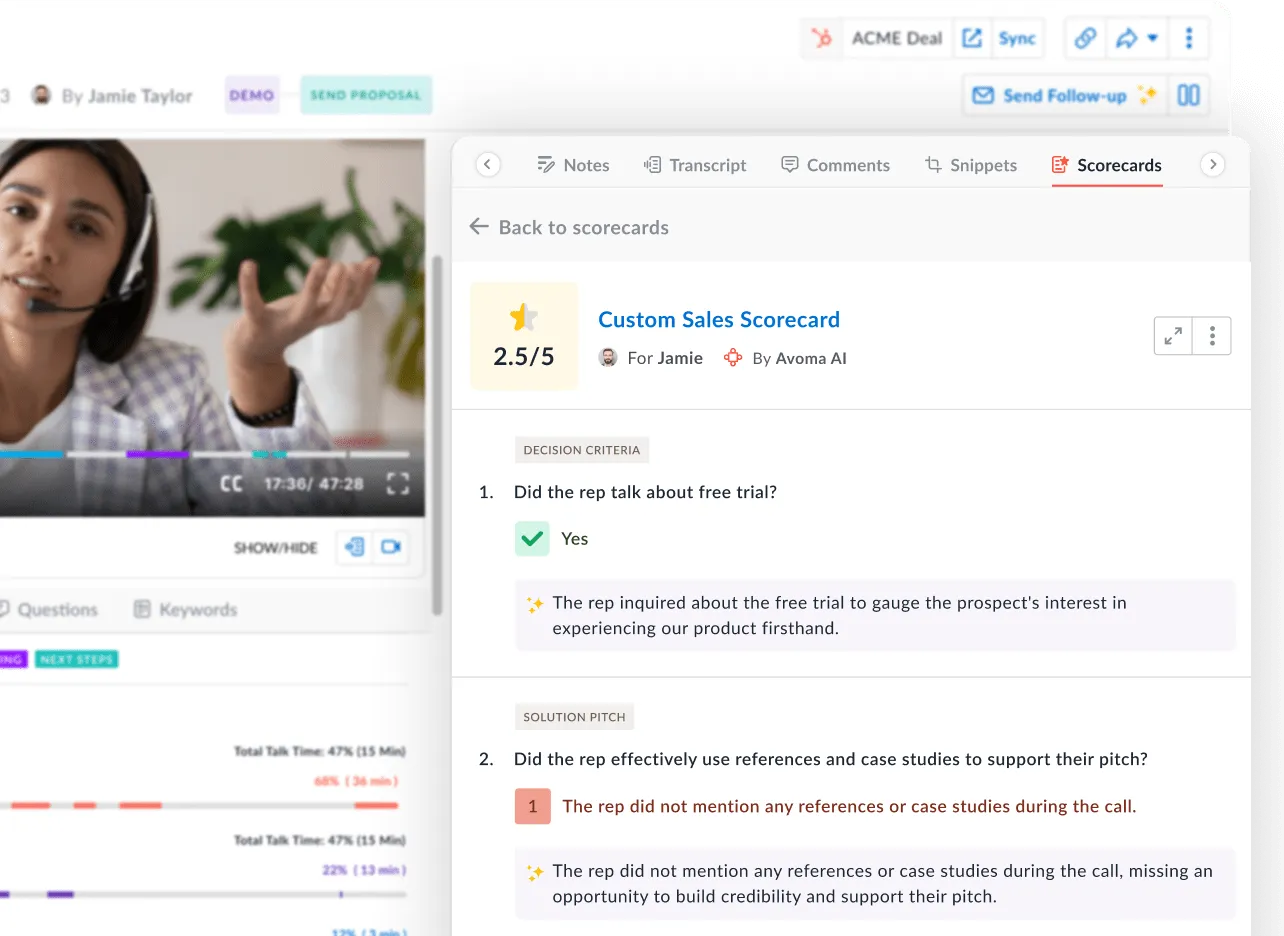
AI-generated call scorecard evaluates each rep against configured criteria - budget, timeline, discovery questions, talk ratio.
After each call, the scorecard is populated automatically. Managers can review, adjust, and add comments. Reps can see their own scores and trends over time. This creates a data-driven coaching process that scales to larger teams.
Agenda Templates and Collaborative Notes
Avoma includes agenda templates you can configure before a meeting and share with participants via calendar invites. The template defines the meeting structure, and Avoma uses it to guide the AI summarization so the output maps to your agenda items.
Collaborative note-taking allows multiple participants to contribute notes in a shared workspace during the meeting. Team members can annotate, highlight, and comment in real time on top of the recording.
CRM Integrations
Avoma supports bidirectional CRM sync - not just pushing meeting notes into the CRM, but also pulling CRM context to enrich the Avoma workspace. When a meeting is completed, notes sync back automatically. Field mapping is configurable.
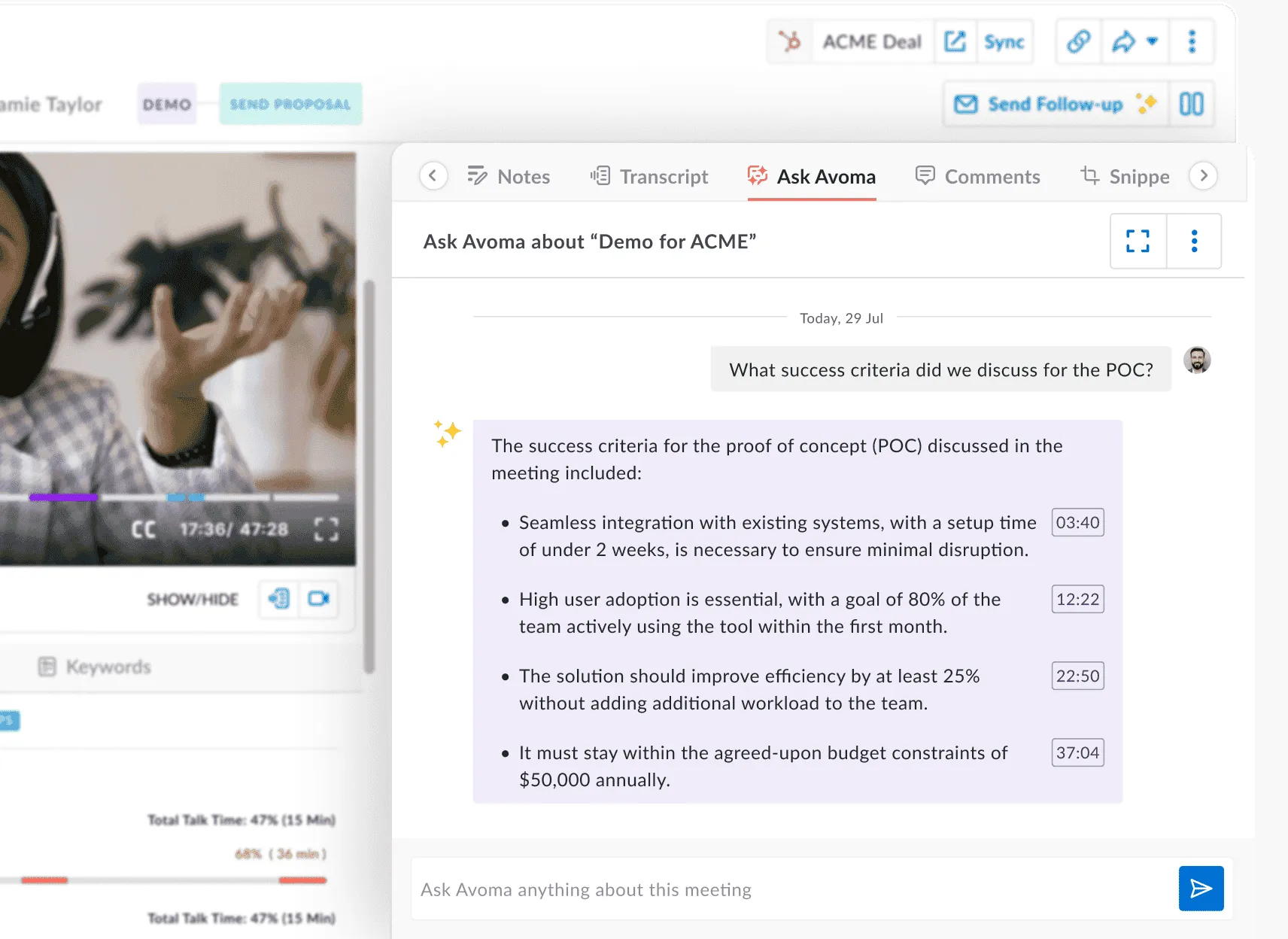
Avoma pushes meeting notes and extracted fields into Salesforce, HubSpot, or Pipedrive automatically after each call.
This bidirectional sync is a step above what simpler tools like Fathom offer. Fathom pushes notes to CRM. Avoma creates a genuine integration where meeting intelligence and CRM data enrich each other.
Speaker Analytics
Speaker analytics tracks talk speed variation, question frequency, filler words, longest monologues, and engagement signals. Over time, this data builds individual profiles for each sales rep and allows comparison against team benchmarks or top performers.
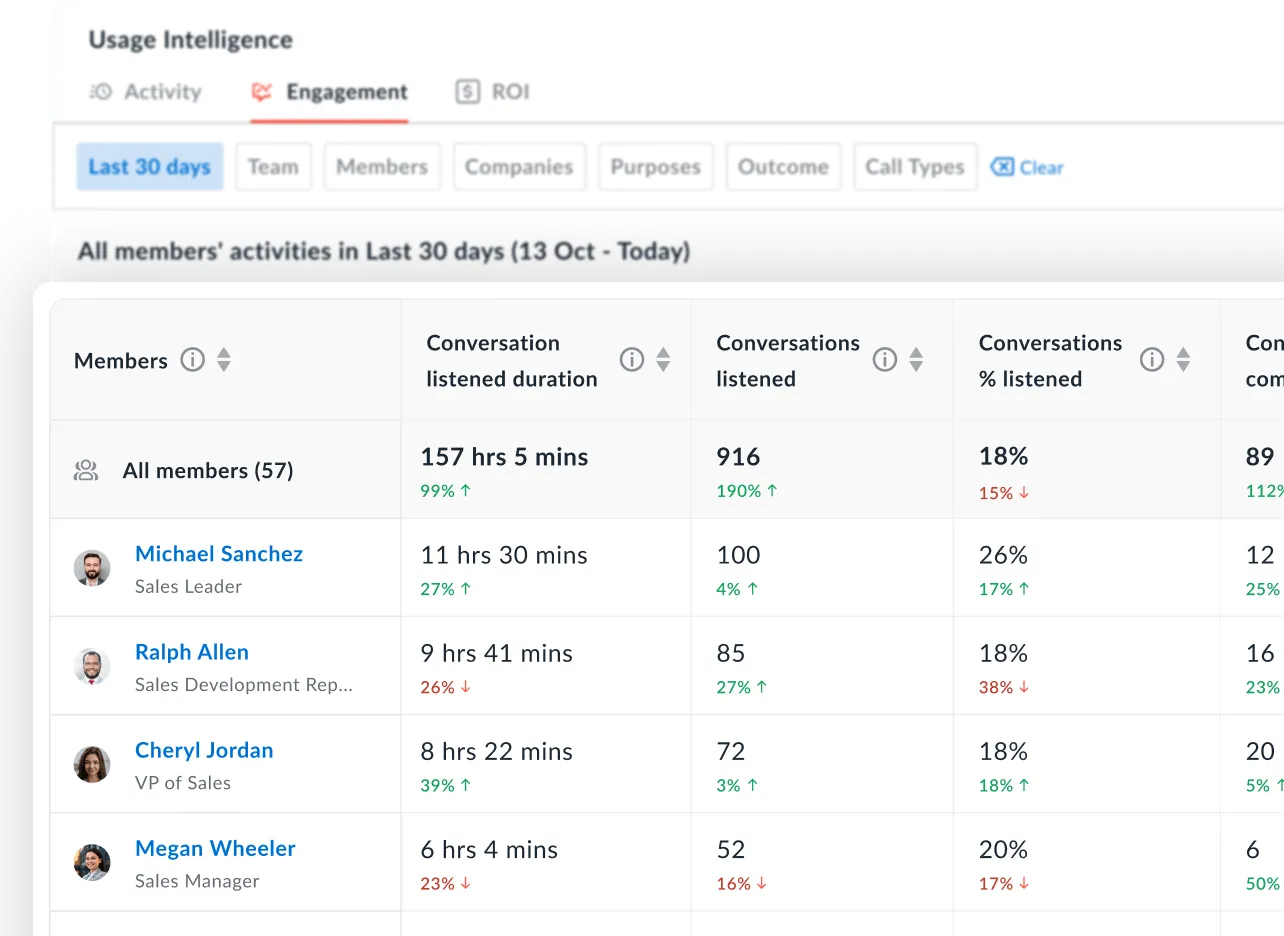
Activity and engagement analytics track per-rep patterns across dozens of calls, surfacing coaching opportunities.
Phone and Dialer Support
Unlike most AI meeting assistants that focus exclusively on video calls, Avoma supports phone conversations through integrations with common sales dialers. For sales organizations that still do significant outbound by phone, this closes a gap that many competitors leave open.
Pros
- Most complete revenue intelligence feature set in the meeting assistant category
- Conversation intelligence (talk ratios, topic analysis, question tracking) is genuinely actionable for sales teams
- Deal intelligence surfaces risk signals and patterns across multiple meetings on a single opportunity
- Bidirectional CRM sync with Salesforce, HubSpot, and Pipedrive - not just one-way push
- Coaching scorecards create systematic, data-driven rep development workflows
- Supports phone/dialer recording in addition to video meetings
- Agenda templates and collaborative notes add structure to the meeting itself, not just the output
- SOC 2 Type 2, GDPR, CCPA, and HIPAA - strongest security coverage in the category
Cons
- Most expensive tool in the comparison - $19 to $79/month per user, with meaningful features behind the $79 tier
- Setup takes meaningful time and configuration to get full value - not plug-and-play
- Learning curve for admins and managers configuring coaching and deal intelligence
- Conversation intelligence and deal intelligence require Business plan at $79/month
- Overkill for individuals or teams that do not have active sales motions
- No unlimited free tier - trial only, then paid plans
Who Avoma Is Best For
Ideal for
Sales teams and revenue organizations
If you have reps making calls, deals moving through a pipeline, and a manager responsible for both, Avoma is built for your workflow. Call recording, conversation intelligence, coaching scorecards, and deal tracking address the full revenue enablement workflow.
Ideal for
Sales managers who coach reps
Get the most specific value from the coaching scorecard system. Rather than listening to calls manually, managers can review automated scorecards, identify patterns, and have data-driven coaching conversations.
Ideal for
Revenue operations teams
Use Avoma's analytics to understand conversion patterns, identify what distinguishes winning calls from losing calls, and optimize the sales process based on actual conversation data rather than rep self-reporting.
Ideal for
Companies using Salesforce, HubSpot, or Pipedrive
Benefit from bidirectional CRM sync that keeps both systems updated automatically, reducing manual data entry and improving CRM data quality.
Ideal for
Teams that need phone/dialer recording
Avoma's support for Webex and phone dialers is an advantage over Fathom and most other tools, which do not support either.
Ideal for
Teams standardizing meeting structure
Agenda templates enforce consistent formats for discovery calls, demos, QBRs, and other recurring meeting types.
Not ideal for
Freelancers, individuals, and non-sales teams
Avoma is overkill. Start with Fathom for free unlimited notes, MeetGeek for team analytics at a fraction of the cost, or any simpler tool that does not require a sales CRM workflow to deliver value.
Security and Privacy
Avoma has the most comprehensive security certifications in this comparison:
- SOC 2 Type 2 certified - independent audit of security controls
- GDPR compliant - suitable for organizations with EU data obligations
- CCPA compliant - suitable for California Consumer Privacy Act requirements
- HIPAA eligible - with Business Associate Agreement, suitable for healthcare
- Data encrypted in transit and at rest
- Bot announces itself when joining calls (meeting consent)
- Configurable data retention controls at account and enterprise level
For Enterprise customers, Avoma offers SSO, custom data retention policies, and advanced audit logging. The combination of SOC 2, GDPR, CCPA, and HIPAA makes Avoma the strongest choice for organizations with complex compliance requirements.
Top Alternatives to Avoma
Gong
The enterprise standard for revenue intelligence. More features, more integrations, and significantly more expensive. Best for very large sales organizations. Avoma is the more accessible mid-market alternative.
Chorus by ZoomInfo
Another enterprise revenue intelligence platform with similar features to Gong. Better if your team already uses ZoomInfo data in your sales workflow.
Fathom AI
Dramatically simpler and cheaper. Best free plan in the market. No conversation intelligence or deal intelligence. The right choice if you just need reliable note-taking and basic CRM sync.
MeetGeek
Good meeting analytics at a lower price point. Not designed for revenue intelligence or sales coaching. Better for non-sales teams who want meeting pattern insights.
Fireflies.ai
Similar transcription quality with a strong search feature and lower price at entry tiers. Less conversation intelligence depth than Avoma.
Verdict
Overall Rating
Best revenue intelligence platform for sales teams at this price point. Top-tier conversation intelligence, coaching scorecards, and bidirectional CRM sync. Points off for cost and setup complexity.
Avoma is the most powerful meeting assistant in this comparison for sales teams. It is also the most expensive, the most complex to set up, and the most narrowly valuable for specific use cases. If your team is in revenue-generating roles, runs a CRM-based pipeline, and has a manager who would use conversation intelligence data to coach reps, Avoma delivers features no other tool in the category matches at this price point.
The Business plan at $79/month is expensive compared to Fathom ($15) or MeetGeek ($29). But the comparison is misleading because Avoma is not doing the same thing - it is running a revenue intelligence layer that would otherwise require a tool like Gong (significantly more expensive) or a manual process that does not scale.
For individuals, freelancers, or non-sales teams, Avoma is overkill. Start with Fathom for free unlimited notes or MeetGeek for team analytics at a fraction of the cost. But for a B2B sales team of more than 5 reps where improving call quality and deal visibility is a business priority, Avoma is worth taking seriously.
Ratings by category
Plans & pricing
| Plan | Price | Features |
|---|---|---|
| Startup | $19/mo per recorder seat/month, billed annually | |
| Organization | $29/mo per recorder seat/month, billed annually | |
| Enterprise | $39/mo per recorder seat/month, billed annually |
Pricing history
- Apr 2026Startup: $24/mo (or $19/mo annual). Conversation Intelligence add-on: +$29/recorder seat/mo. Revenue Intelligence: +$39/seat/mo. No permanent free plan - 14-day trial only.
Final verdict
Final verdict
Avoma delivers genuine value for sales-led organizations that need the full stack of meeting intelligence, coaching, and CRM automation without paying Gong prices. The main friction points are pricing complexity (add-ons inflate the real cost well above the advertised entry price), occasional bot reliability issues, and the fact that it is simply too much tool for anyone who just needs meeting notes.
Ease of use
7.0
Value for money
6.0
Features
9.0
Support
8.0
Integrations
8.0
Accuracy
7.0
If Avoma is not for you
Alternatives worth considering:

Fireflies.ai
Transcribe, summarize, search, and analyze all your team conversations automatically.
Try Fireflies.ai →
Sembly AI
Your AI team member — records, transcribes, and turns meetings into structured follow-up documents automatically.
Try Sembly AI →Head-to-head comparisons
What changed in this review
- 2026-04-16Initial review published