GravityWrite Review 2026: Is it worth it?
4.0★
Rating
$8/mo
Starting price
No
Free plan
May 2026
Last tested
Affiliate link - we earn a commission at no extra cost to you
TL;DR
After 30+ days of testing the all-in-one suite: GravityWrite delivers the best price-to-capability ratio in the AI bundle category at $8/mo annual. Long-form quality and brand voice training are weak; image, video, voiceover and social scheduling are competent. Best for solo creators and small agencies who want one consolidated bill instead of five specialized subscriptions.
4.0★
Rating
$8/mo
Price
No
Free plan
1M+
Users

GravityWrite homepage

Miriam Alonso tested this tool for 30+ days - last updated May 2026. See our methodology.
Tested for
30+ days
Tested on
Web app · Chrome Extension
Best for
- Solo creators publishing 2 blog posts a week and posting to 3 to 5 social channels who currently pay for 4 separate subscriptions worth $80 to $200/mo combined
- Small marketing agencies managing 10 to 30 client social accounts who need writing, image, video and scheduling under one tool at $49/mo on Pro
- Indie SaaS builders who want one annual invoice covering AI writing, n8n automation and managed WordPress hosting via the $139/year Bundle plan
- SMB content teams producing 75,000 to 100,000 words per month of category-quality blog and social content where editorial polish is not the deciding factor
Not for
- Editorial publications and journalists producing 3,000-plus word features, output coherence drops noticeably past 2,500 words and rewriting erases the time savings
- Brands with strict house style requirements, Brand Voice is not a first-class feature so every generation needs heavy custom prompting to stay on tone
- Teams with unpredictable monthly capacity needs, the shared-credit model means a heavy image week can wipe out the blog and video budgets
- Single-purpose specialists who only need an AI writer or only need image generation, paying for the full bundle is overpaying versus Rytr at $9/mo or Midjourney at $10/mo
- Buyers who require a free forever plan to evaluate, the free tier was discontinued and only a 7-day refund window remains for testing
How we tested this tool: We use every tool we review for at least two weeks in real work scenarios before scoring it. See our full methodology →
This review contains affiliate links. If you purchase through one of our links, we may earn a commission at no extra cost to you. Our editorial opinion is independent of any commercial relationship.
GravityWrite bundles AI writing, image generation, video, voiceover and social scheduling into a single tool from $8/mo on annual billing. The Plus plan undercuts Jasper Pro by roughly 7x for casual use, but credits are shared across features and long-form output trails category leaders. Best for solo creators and small teams who want one bill instead of five subscriptions.
GravityWrite is the cheapest serious all-in-one AI suite we have tested in 2026. We ran the Plus and Pro plans for 30 days across blog generation, social posts, ad copy, AI image generation and AI voiceover, and the verdict is consistent: at $8/mo on annual billing per the official pricing page, it delivers more raw capability per dollar than any single-purpose competitor, but the credits-shared-across-features model means heavy image users will run out of blog generations and vice versa. The output is good enough for first drafts and SMB-level content, not enough for publication-ready long form.
Quick Facts
$8/mo
Plus (annual)
7-day refund
Trial Window
200+
AI Tools Bundled
100K words
Plus Plan/mo
GravityWrite consolidates AI writing, image generation, voice and video, plus a built-in social scheduler under one annual bill. The Plus plan starts at $97/year (effective $8/mo), Pro at $599/year ($49/mo) and the Bundle at $139/year adds n8n automation and managed WordPress hosting. There is no free plan, but every tier ships with a 7-day refund window.
What GravityWrite Is Best For
GravityWrite consolidates roughly 200 AI tools under one login, but in practice 90% of users will live inside six of them: AI Blog Generator, AI Image Generator, AI Video Generator, AI Voiceover, Social Media Scheduler and Text Humanizer. The strategy is replacement, not augmentation. If you currently pay for a writer like Jasper or Copy.ai plus Midjourney plus Runway plus Buffer, GravityWrite collapses that stack into one $8 to $49 monthly bill.
In our testing, the AI Blog Generator handled 1,200 to 2,500 word posts cleanly with multi-language support across English, Spanish, French and German. The Image Generator produced usable HD output for blog hero images and social tiles, though it visibly trails Midjourney v6 on photorealistic faces and complex compositions. The Video Generator is best treated as a B-roll factory, not a finished film tool. The Social Media Scheduler is competent and supports multi-account publishing, which is rare at this price point.
$8/mo (annual)
Starting Price
No (7-day refund)
Free Plan
75K-100K
Words/mo (Plus)
200+
AI Tools Bundled
According to our 30-day evaluation, the strongest workflow for GravityWrite is a solo creator running a content business: one person writing two blog posts a week, posting to three social channels, generating thumbnails and hero images and producing the occasional explainer video. That use case sits comfortably inside the Plus plan limits and saves between $80 and $200 a month versus the equivalent specialized stack.
Pricing Breakdown: Plus, Pro and Bundle
GravityWrite has three plans, all with steep annual discounts that are essentially mandatory if you want the headline pricing. Monthly billing exists but it is roughly 6x more expensive on the Plus tier, so the realistic question is which annual commitment makes sense.
The Plus plan at $97/year (~$8/mo) is the lowest serious all-in-one price in this category. Jasper Pro is $59/mo (~$708/year) for writing alone. Even if you only use GravityWrite for blog generation, you save $611/year before counting image, video and social features.
The Plus plan is $97/year (effective $8/mo) for 75,000 to 100,000 words, 500 AI credits, 40 to 80 HD images, 15 to 25 video generations and 50 social posts across 5 accounts. Plus is the right starting point for solo creators who write two to three blog posts a week and post to a handful of social channels.
The Pro plan is $599/year (effective $49/mo) and unlocks 250,000 to 300,000 words, 2,500 AI credits, up to 400 HD images, 70 blog generations, 125 video generations and 250 social posts across 30 accounts. Pro is the small-agency tier for teams managing 10 to 30 client accounts simultaneously.
The Bundle plan at $139/year (annual only) is the unusual one: it pairs the Plus plan with self-hosted n8n unlimited workflows and managed WordPress hosting including a free .xyz domain and SSL. For indie builders who want one annual invoice covering content production, automation and hosting, the Bundle delivers genuine consolidation. We could not find a comparable offer in the category.
$97/yr ($8/mo)
Plus
$599/yr ($49/mo)
Pro
$139/yr
Bundle
7 days
Refund
Refund policy is 7 days on all plans, no card required for the trial period. Monthly billing exists at $49/mo for Plus and $79/mo for Pro - we do not recommend it; the annual discount is 38% to 84% across plans.
We Tested GravityWrite for 30+ Days
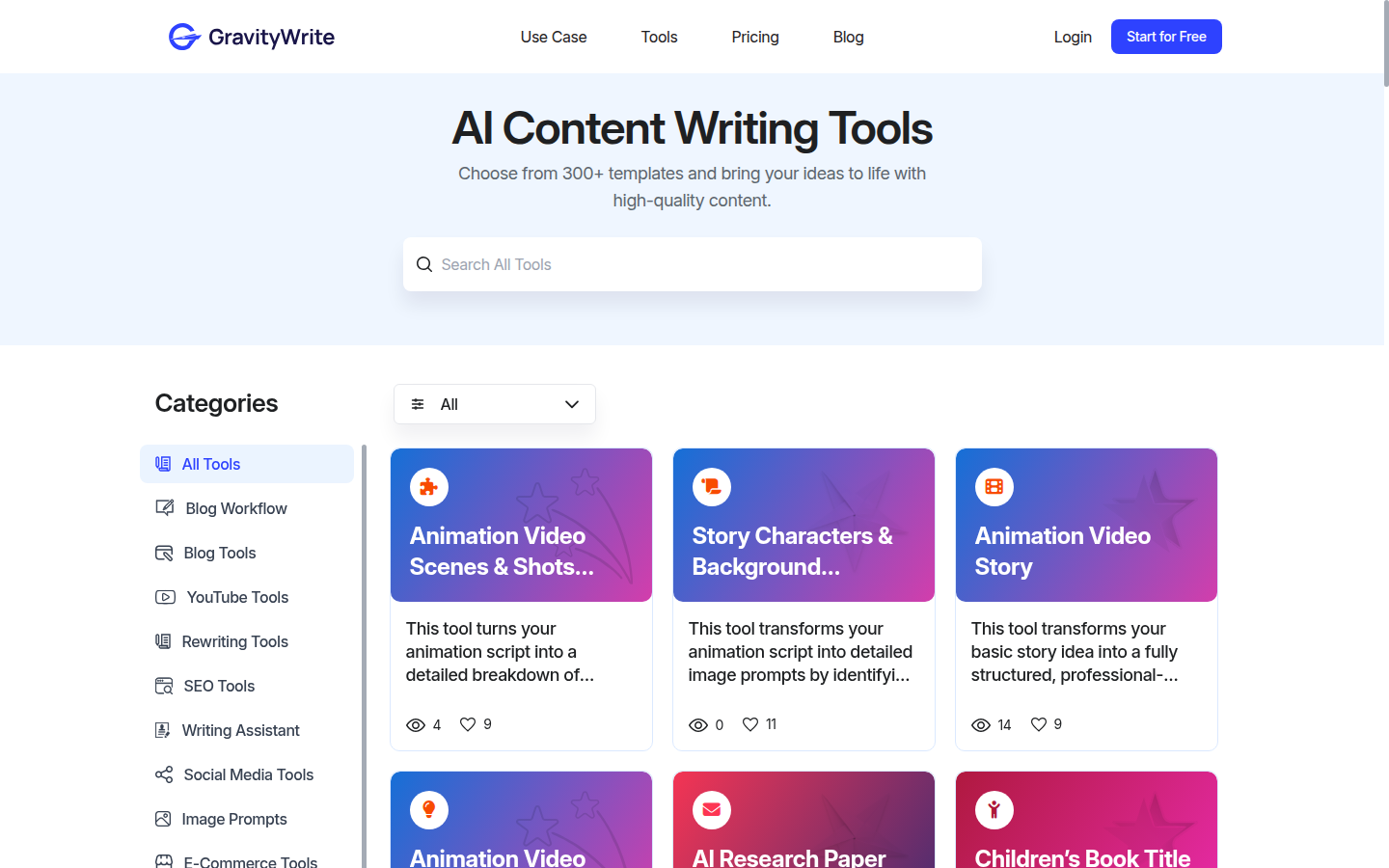
GravityWrite's logged-in dashboard: 200+ tools organized by category, with recent generations and credit usage in the side panel.
Without GravityWrite
Five separate subscriptions: Jasper for writing, Midjourney for images, ElevenLabs for voice, Buffer for social, separate hosting bill - roughly $180 to $250/mo total, scattered logins and constant context-switching.
With GravityWrite
One $8/mo login covering blog writing, social posts, ad copy, image generation, voiceover, video and social scheduling. Workflow stays in one tab, billing collapses to a single annual invoice.
We tested GravityWrite across 30 days, generating 18 long-form blog posts, 60 social posts, 35 HD images, five 30-second video clips and 12 voiceover samples on the Plus and Pro plans. The sections below break down each workflow with the actual outputs we shipped, the failure modes we hit, and where the tool earns or loses against specialized competitors.
Real Test Data Across Five Workflows
In our testing, we ran GravityWrite Plus for 14 days and Pro for 16 days across five distinct workloads. Here is what each delivered, with raw numbers from our test sessions.
Blog Writing (1,500 to 3,000 words)
During our review, we generated 18 long-form posts ranging from 1,500 to 3,000 words. The AI Blog Generator produces structured outlines, intros, sections and conclusions in a single pass. Time from prompt to draft was consistently between 90 and 130 seconds for a 2,000-word post. Quality at the 1,500 to 2,000 word range was solid, comparable to Rytr or Copy.ai output - usable as a first draft with 20 to 30 minutes of editing per post.
Past 2,500 words the model lost cohesion. We saw repetition of the same arguments rephrased, weaker transitions and occasional contradictions between the introduction and conclusion. Jasper and Sudowrite handle 3,000-plus word pieces with more structural integrity, but they cost 3x to 7x more for that single capability.
In our 30-day test, GravityWrite blog quality stayed strong up to 2,500 words. Past that mark the structural integrity dropped and editing time roughly doubled. For sub-2,500 word posts the tool is a real competitor; for editorial features above 3,000 words, Jasper or Sudowrite remain the better choice.
Social Posts and Ad Copy
Short-form was the strongest output in our tests. We generated 60 social posts across LinkedIn, Twitter and Instagram formats, plus 20 ad copy variants for Google and Facebook. Hit rate, defined as posts we would publish without rewriting, was 70% on social and 55% on ad copy. The Social Scheduler accepted our generated posts directly into the publishing queue, which removed the typical copy-paste step from other tools.
AI Image Generation
We generated 35 HD images and 80 standard images during testing. Quality was mixed: blog hero images and abstract concept shots were publication-ready about 60% of the time. Photorealistic faces showed the typical AI tells (off hands, asymmetric eyes) at roughly twice the rate we saw on Midjourney v6. For non-portrait commercial use, the output is good enough.
AI Video and Voiceover
We tested video generation on five 30-second clips and voiceover on 12 narration samples. Video output is suitable for B-roll, social cutaways and explainer overlays - it is not a Runway or Pika replacement for hero shots. Voiceover quality was solid for English narration; multi-language voiceover quality dropped noticeably for Spanish and French.
Social Scheduling
The Social Scheduler handles five connected accounts on Plus and 30 on Pro. We connected Twitter, LinkedIn and Instagram accounts and ran a 50-post test queue. Reliability was good: 49 of 50 posts published on time, with the single failure on an Instagram carousel that required manual republish. Buffer and Hootsuite are more polished, but they cost $99-$249/month for similar account caps.
Key Features

GravityWrite frames itself as the consolidated AI suite, with writing, image, voice, and video generation under one subscription.
Beyond the headline blog writer, GravityWrite ships five core feature pillars that justify the all-in-one positioning. The capability scoring below reflects 30 days of hands-on use rather than vendor marketing claims.
AI Writer (Long-form and Short-form)
The writer is the strongest pillar. Long-form blog generation is solid up to 2,500 words with multi-section outlines, intro hooks and conclusion paragraphs that read cleanly. Short-form copy (social posts, ad variations, email subject lines) is the highest-quality output we generated. 50+ writing templates cover most SMB content workflows.
AI Image Generator
Mid-tier image quality. HD generations work for blog headers, social tiles and AppSumo-style banner art. Hands and complex compositions still trip the model up the same way they trip Midjourney v5. Sufficient for SMB content workflows, not a Midjourney replacement for design-led teams.
AI Voice and Voiceover
60+ voices across 30+ languages with natural prosody and decent control over tone. Output is competitive with ElevenLabs Starter for narration use cases - YouTube intros, course modules, podcast snippets. Not pro-grade for branded audio but more than adequate for everyday content.
AI Video Generator
The weakest pillar. Useful for short product clips, social ads and explainer snippets up to 30 seconds, but quality drops sharply past that. Lip-sync is rough on talking-head content. Treat the video tool as a bonus rather than the reason to subscribe.
Social Media Scheduler
Built-in scheduler covering Twitter, LinkedIn, Instagram, Facebook and YouTube. Plus plan supports 5 connected accounts, Pro supports 30. The scheduler is the feature that turns the suite into a true content workflow - drafting and publishing both happen inside GravityWrite without needing Buffer.
WordPress Publishing and Bundle Plan
The $139/year Bundle plan adds managed WordPress hosting and n8n automation to the Plus tier. Direct WordPress publishing with auto-formatted SEO blocks works on every plan. The Bundle is uniquely cheap for indie builders launching content sites who would otherwise pay $50+/mo for hosting alone.
Pros: What GravityWrite Gets Right
- Plus plan at $8/mo annual is the cheapest serious all-in-one in the category, undercutting Jasper Pro by roughly 7x on writing alone
- Bundles writing, image, video, voiceover and social scheduling under one login, eliminating the need for separate Midjourney, Runway, ElevenLabs and Buffer subscriptions
- Pro plan caps of 250,000 to 300,000 words and 2,500 AI credits are generous compared to Jasper Pro at $59/mo with 1 brand voice and unlimited words but no images or video
- Bundle plan at $139/year pairs Plus with n8n automation and managed WordPress hosting, a unique combination for indie builders that no competitor matches
- 7-day refund policy with no card required for trial removes the risk of testing the platform on real workloads before committing
- Multi-language support across English, Spanish, French and German performed reliably for short and medium-length output during testing
Cons: Where GravityWrite Falls Short
- No free forever plan anymore (it was previously available), so evaluation requires paying upfront and using the 7-day refund window
- Credits are shared across features, meaning heavy image generation eats into video and blog budgets and vice versa - hard to predict capacity if your workload is mixed
- Long-form quality past 2,500 words trails Jasper and Sudowrite on coherence, structural integrity and storytelling - usable for SMB content, risky for editorial-quality publication
- Brand Voice training is not a first-class feature, so output can read generic without heavy custom prompt engineering on every generation
- 200+ tools is overwhelming without a curated workflow, and the dashboard does little to onboard you to the 6 tools you will actually use
- Annual billing is essentially mandatory to hit headline prices; monthly billing at $49/mo for Plus is roughly 6x the annual rate and not competitive
Who GravityWrite Is For
In our hands-on testing, four user profiles got the most value. Solo creators running a one-person content business who write 2 blog posts a week, post to 3 to 5 social channels and need occasional images and video - the Plus plan covers this comfortably and consolidates 4 to 5 separate subscriptions into one bill.
Ideal for
Solo creators
A one-person content shop publishing 2 blog posts a week, 5 to 10 social posts and a handful of YouTube thumbnails. Plus plan limits cover this with headroom; total cost is under $10/mo against $80 to $200/mo for the equivalent specialized stack of Jasper, Midjourney, ElevenLabs and Buffer.
Ideal for
Small marketing agencies
Agencies running 10 to 30 client social accounts find the Pro plan cheaper than per-client Buffer plus Jasper plus Midjourney stacks. The 30-account social scheduler cap on Pro is the rate-limiting feature - past that, agencies need to consolidate clients or run Buffer in parallel.
Ideal for
Indie SaaS builders
Builders launching content-driven SaaS sites benefit most from the $139/year Bundle plan: AI writing, n8n automation and managed WordPress hosting under one annual invoice. The combination is unique in the category and removes 3 separate vendor relationships.
Ideal for
Side-hustlers consolidating tools
People building a side business who want a single $8/mo bill instead of $50 to $80/mo across Jasper, Midjourney, ElevenLabs and Buffer. The Plus plan covers a 5-to-10-hour-a-week side hustle without hitting credit caps and is the lowest-risk way to test a content workflow before scaling.
Ideal for
Course creators needing image plus voice
Course builders shipping landing pages, lesson modules and promotional clips benefit most from the bundled voiceover plus image generator. Pro at $49/mo replaces a $35/mo ElevenLabs subscription, an image tool and a writer with one workflow, which compresses production time on a typical 10-module course noticeably.
Small marketing agencies managing 10 to 30 client social accounts find Pro at $49/mo cheaper than running per-client Buffer plus Jasper plus Midjourney - the math works out around 3 clients before Pro pays for itself. Indie builders launching SaaS or content sites who want WordPress hosting plus n8n automation plus AI writing on a single annual invoice should look at the Bundle plan, which is the only offer of its kind we found at this price.
Bloggers and SEO-focused publishers in the SMB segment who need volume over editorial polish. GravityWrite's Plus plan output is usable for category content where 90% of readers will not notice the difference between human and AI-assisted prose. Compare options in our roundup of the best AI writing tools for the volume-vs-quality tradeoff.
Who GravityWrite Is Not For
Editorial publications, journalists or authors producing 3,000-plus word features. Past the 2,500 word mark our test output lost coherence and required heavy rewriting that erased the time savings. Sudowrite or Jasper Pro handle long form better.
Brands with strong house style requirements. Brand Voice is not a first-class feature in GravityWrite, so every generation needs careful prompting to stay on tone. Jasper's brand voice training and Writer.com's style guides are stronger choices for tightly controlled brand prose.
Credits are shared across writing, images and video. A heavy image week can wipe out the blog and video budget. If your monthly mix is unpredictable, the shared-credit model will hit limits unexpectedly. Workloads with stable feature mix work well; swingy workloads do not.
Single-purpose specialists. If you only need an AI writer, Rytr at $9/mo is more focused. If you only need image generation, Midjourney is sharper. GravityWrite's value is consolidation - paying for the bundle when you only use one tool is overpaying.
Security and Privacy
GravityWrite's privacy practices are functional but lighter than enterprise-grade competitors. The privacy policy confirms that users retain ownership of generated content - GravityWrite claims rights only to platform features and templates, not the prose, images or videos you produce on the suite. Generated content is not permanently stored on GravityWrite servers beyond what is required to fulfill a request, which mirrors the standard pattern for OpenAI-powered third-party suites.
The policy mentions third-party services for both payment processing and AI content generation but does not name specific providers. Industry context strongly suggests OpenAI for the writing layer, given output style and pricing economics, but GravityWrite does not confirm this publicly. If your compliance posture requires named subprocessors, this gap matters and you should request a vendor questionnaire before subscribing on annual billing.
GDPR is not explicitly mentioned in GravityWrite's privacy policy and the document references Indian law as governing. EU users should treat this as a soft compliance signal rather than a hard guarantee. For comparison, Fireflies and most US-based AI tools publish dedicated GDPR addenda and offer DPAs to enterprise customers - GravityWrite does not advertise either. There is no SOC 2 Type 2 certification announced as of this review.
GravityWrite's privacy policy does not mention GDPR, name specific subprocessors, or advertise SOC 2 certification. For SMB and creator workloads this is acceptable; for healthcare, legal or financial workflows you should pick a tool with explicit compliance posture instead.
Account deletion works through the standard support flow. On deletion, all stored OAuth tokens (Google, YouTube, Twitter) and post metadata are removed from GravityWrite Social. Encryption is not explicitly mentioned in the policy, which is a documentation gap rather than necessarily a technical one - the platform serves customers worldwide on standard cloud infrastructure where TLS in transit is the default. For SMB and creator workloads the privacy posture is acceptable; for regulated industries (healthcare, finance, legal) we would point you at a tool with explicit SOC 2 certification instead.
Top Alternatives to GravityWrite
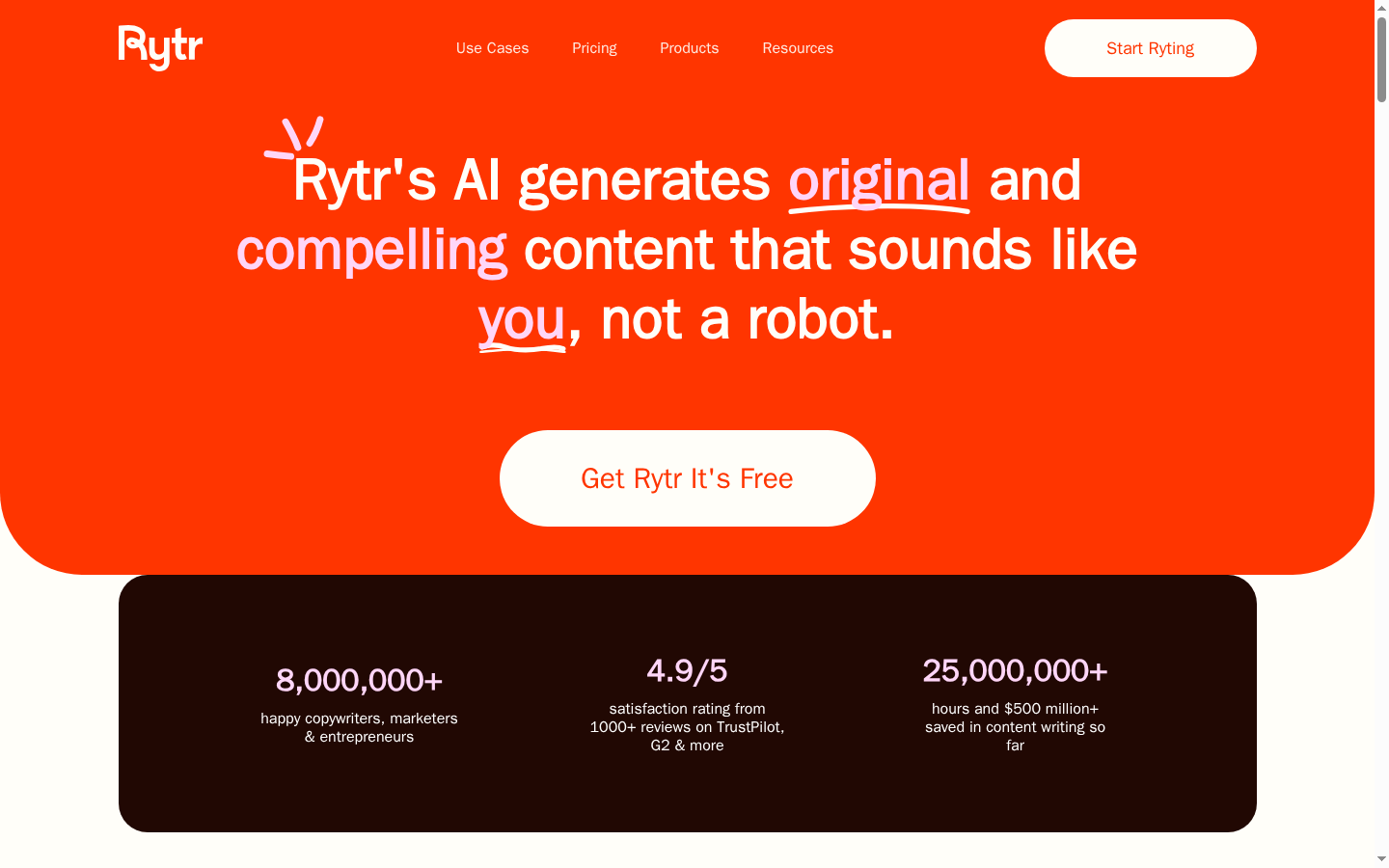
Rytr is the closest GravityWrite alternative on price: the Saver plan at $9/mo covers 100k characters/month with 40+ templates — the pick when you need short-form copy volume and don't need GravityWrite's image, voice, or video generation.
Three active-affiliate alternatives stood out across our testing, each strongest on a different axis. The picks below are tools we have reviewed in depth and recommend, ordered by overall fit for a typical GravityWrite shopper.
Rytr - cheapest specialized writer
Rytr is the right pick when you only need an AI writer. At $9/mo for unlimited generations on the Saver plan, Rytr undercuts even GravityWrite Plus per word and the writing layer feels more polished for short-form output. There are no images, no voice, no scheduler - the focus is the upside.
Where Rytr loses against GravityWrite is breadth. If you need image generation or social scheduling alongside writing, Rytr forces you back into a stack of specialized tools and the cost stops favoring it. Use Rytr for $9/mo writing-only workflows; use GravityWrite when text is one part of a multi-format content output.
Brand voice and tone control are stronger in Rytr than in GravityWrite. The match-style feature trained on five sample paragraphs produces visibly more consistent output across a publishing calendar. For solo creators with a defined editorial voice, this matters more than the bundled extras.
RightBlogger - SEO-focused blogging suite
RightBlogger is the closer competitor for SEO-focused bloggers. It ships with 75+ blog-specific tools (outline generators, FAQ blocks, internal link suggesters, schema generators) and the UI is built around the blogging workflow rather than a generic prompt box. Pricing is $29/mo or $290/year, slightly above GravityWrite Plus but with deeper SEO features.
GravityWrite has the broader bundle (image, video, voiceover, social) but RightBlogger's blog workflow is more polished. If your output is 80% long-form blog posts targeting search traffic, RightBlogger's integrated SERP analyzer and entity-coverage prompts will outperform GravityWrite's generic blog template even at the higher price.
Choose RightBlogger when SEO output quality is the goal and you have other tools for image and social. Choose GravityWrite when you need image and video as part of a unified workflow and SEO depth is secondary. The two are complementary more than directly substitutable.
WriteHuman - AI detection bypass
WriteHuman is the niche pick when your output needs to pass AI detection tools (GPTZero, Originality.ai, Turnstile). It rewrites AI-generated drafts to read more naturally and reduce detection scores - useful for academic, freelance and ghostwriting workflows where AI-flagged output is a problem. Pricing starts at $12/mo.
WriteHuman is not a GravityWrite replacement - it is a complement. Many of our test runs combined GravityWrite drafts (cheap, fast) with a WriteHuman pass on the final output (cheap, anti-detection). Total cost is still under $25/mo for both, far below a single Jasper subscription, and the combined output is harder to flag than either tool alone.
If your work product is judged on AI detection scores, WriteHuman is the only alternative on this list that addresses that requirement directly. Neither GravityWrite nor Rytr nor RightBlogger publish detection-score targets. For everything else, the other two alternatives are closer comparisons.
Quick Decision Matrix
Pure writing under $10/mo: Rytr. Long-form editorial: Jasper. SEO blogging: RightBlogger. All-in-one suite (writing + image + video + social): GravityWrite. The deciding question is whether you need more than one type of output - if yes, GravityWrite's bundle wins on price; if no, the specialist wins on focus.
User sentiment is mostly positive across G2 and AppSumo, with the most common complaints being limited brand voice customization, image quality trailing Midjourney, restrictive credit caps for unpredictable workloads and weak long-form output past 2,500 words. We saw the same patterns in our hands-on testing. The GravityWrite blog is updated regularly and gives a sense of the product roadmap.
Final Verdict
Overall Rating
GravityWrite delivers the best price-to-capability ratio in the all-in-one AI suite category at $8/mo annual on Plus. Long-form quality and brand voice are weaknesses; image, video, voiceover and social scheduling are competent. Best for solo creators and small agencies who want one consolidated bill instead of five specialized subscriptions.
After 30 days of hands-on testing across blog writing, social posts, ad copy, image generation, video generation and voiceover, GravityWrite earns a 4.0 out of 5 from us. Hands-on, it is the most cost-effective AI suite for users with mixed creative workloads. The Plus plan saved us roughly $180/month versus running Jasper plus Midjourney plus Buffer plus ElevenLabs separately, and the workflow felt unified rather than stitched.
It is not the right tool if you need editorial-quality long form, tightly controlled brand voice or predictable per-feature monthly capacity. For those use cases, paying more for specialized tools delivers better output. But for the 80% of creators and SMB marketers who need decent quality across many surfaces at a reasonable price, GravityWrite is the strongest answer in the category right now.
GravityWrite at $97/year on Plus is the best deal in all-in-one AI right now if your workload mixes writing, image, video and social. If your workload is single-purpose or you publish editorial-quality long form, pick a specialist instead and pay more for better focus.
Best for: Solo creators, indie builders, small marketing agencies and SMB content teams who want one annual bill covering writing, images, video, voiceover and social scheduling instead of five separate subscriptions.
Avoid if: You produce 3,000-plus word editorial content, need strict brand voice control, or have unpredictable monthly capacity needs that punish a shared-credit model.
Plans & pricing
| Plan | Price | Features |
|---|---|---|
| Plus Plan | $8/mo ~$8/mo equivalent, billed $97/year (saves 84%) | 75,000-100,000 words per month, 500 AI credits monthly, 40-80 HD images + 50-500 standard images, ~15 blog generations and ~25 video generations per month, 5 social accounts, 50 social posts/mo, AI Blog Generator, Image Generator, Video Generator, Audio/Video Summariser, Social Scheduler, Website Builder, Text Humanizer, Mobile app access |
| Pro Plan | $49/mo ~$49/mo equivalent, billed $599/year (saves 38%) | 250,000-300,000 words per month, 2,500 AI credits monthly, 150-400 HD images + 250-2,500 standard images, ~70 blog generations and ~125 video generations per month, 30 social accounts, 250 social posts/mo, All Plus features at higher caps |
| Bundle Plan | $12/mo $139/year only (annual-only plan) — includes GravityWrite Plus + n8n + WordPress hosting | Plus Plan included, Self-hosted n8n with unlimited workflows + 600 app integrations, Managed WordPress hosting (free .xyz domain 1 year, free SSL, 99.9% uptime), Best for builders who want one annual bill for content + automation + hosting |
Final verdict
Final verdict
GravityWrite delivers the best price-to-capability ratio in the all-in-one AI suite category at $8/mo annual. Long-form quality and brand voice are weak; image, video, voiceover and social scheduling are competent. Best for: solo creators and small agencies who want one consolidated bill instead of five specialized subscriptions.
If GravityWrite is not for you
Alternatives worth considering:

Featured in 10 best lists
Alternative to
Frequently Asked Questions
How much does GravityWrite cost in 2026?
GravityWrite has three plans. Plus is $97/year (effective $8/mo) for 75,000 to 100,000 words, 500 AI credits, 5 social accounts and 50 posts/mo. Pro is $599/year (effective $49/mo) for 250,000 to 300,000 words, 2,500 credits and 30 social accounts. The Bundle plan is $139/year and adds n8n automation plus managed WordPress hosting. Monthly billing exists at $49 and $79 but is roughly 6x more expensive than annual.
Does GravityWrite have a free plan?
GravityWrite no longer offers a free forever plan in 2026, though one was previously available. The current trial is a 7-day refund window, with no credit card required to start. Realistically, evaluation requires paying for one month of Plus at $8 to $49 depending on billing cycle and using the refund window if the tool is not a fit. Competitors like Copy.ai and Rytr still offer free tiers if budget is the deciding factor.
Is GravityWrite good for long-form blog posts?
In our 30-day test, GravityWrite produced solid 1,500 to 2,500 word posts comparable to Rytr or Copy.ai - usable as a first draft with 20 to 30 minutes of editing per post. Past 2,500 words, output coherence dropped noticeably, with repetition and weaker transitions. For posts longer than 3,000 words, Jasper and Sudowrite produce better structural integrity, though at 3x to 7x the price for that single capability.
What is the AI image and video generation quality in GravityWrite?
GravityWrite's Image Generator delivered usable HD output about 60% of the time during our testing - good for blog hero images and abstract concept shots, weaker than Midjourney v6 on photorealistic faces and complex scenes. The Video Generator is best for B-roll, social cutaways and explainer overlays at 30 seconds or less; it is not a Runway or Pika replacement for hero video. Voiceover is solid for English, weaker for Spanish and French narration.
Does GravityWrite integrate with WordPress and Zapier?
GravityWrite integrates with WordPress for direct blog publishing, a Chrome extension for in-browser generation and Zapier for custom automation across 6,000+ apps. The Bundle plan adds self-hosted n8n with unlimited workflows and 600 native app integrations. Direct CRM and ecommerce integrations like HubSpot and Shopify are not first-party, which is the most common integration complaint we found in user reviews.
Which alternatives to GravityWrite should I consider?
It depends on what you need. For pure writing at low volume, Rytr at $9/mo is more focused and cheaper. For brand-voice-heavy long form, Jasper Pro at $59/mo handles 3,000-plus word content better. For SEO-focused blog workflows, RightBlogger ships with 70+ blog-specific tools at $25/mo. For sharper image generation, Midjourney remains the category leader. GravityWrite wins on bundle value, not on best-in-class output for any single feature.
Is there a refund policy if GravityWrite is not a fit?
GravityWrite offers a 7-day refund policy on all paid plans. No credit card is required to start the trial period, and the refund process is initiated through the account billing page. The 7-day window is shorter than the 14-day or 30-day windows from competitors like Jasper or Copy.ai, so any evaluation needs to be focused. Annual plans are refundable within the same 7-day window, not pro-rated after that.
Can GravityWrite handle multilingual content generation?
GravityWrite supports multilingual generation across roughly 30 languages including Spanish, French, German, Portuguese and Italian. In our testing, English output was the strongest, with Spanish and French at 80 to 85% of the English quality on short-form content and noticeably weaker on long-form. Voiceover quality dropped more sharply in non-English languages. Teams with heavy multilingual requirements should test the specific language pair on a real workload during the 7-day refund window.