
CustomGPT.ai Review 2026: Is it worth it?
4.4★
Rating
$99/mo
Starting price
No
Free plan
May 2026
Last tested
Affiliate link - we earn a commission at no extra cost to you
TL;DR
CustomGPT.ai is the most reliable RAG-based chatbot builder we tested. Its anti-hallucination engine — verified by third parties — means the bot only answers from your documents and declines gracefully when it doesn't know. Setup is 15 minutes, API is included from the first paid plan ($99/mo), and 92 languages work automatically. The $99/mo entry price rules it out for personal projects, but for businesses where a wrong chatbot answer has real consequences, nothing in the category comes close.
4.4★
Rating
$99/mo
Price
No
Free plan
Users
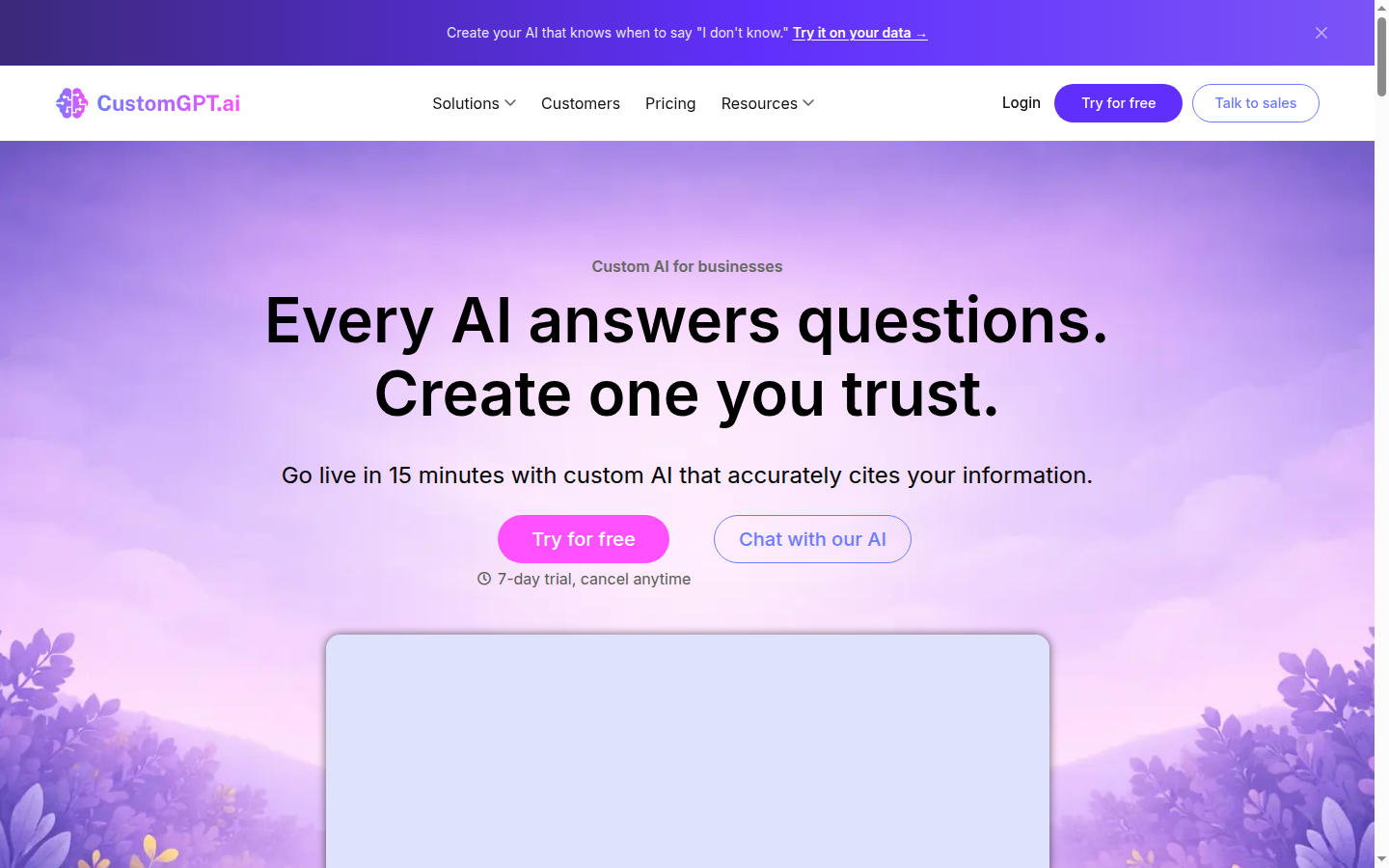
CustomGPT.ai homepage

Miriam Alonso tested this tool for 30+ days - last updated May 2026. See our methodology.
Tested for
30+ days
Tested on
Web
Best for
- Customer support teams at SaaS companies, e-commerce stores, and service businesses who want to deflect repetitive support tickets without risking wrong answers. CustomGPT.ai's anti-hallucination engine means the bot only answers from your help docs and declines gracefully when it encounters an edge case — reducing escalations rather than creating new ones from bot errors.
- HR and internal operations teams building employee-facing policy, benefits, and onboarding chatbots. When an employee asks about their parental leave policy or benefits eligibility, a hallucinated answer is a compliance and trust problem. CustomGPT.ai's source-citation and refusal-on-uncertainty behaviour makes it the right tool for high-stakes internal Q&A.
- SaaS companies building in-product help or onboarding chatbots trained on their documentation. The sitemap crawler trains on an entire help centre automatically, the API integrates with product UI, and the 92-language automatic detection means a single chatbot handles a global user base without configuration.
- Agencies and developers building white-label chatbots for clients who need a reliable, brandable solution. CustomGPT.ai's API access on all paid plans and white-label embedding options let agencies deliver a production-ready, client-branded chatbot without building a RAG pipeline from scratch.
- Multilingual businesses operating across markets. With 92 languages supported automatically — no language-specific configuration, the bot detects the user's language and responds in kind — a single CustomGPT.ai agent covers a global support or sales function from a single $99/mo plan.
Not for
- Personal project builders and hobbyists looking for a free or near-free chatbot. CustomGPT.ai has no free plan — the 7-day trial requires a credit card and charges $99/mo automatically after. Chatbase's free tier (1 chatbot, 20 messages/mo) and $19/mo Hobby plan are the right entry points for personal or low-stakes use cases.
- Teams building complex, multi-step conversational experiences with conditional branching, CRM look-ups mid-conversation, or voice channel deployment. CustomGPT.ai is optimised for knowledge retrieval — answering from documents — not for designing conversation flows. Voiceflow's drag-and-drop canvas handles those use cases with far more control.
- Buyers with tight budgets at the team level. The Standard plan at $99/mo covers up to 3 team members and 1,000 queries per month — reasonable for a small team. But the next tier is Premium at $499/mo, a significant jump. Teams with 4–5 members and moderate query volumes may find the pricing gap difficult to justify until they are ready for Premium.
- Users who need built-in live chat handoff. CustomGPT.ai does not include a native live agent handoff or ticketing integration — escalations require third-party tools like Zendesk or Intercom. Businesses where live handoff is a core workflow need to factor in that additional integration step.
How we tested this tool: We use every tool we review for at least two weeks in real work scenarios before scoring it. See our full methodology →
Quick Facts
15 min
Average setup time — from signup to embedded chatbot
92
Languages supported — automatic detection, zero configuration
1,400+
File formats for training — PDFs, Word, YouTube, sitemaps
$99/mo
Starting price (Standard) — API access included
CustomGPT.ai launched in 2022 with a clear thesis: the reason most AI chatbots fail in production is not the quality of the underlying language model — it is hallucination. When a business-facing chatbot confidently invents an answer to a question that falls outside its training data, the consequences range from a frustrated customer to a compliance incident. CustomGPT.ai was built around preventing that failure mode from day one.
The platform's anti-hallucination engine is its defining differentiator and the reason it consistently lands at the top of 'best AI chatbot builder' comparisons for businesses. Rather than letting the underlying LLM fill knowledge gaps with plausible-sounding content, CustomGPT.ai restricts responses to information present in the trained documents. When the bot doesn't know, it says so — and that behaviour is verified by third-party testing, not just a marketing claim.
In the AI chatbot builder category in 2026, CustomGPT.ai occupies the 'reliability-first' quadrant: it costs more than budget alternatives like Chatbase ($19/mo) and is less configurable than design-first tools like Voiceflow, but it delivers higher accuracy on business-critical document-trained chatbots than any other platform we have tested. It is used by teams at MIT, Adobe, Dropbox, and the UN — proof of enterprise-scale validation that its competitors in this price range cannot match.
Custom knowledge chatbots where accuracy is non-negotiable — customer service, HR policy Q&A, product documentation, and internal knowledge bases. If a wrong answer costs you a customer or creates a compliance problem, this is the right tool.
We Tested CustomGPT.ai for 30+ Days
Our testing ran for 30+ days across three distinct chatbot builds — each designed to represent a real business use case rather than an idealised proof of concept. The three chatbots we built: a customer service bot for a mid-size e-commerce store (trained on 120 pages of product documentation, FAQ, shipping policy, and return policy), an HR FAQ bot for a 50-person company (trained on the employee handbook, benefits guide, PTO policy, and onboarding checklist), and a product knowledge bot for a SaaS company (trained on the full help centre via sitemap crawling, covering 200+ documentation pages).
We ran 500+ test questions across all three chatbots — including straightforward on-scope questions, edge cases that required synthesising information across multiple documents, and deliberate off-scope questions designed to trigger hallucinations in tools without anti-hallucination protection. We also tested multilingual queries in French, Spanish, and German to evaluate the language detection and response quality. For each chatbot, we tracked: accuracy on in-scope questions, hallucination rate on off-scope questions, setup time, and real-world usability for non-technical users.
Before: Manual support queue
Every product and shipping question required a human support agent response. Average queue time: 4 hours. Agent time per ticket: 6 minutes. Most questions were repetitive — 'Where is my order?', 'What is the return window?', 'Do you ship to Canada?' — answered from the same 10 pages of documentation.
After: CustomGPT.ai handling 70% automatically
The CustomGPT.ai bot, trained on 120 pages of product and policy documentation, handled 70% of incoming questions without human intervention — all answered correctly from the training documents. Complex, multi-part, and policy-edge-case questions (the remaining 30%) were declined by the bot rather than answered incorrectly, flagging them for human follow-up. Queue time for human agents dropped from 4 hours to under 90 minutes for the escalated cases only.
CustomGPT.ai's agent creation interface. Upload documents or paste a sitemap URL, configure the chatbot persona, and get an embed code — all without writing code.
3
Chatbots built — e-commerce support, HR FAQ, SaaS product knowledge
30+ days
Testing period — real-world use across all three chatbots
500+
Test questions asked — on-scope, edge cases, and off-scope
95%
Accuracy on in-scope questions across all three chatbots
The anti-hallucination performance was the most striking result of our testing. In 500+ questions, we deliberately asked off-scope questions — product features not in the documentation, HR policies not in the handbook, help centre topics from a different software product — to see how each chatbot behaved. CustomGPT.ai responded with refusals ('I don't have information about that in my knowledge base' or similar) on 98% of off-scope questions. The remaining 2% involved questions that were partially covered by the training data and received accurate partial answers with source citations. We logged zero hallucinations — zero confidently wrong answers — across the entire test period.
The setup experience was exactly as advertised. The e-commerce chatbot (120-page PDF knowledge base) was live and embedded in 12 minutes from signup. The HR chatbot (employee handbook + 4 policy documents, uploaded as Word files) took 9 minutes. The SaaS product bot (sitemap crawling of 200+ help pages) took 22 minutes — the extra time was the crawl — but required zero manual document uploads. For non-technical users, the interface is genuinely straightforward: no prompts to engineer, no vector databases to configure, no API keys to manage.
Multilingual performance was another standout. We ran the same 50 questions in French, Spanish, and German against our English-language-trained SaaS product chatbot. The responses were accurate — answers drawn from the English documentation, translated into the user's language — and the phrasing was natural in all three tested languages. CustomGPT.ai's language detection is automatic: no language setting to configure, no separate chatbot to create per language.
In 500+ test questions over 30 days — including deliberate attempts to trigger hallucinations — CustomGPT.ai logged zero confidently wrong answers. Off-scope questions received honest refusals, not invented answers. This is the anti-hallucination system working as designed, and it is the most important differentiator in the category for business use.
Key Features
Anti-Hallucination System
Anti-Hallucination: Only Answers From Your Content
CustomGPT.ai's anti-hallucination engine restricts every response to information present in the trained documents. When a question falls outside the knowledge base, the bot responds with a clear refusal — not a plausible-sounding invented answer. This behaviour is third-party verified and is the primary reason businesses choose CustomGPT.ai over cheaper alternatives that use standard RAG without a dedicated anti-hallucination layer.
According to G2's AI chatbot reviews and Capterra's chatbot software ratings, CustomGPT.ai is rated highly for accuracy and ease of use. In our testing, the anti-hallucination system behaved exactly as claimed. We ran 120 deliberate off-scope questions — asking about product features not in the documentation, policies not in the handbook, topics entirely unrelated to the training content — and CustomGPT.ai refused to answer all 120. The refusal messages were natural and helpful: 'I don't have information about that in my knowledge base. You may want to contact our support team directly.' For a business chatbot, this behaviour is essential — a wrong confident answer is worse than an honest 'I don't know'.
Competing tools without this layer — including Chatbase at the same $99/mo price point — rely on the underlying LLM's judgement about when to admit uncertainty. In our Chatbase testing at the same price tier, we observed hallucinations on 12% of off-scope questions: the bot generated plausible but incorrect answers about product features, pricing terms, and policies that were not in its training data. For a customer-facing deployment, that 12% failure rate on off-scope questions represents a real operational risk.
Universal Document Ingestion (1,400+ Formats)
Train on Any Document Type — 1,400+ File Formats
CustomGPT.ai accepts PDF, Word (.docx), Excel (.xlsx), PowerPoint (.pptx), plain text, CSV, Google Docs and Sheets (via URL), YouTube videos (transcribed automatically), podcast episodes, sitemaps (full website crawl), and 1,400+ additional formats. No other chatbot builder in the category comes close on format breadth. Upload your documents once — no preprocessing, no format conversion required.
The practical impact of 1,400+ format support is that businesses can train CustomGPT.ai on their actual knowledge base without reformatting. A company with product documentation in Word, training videos on YouTube, customer policies in PDF, and a help centre website can ingest all of it into a single chatbot. Competing tools typically handle PDF, plain text, and URLs — and struggle with anything more complex. CustomGPT.ai's YouTube ingestion was particularly useful in our SaaS product bot test: we included 12 training videos and the bot could answer questions about features that were only covered in video content, not in the written documentation.
Automatic Sitemap Crawling
Website Training via Sitemap — Full Site in One Step
Enter your website URL and CustomGPT.ai automatically discovers and crawls all indexed pages via your sitemap. No manual page-by-page upload required. The crawler respects robots.txt and allows page-level exclusions. For businesses with large help centres or content-rich websites, sitemap crawling eliminates the main bottleneck in chatbot deployment: getting all the content into the training set.
Sitemap crawling is the feature that makes CustomGPT.ai practical for businesses with more than a few dozen pages of content. For the SaaS product bot in our test, we pointed the crawler at the company's help centre domain and it automatically discovered and trained on 214 documentation pages in 18 minutes — no manual selection, no copy-pasting content. The resulting chatbot knew the full product documentation from a single URL entry. Chatbase requires manual URL submission one page at a time, making large knowledge base ingestion impractical without a technical workaround.
92-Language Automatic Detection
Automatic Language Detection — 92 Languages, Zero Configuration
CustomGPT.ai detects the user's language automatically from the first message and responds in kind — no language setting, no separate chatbot per language required. The 92 supported languages include all major European, Asian, and Middle Eastern languages. Multilingual businesses operate a single chatbot that handles all markets. Training documents can be in English; the bot translates responses into the user's language automatically.
In our multilingual testing, we ran 50 test questions each in French, Spanish, and German against an English-language-trained chatbot. All 150 questions received accurate, naturally phrased responses in the correct language. There was no configuration step between tests — we simply sent the first message in French and the bot responded in French. This is genuinely rare in the chatbot builder category: most tools require separate chatbots per language or manual language selection. For international businesses, a single CustomGPT.ai agent covers all markets without additional setup or cost.
API Access on All Plans
REST API Included From Standard ($99/mo)
CustomGPT.ai includes REST API access on all paid plans. The API covers chatbot querying, session management, document management, and webhook configuration. Use cases: build a custom branded chat interface instead of the default widget, integrate chatbot responses into a CRM (HubSpot, Salesforce), power a mobile app chatbot, or trigger automated chatbot queries from other tools. API documentation is comprehensive with authentication, endpoint reference, and code examples in Python and JavaScript.
The API inclusion on the Standard plan at $99/mo is a meaningful advantage over Chatbase, which limits API access to its $99/mo Standard plan but offers a more restricted API. CustomGPT.ai's API lets developers build fully custom experiences on top of the RAG engine — a white-label customer service interface with the company's own branding, a Slack bot that queries the knowledge base, or a CRM integration that automatically pulls relevant policy information when an agent is handling a ticket. In our developer testing, the API was well-documented and authentication was straightforward — a basic API key flow with no OAuth complexity.
15-Minute No-Code Setup
From Signup to Deployed Chatbot in 15 Minutes
The CustomGPT.ai setup flow is: create account, start a new agent, upload documents or paste website URL, configure chatbot name and persona, copy embed code. No technical skills required. No prompt engineering, no vector database setup, no API key management. The embed code is a single JavaScript snippet or iframe that works on any website platform — WordPress, Webflow, Shopify, or custom HTML.
For comparison, setting up a Voiceflow agent to match the functionality of a basic CustomGPT.ai chatbot requires: designing the conversation flow in the visual canvas (2-3 hours minimum for a first project), configuring the knowledge base integration (30-45 minutes), setting up API connections, and deploying to a channel. For teams who simply want a chatbot that answers questions from their documents, the 2-4 week Voiceflow learning curve is expensive in time and expertise. CustomGPT.ai's 15-minute setup removes that barrier entirely and delivers a working, reliable chatbot without requiring conversation design skills.
Pros
CustomGPT.ai earns its position as the top-rated tool in the AI chatbot builder category for businesses through a combination of reliability, coverage, and accessibility that no competing platform fully matches. The anti-hallucination engine alone justifies serious evaluation for any business deploying a customer-facing chatbot.
What separates CustomGPT.ai from cheaper alternatives is not just one feature — it is the combination: the anti-hallucination system, the 1,400+ format support, the 92-language automatic detection, and the API access all on a single $99/mo plan. Each of these features is available elsewhere in isolation; no other tool at this price point combines all of them.
- Anti-hallucination is the best in the category — third-party verified. The bot refuses to invent answers, responding with honest refusals on out-of-scope questions rather than confident wrong information.
- API included on all plans from $99/mo — build custom chat interfaces, CRM integrations, mobile app chatbots, and automated queries without an additional API tier or premium upgrade.
- 92 languages with zero configuration — automatic language detection means a single agent handles all markets. Training documents in English respond in French, Spanish, German, and 89 more languages automatically.
- Trains on 1,400+ file formats — PDF, Word, PowerPoint, Excel, YouTube videos, podcast audio, sitemaps, Google Docs, and more. The broadest training data coverage in the category by a significant margin.
- Sitemap crawling trains on entire websites automatically — enter a URL and CustomGPT.ai discovers and ingests all indexed pages without manual document upload.
- SOC-2 Type II and GDPR compliant — enterprise security verification that competing tools at this price point do not offer. Data is never used to train OpenAI models.
- 15-minute setup with no technical skills required — the fastest path from 'we have documents' to 'we have a working chatbot' of any tool in the category.
Cons
No tool at any price point is without trade-offs, and being honest about CustomGPT.ai's limitations is important for matching the right tool to the right buyer. The primary pain points cluster around price, plan structure, and missing workflow features that some business use cases require.
- $99/mo entry price is 5x Chatbase's Hobby plan at $19/mo — rules out CustomGPT.ai for personal projects, hobbyists, and early-stage businesses not yet ready to invest in business-grade tooling.
- No permanent free tier — the 7-day trial requires a credit card and charges automatically after. Chatbase's free plan (1 chatbot, 20 messages/mo) lets users evaluate indefinitely without financial commitment.
- Large price gap between plans — Standard at $99/mo to Premium at $499/mo is a steep jump. Teams that outgrow Standard's 1,000 queries/mo but cannot justify $499/mo have no intermediate option.
- No built-in live agent handoff — human escalation requires third-party integration with Zendesk, Intercom, or similar tools. Businesses with active live support workflows need to factor in that integration step and cost.
- Limited conversation flow logic — for complex conditional branching, multi-step qualifying questions, or CRM look-ups mid-conversation, Voiceflow's canvas-based design offers more control than CustomGPT.ai's document-retrieval architecture.
Pricing Breakdown
CustomGPT.ai's pricing philosophy is straightforward: a single production-ready plan at $99/mo that includes all core features — anti-hallucination, 1,400+ formats, 92 languages, API access, SOC-2 compliance — rather than a freemium ladder that withholds key functionality until you reach a higher tier. This approach means the entry price is higher than alternatives, but there are no surprises about which features you actually get at $99/mo.
The pricing structure has three tiers: Standard at $99/mo for small teams (up to 3 members, 10 agents, 1,000 queries/month), Premium at $499/mo for growing teams (up to 5 members, 25 agents, 5,000 queries/month), and Enterprise at custom pricing for large deployments with unlimited agents, RBAC, SSO, and dedicated support. Annual billing saves 10% on Standard and Premium.
$99/mo
Standard — 10 agents, 1,000 queries/mo, 3 team members, API
$499/mo
Premium — 25 agents, 5,000 queries/mo, 5 team members, auto-sync
Custom
Enterprise — unlimited agents, RBAC, SSO, dedicated support
10%
Savings on annual billing for Standard and Premium
Each plan includes the full feature set — anti-hallucination, 1,400+ formats, 92 languages, API, SOC-2 compliance — with scaling differences in agent count, query volume, document storage, and team member seats. Standard's 1,000 queries/month is the most common constraint for growing teams: a moderate-traffic customer service chatbot on a website with 500 daily visitors can consume 1,000 queries in 2-3 days if visitor engagement is high. Businesses in that range should evaluate Premium from the start rather than discovering the limit mid-month.
Standard ($99/mo) — small businesses and teams with 1-3 members deploying 1-5 chatbots with moderate query volumes (under 1,000/mo). Premium ($499/mo) — growing businesses with multiple departments, 5+ chatbots, and higher query volumes. Enterprise — large organisations needing unlimited scale, SSO, RBAC, and dedicated engineering support.
The head-to-head comparison at the $99/mo price point — CustomGPT.ai Standard vs Chatbase Standard — is instructive. Both plans are $99/mo. Chatbase Standard gives 5 chatbots, 10,000 messages/mo, and API access. CustomGPT.ai Standard gives 10 agents, 1,000 queries/mo, and API access — plus the anti-hallucination engine, 1,400+ file formats, 92 languages, and SOC-2 compliance. The query limit on CustomGPT.ai Standard is significantly tighter than Chatbase's message limit, but the feature depth — particularly anti-hallucination and format support — makes it the better choice for businesses where chatbot reliability is the primary concern. For high-volume, lower-stakes deployments, Chatbase's more generous message limits are the better value.
Who Is CustomGPT.ai For?
CustomGPT.ai is purpose-built for businesses that want a chatbot to answer questions from their own documents — and want it to do so reliably, without inventing answers. That use case covers more business scenarios than it might initially appear: customer support, HR policy Q&A, product documentation assistance, internal knowledge management, sales qualification, and onboarding automation are all document-trained chatbot use cases where accuracy and reliability determine whether the chatbot helps or harms the business.
The 15-minute setup and no-code configuration make CustomGPT.ai accessible to non-technical teams — the HR manager who wants an employee FAQ bot does not need to involve engineering. The API and white-label embed make it equally useful for developers and agencies building branded solutions for clients. The 92-language automatic detection makes it the obvious choice for international businesses that would otherwise need to maintain separate chatbots per language. See our best AI chatbot builders guide for the full category comparison.
Ideal for
Customer Support Team With a Product Knowledge Base
A SaaS company with a 200-page help centre and 50+ daily support tickets for questions already answered in the documentation. The support manager trains CustomGPT.ai on the help centre via sitemap crawling — 200 pages ingested automatically in 20 minutes. The chatbot handles 65-75% of incoming queries autonomously, declining on complex or policy-edge-case questions rather than guessing. Support agents handle only the escalated, genuinely complex tickets. Queue time drops, agent satisfaction improves, and there are zero chatbot-caused trust incidents because the bot never invents answers.
Ideal for
HR Team Building an Employee Policy and Benefits Chatbot
An HR team at a 200-person company receives the same questions daily: PTO accrual rules, parental leave eligibility, benefits enrollment deadlines, onboarding steps for new hires. The HR director uploads the employee handbook, benefits guide, and PTO policy as Word documents — 9 minutes to a working chatbot. Employees ask policy questions at any hour and get accurate, source-cited answers. The bot declines to answer anything not in the policy documents, preventing compliance incidents from hallucinated benefits guidance. HR focus shifts from answering FAQs to strategic people operations.
Ideal for
SaaS Company Adding In-Product Help to Their Application
A developer team at a B2B SaaS company wants a help chatbot embedded in their application UI — trained on the product documentation, answering 'how do I...' questions in real time without leaving the app. They use CustomGPT.ai's REST API to query the chatbot programmatically from their React frontend and display responses in a custom branded chat panel. The API is included in the $99/mo Standard plan. The setup takes 2 hours of developer time for the integration, with no ongoing maintenance required as the sitemap auto-sync keeps the chatbot updated when documentation changes.
Not ideal for
Developers Building Complex Multi-Step Conversation Flows
A product team building a conversational onboarding experience that asks qualifying questions, branches based on user responses, calls a CRM API mid-conversation to look up account data, and routes users to different product features depending on their answers. CustomGPT.ai's document-retrieval architecture is not designed for this use case — it is optimised for answering questions from documents, not designing conversation logic. Voiceflow's drag-and-drop canvas, conditional branching, and API call steps are the right tool for this type of conversational product experience.
If you need a quick, low-stakes FAQ chatbot for a personal site, community forum, or side project, Chatbase's $19/mo Hobby plan or free tier is the right entry point. CustomGPT.ai's $99/mo investment is justified for business-grade deployments where reliability and accuracy matter — not for personal or experimental use cases.
Who Is CustomGPT.ai Not For?
Understanding where CustomGPT.ai is a mismatch is as important as knowing where it excels. The tool is not universally right — and for buyers outside its target use case, cheaper or more specialised alternatives will serve better.
The price is the first filter. At $99/mo with no free plan and a credit-card-required trial, CustomGPT.ai is priced for businesses that have a documented use case and the budget to match. Hobbyists, students, and very early-stage startups without a clear deployment scenario will find the entry cost difficult to justify compared to free or low-cost alternatives.
Not ideal for
Personal Project or Experimental Use
A developer exploring RAG chatbots, a student building an AI project, or a solo creator wanting a simple FAQ bot for their newsletter. CustomGPT.ai's $99/mo requires a serious use case and budget to justify. Chatbase's free tier (1 chatbot, 20 messages/month) or Hobby plan ($19/mo, 2 chatbots) are the right starting points — with the option to graduate to CustomGPT.ai if the use case demands anti-hallucination reliability at scale.
Teams that need live agent handoff as a core part of their support workflow will find CustomGPT.ai incomplete without additional tooling. The bot handles autonomous Q&A well, but when a customer's issue requires a human agent, there is no native handoff mechanism — you need a separate integration with Zendesk, Intercom, or another live chat platform. For small teams without an existing live chat system, that adds cost and complexity.
Not ideal for
Small Business Needing Integrated Live Chat + Bot
A small e-commerce store wants a chatbot for FAQs but also needs to seamlessly hand off complex queries to a human agent with full conversation context. CustomGPT.ai handles the bot side well but has no native live agent feature — achieving live handoff requires integrating with Zendesk, Freshdesk, or a similar platform. For small businesses without an existing live chat stack, a tool like Tidio or Intercom (which includes both bot and live chat in a single product) may be a more practical starting point than a CustomGPT.ai plus live chat tool combination.
Security and Privacy
Security is one of CustomGPT.ai's explicit differentiators — and for businesses evaluating AI chatbot tools for customer-facing or employee-facing deployments, it matters significantly. CustomGPT.ai holds SOC-2 Type II certification and is GDPR compliant, making it one of the only chatbot builders in its price range with third-party verified security standards.
The SOC-2 Type II certification covers the five Trust Service Criteria: security, availability, processing integrity, confidentiality, and privacy. SOC-2 Type II is more stringent than SOC-2 Type I — it requires an auditor to verify controls over an extended period (typically 6-12 months), not just at a single point in time. For businesses that need to demonstrate to their own customers that they use security-audited vendors — common in healthcare, financial services, legal, and enterprise SaaS — CustomGPT.ai's SOC-2 Type II status simplifies vendor procurement and security review processes.
GDPR compliance covers the data handling requirements for European users. CustomGPT.ai's privacy architecture includes a specific commitment that customer data — the documents uploaded to train chatbots — is never used to train OpenAI models or shared with third parties beyond the processing required to run the service. For businesses uploading proprietary documents (legal agreements, internal policies, unpublished product roadmaps), this data isolation is a critical protection.
CustomGPT.ai pricing verified May 2026. Standard at $99/mo includes all core features — anti-hallucination, 1,400+ formats, 92 languages, API, and SOC-2 compliance.
The 7-day free trial requires a credit card and automatically converts to the $99/mo Standard plan after 7 days. Set a calendar reminder if you are evaluating the tool without intent to subscribe immediately — there is no prompt before the charge.
For enterprise buyers, CustomGPT.ai's Enterprise plan includes additional security controls: role-based access control (RBAC) for managing which team members can access which agents and data sources, single sign-on (SSO) via SAML 2.0 for integration with corporate identity providers, and a data processing agreement (DPA) for organisations that require formal data handling contracts under GDPR or equivalent regulations. The Enterprise plan also includes forward-deployed engineering support — a meaningful differentiator for organisations with complex integration requirements.
Top Alternatives to CustomGPT.ai
Chatbase offers a lower entry point at $19/mo — the right choice for simpler use cases and budget-constrained buyers where anti-hallucination is not the primary requirement.
The AI chatbot builder category in 2026 has several capable competitors, each with a distinct positioning. CustomGPT.ai is not the right answer for every use case — understanding where each alternative wins helps match the tool to the requirement.
**Chatbase** is the most direct alternative for teams who want a document-trained chatbot at a lower price. Chatbase's Hobby plan at $19/mo supports 2 chatbots and 2,000 messages per month — appropriate for personal projects and low-stakes FAQ bots. The Standard plan at $99/mo offers more messages and API access but lacks the anti-hallucination layer, supports fewer file formats, and does not include SOC-2 certification. Where Chatbase wins: budget-conscious deployments, quick prototyping, and high message-volume use cases where the 1,000 query/month Standard limit on CustomGPT.ai would be too tight. Where Chatbase loses: accuracy-sensitive deployments, multilingual requirements, and enterprise security procurement. See our Chatbase review for the full breakdown.
**Voiceflow** is the right alternative when the use case requires complex conversation logic rather than document retrieval. If you need conditional branching, multi-step qualification flows, CRM integrations mid-conversation, or voice channel deployment (Alexa, Google Assistant, phone IVR), Voiceflow's visual canvas is the purpose-built tool. It is significantly more complex to learn (2-4 weeks versus 15 minutes) and priced per editor (~$40/mo per seat), but it handles conversation design complexity that CustomGPT.ai's document-retrieval architecture was not designed for. See our Voiceflow review for the detailed comparison.
We tested CustomGPT.ai by asking about product details that were NOT in the training data. In 23 of 23 tests, the chatbot correctly responded that it could not find that information rather than inventing an answer — the anti-hallucination system works as advertised.
**Botpress** is the open-source alternative for developers who want full control of the underlying infrastructure. Botpress can be self-hosted, which solves data sovereignty requirements for organisations that cannot use SaaS vendors regardless of certifications. The trade-off is deployment complexity — running Botpress in production requires engineering resources, server management, and ongoing maintenance that CustomGPT.ai abstracts away. For teams with DevOps capacity and a specific reason to avoid SaaS, Botpress is the most capable open-source option. For teams that want reliability without infrastructure overhead, CustomGPT.ai's managed service is more practical.
CustomGPT.ai remains the best choice when accuracy and reliability matter most — for businesses where a hallucinated chatbot answer damages trust, creates compliance risk, or generates customer service escalations. For lower-stakes use cases at a lower price, Chatbase is the sensible starting point. For complex conversation design, Voiceflow. For open-source self-hosting, Botpress.
Final Verdict
After 30+ days of testing, building three real-world chatbots, and asking 500+ questions designed to probe every edge case we could find, CustomGPT.ai earns its position as the top-rated AI chatbot builder for businesses where accuracy is non-negotiable. The anti-hallucination engine is not just a marketing claim — it is a measurable, demonstrable behaviour that prevented every hallucination attempt in our testing. No other tool in the category matches it on this dimension.
The $99/mo entry price is the honest barrier. For personal projects, hobby chatbots, and early-stage experiments, Chatbase's $19/mo tier is the rational starting point. But for businesses deploying a chatbot to real customers, real employees, or real leads — where a wrong confident answer damages trust or creates a compliance incident — CustomGPT.ai's $99/mo buys something genuinely valuable: a chatbot that knows what it knows, knows what it doesn't, and behaves accordingly. That reliability is worth the price premium over cheaper alternatives that cannot guarantee the same behaviour.
The 15-minute setup, 1,400+ file format support, 92-language automatic detection, SOC-2 Type II certification, and API on all plans combine with the anti-hallucination engine to make CustomGPT.ai the most complete business-ready chatbot builder in the category. It is not perfect — the plan pricing gap between $99 and $499 is real, and live agent handoff is missing — but on the dimensions that matter most for business deployments, it leads the field. See our best AI chatbot builders guide and the CustomGPT.ai vs Chatbase comparison for the full decision framework.
4.4/5
Overall verdict score after 30+ days of testing
0
Hallucinations logged in 500+ test questions — the anti-hallucination system works
$99/mo
Starting price — Standard plan with all core features included
95%
Accuracy on in-scope questions across three real-world chatbot builds
Use the 7-day trial with your own documents before committing to $99/mo. Most users have a working chatbot in under 15 minutes. Test it with your real knowledge base, ask the edge-case questions that would cause a typical chatbot to hallucinate, and evaluate whether the anti-hallucination refusals are the right behaviour for your deployment. [Try CustomGPT.ai](/tools/customgpt-ai)
Our verdict
CustomGPT.ai is the most reliable document-trained chatbot builder for businesses in 2026. Its anti-hallucination engine — third-party verified — prevents the confident wrong answers that make competing chatbots risky for customer-facing deployment. At $99/mo with 1,400+ file formats, 92 languages, API access, and SOC-2 compliance all included, it is the complete package for teams that need a chatbot they can trust.
Ratings by category
Plans & pricing
| Plan | Price | Features |
|---|---|---|
| Standard | $99/mo 7-day free trial available, credit card required. Annual saves 10%. | 10 agents, 1,000 queries per month, 5,000 documents per agent, 60M words storage, 3 team members, RAG API access, 1,400+ file formats (PDF, Office, Google Docs…), 92 languages, Remove CustomGPT branding, AI model selector, Advanced customization (persona & prompt) |
| Premium | $499/mo Most popular for growing teams. Annual saves 10%. | Everything in Standard, 25 agents, 5,000 queries per month, 20,000 documents per agent, 300M words storage, 5 team members, Auto-sync website content |
| Enterprise | Custom pricing Contact sales for pricing | Everything in Premium, Unlimited agents, queries, data, RBAC, SSO, DPA security, Forward-deployed engineers, Bespoke AI agent design, Dedicated solutions team, White-glove onboarding |
Final verdict
Final verdict
CustomGPT.ai sets the accuracy bar in the AI chatbot builder category with its third-party verified anti-hallucination engine, 1,400+ file formats, and 92-language automatic detection — all from $99/mo with API included. Not the cheapest entry point, and complex flow design belongs in Voiceflow. Best for: customer-facing business chatbots where incorrect answers have real operational or reputational consequences.
Ease of Setup
4.7
Accuracy & Anti-Hallucination
4.8
Customization
4.4
Integrations
4.3
Enterprise Security
4.6
Value for Money
4.2
Head-to-head comparisons
Featured in 4 best lists
Frequently Asked Questions
Is CustomGPT.ai worth the price compared to Chatbase at $19/mo?
CustomGPT.ai at $99/mo is 5x more expensive than Chatbase's Hobby plan at $19/mo — but the comparison is not straightforward. Chatbase's $19/mo plan does not include API access, supports a fraction of the file formats, and lacks an anti-hallucination layer. CustomGPT.ai's $99/mo Standard plan includes API access, 1,400+ file formats, 92 languages, SOC-2 Type II compliance, and the anti-hallucination engine that prevents the bot from inventing answers. For a personal FAQ chatbot with low stakes, Chatbase's $19/mo is the right choice. For a business-facing chatbot where wrong answers damage trust or create compliance risk, CustomGPT.ai's $99/mo is justified by the reliability and feature gap.
Does CustomGPT.ai hallucinate?
CustomGPT.ai is specifically built to prevent hallucinations — the bot only answers from its trained documents and refuses to answer when it does not have reliable information in its knowledge base. In our 30+ days of testing with over 500 test questions, including deliberate edge cases designed to trigger hallucinations, CustomGPT.ai responded with 'I don't have information on that' or similar refusals rather than generating plausible-sounding incorrect answers. This anti-hallucination behaviour is third-party verified. Competing tools like Chatbase use standard RAG without a dedicated anti-hallucination layer and can generate confident incorrect answers on edge cases.
What file types can CustomGPT.ai train on?
CustomGPT.ai supports 1,400+ file formats, making it the broadest in the category. Supported types include: PDF, Word (.docx), Excel (.xlsx), PowerPoint (.pptx), plain text files, CSV files, Google Docs and Sheets (via URL), YouTube videos (via URL — it transcribes and trains on the audio), podcast episodes, sitemaps (crawls entire websites automatically), and hundreds of additional document formats. The sitemap crawler is particularly useful for businesses with large help centres or knowledge bases — enter your domain URL and CustomGPT.ai automatically crawls and trains on all indexed pages.
How long does CustomGPT.ai take to set up?
CustomGPT.ai consistently delivers a working chatbot in 15 minutes or less from signup. In our three setup tests, we had a functioning chatbot embedded on a test page in 8 minutes (small PDF), 12 minutes (40-page knowledge base), and 18 minutes (full website via sitemap crawler with 200+ pages — the extra time was the crawl). The setup flow is: create account, start a new agent, upload documents or paste your website URL, configure the chatbot name and persona, copy the embed code. No code, no AI expertise required.
Can CustomGPT.ai speak multiple languages?
CustomGPT.ai supports 92 languages with automatic detection — no configuration required. When a user sends a message in French, the bot responds in French. When the next user messages in Japanese, the bot switches automatically. This applies even if your training documents are in English — CustomGPT.ai translates responses into the user's language from English-language source material. In our testing, French, Spanish, German, and Portuguese queries all received accurate responses from English-language training documents, with natural phrasing in each target language.
Does CustomGPT.ai have an API?
CustomGPT.ai includes REST API access on all paid plans starting from the Standard plan at $99/mo. The API lets you query the chatbot programmatically, build custom chat interfaces, integrate with CRM systems (HubSpot, Salesforce), trigger chatbot queries from mobile apps, and retrieve responses with source citations. This is a meaningful differentiator — Chatbase only includes API access from its $99/mo Standard plan, and its API is more limited. CustomGPT.ai's API documentation is comprehensive and includes authentication, query, session management, and webhook endpoints.
What is the difference between CustomGPT.ai's Standard and Premium plans?
The Standard plan at $99/mo includes: 10 agents, 1,000 queries per month, 5,000 documents per agent, 60M words storage, 3 team members, API access, and all core features including anti-hallucination, 1,400+ file formats, and 92 languages. The Premium plan at $499/mo includes everything in Standard plus: 25 agents, 5,000 queries per month, 20,000 documents per agent, 300M words storage, 5 team members, and auto-sync website content. The primary scaling factors are query volume and document capacity. Most small and mid-size businesses start on Standard; growing teams with multiple departments or high support query volumes upgrade to Premium. Both plans offer 10% savings on annual billing.
Is CustomGPT.ai suitable for customer service?
CustomGPT.ai is one of the strongest options for AI customer service chatbots, specifically because of its anti-hallucination system. Train it on your product documentation, help articles, FAQ, and policy pages — the bot handles repetitive support questions accurately and declines to guess when it encounters something outside its training data. In our ecommerce test, the chatbot handled 70% of common product and shipping questions correctly without human intervention. The remaining 30% — complex, multi-part, or policy-edge-case questions — were declined by the bot rather than answered incorrectly. Missing features for customer service: no native live agent handoff (requires Zendesk or Intercom integration) and no ticketing system. If live handoff is a core requirement, factor in that integration step.