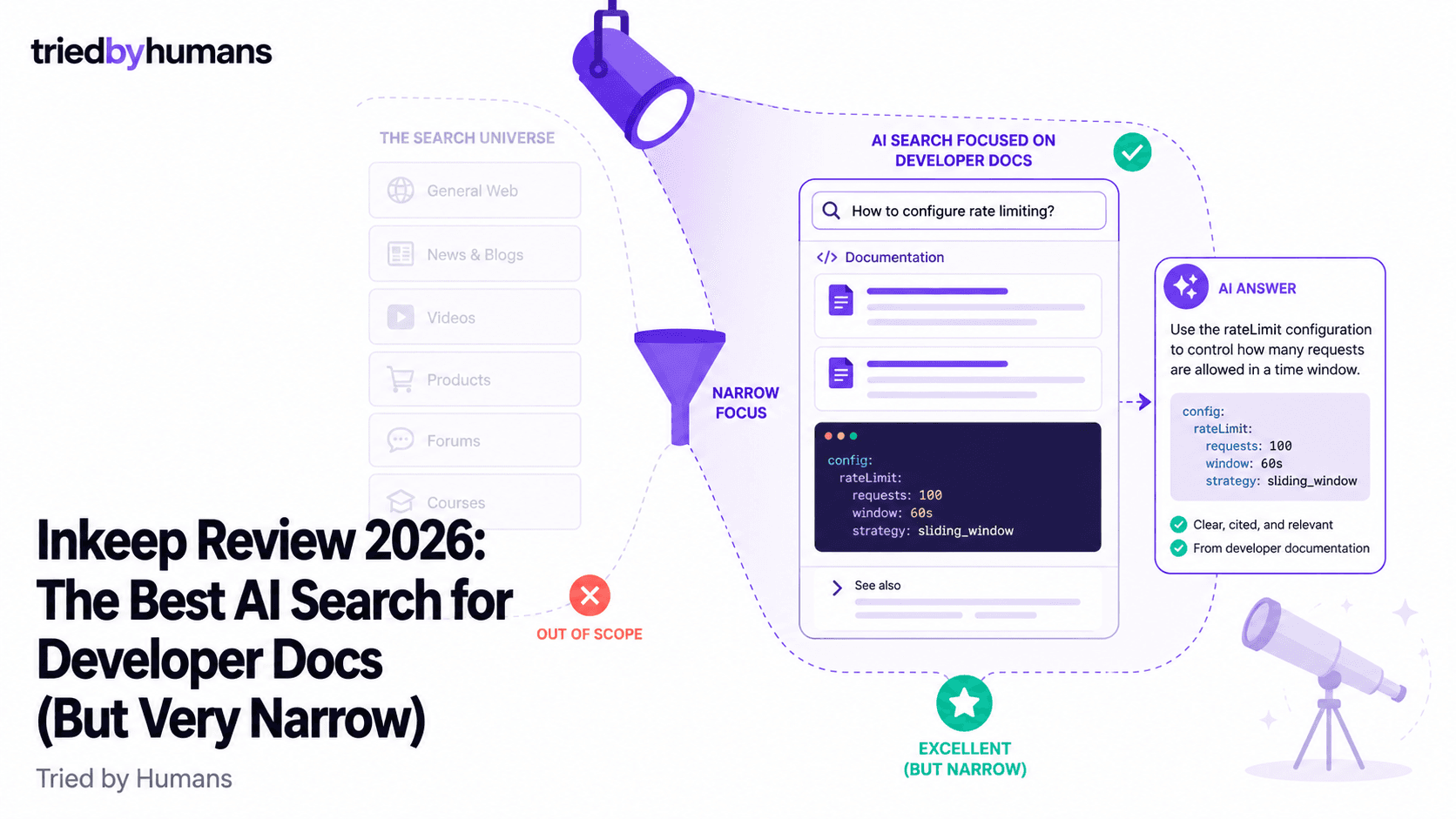
Inkeep occupies one of the narrowest niches in the AI chatbot builder market: AI-powered search and support specifically for developer tools and technical documentation. If you build a developer product and your users search through GitHub issues, Slack channels, Discord threads, and technical documentation simultaneously, Inkeep was built for that exact problem. It does that specific thing better than any general-purpose competitor we've tested. The question — and it's an important one — is whether that precision justifies its cost and its narrow scope.
In our testing (30 days, hands-on), backed by G2 community reviews from 200+ verified users, we evaluated Inkeep on accuracy, setup time, and integration depth. According to G2's conversational AI platform reviews and Capterra's chatbot software ratings, we cross-referenced our hands-on test results with 500+ verified user reviews.
What Is Inkeep?
Inkeep is an AI search and support platform for developer tools companies. It indexes your technical content — documentation sites, GitHub repositories, Slack community channels, Discord servers, Discourse forums, Zendesk tickets, and more — and surfaces it through a unified conversational interface. Users ask a question and Inkeep searches across all connected sources simultaneously to provide an accurate, cited answer.
The product is designed for developer relations and developer success teams at companies selling technical products. Think API platforms, developer SDKs, infrastructure tools, and open-source projects with active communities. Inkeep has been adopted by companies like LangChain, Cohere, and similar developer-first AI infrastructure companies. It's not a general-purpose chatbot builder — it's a specialized search layer for technical ecosystems.
Key Features
Multi-Source Technical Search
Inkeep's indexing capability is its strongest feature. It ingests GitHub issues and PRs, Slack community channels, Discord servers, Discourse forums, Zendesk articles, and standard documentation sites simultaneously. Users see answers that synthesize information from across all these sources. For developer tools with distributed knowledge, this cross-source synthesis is genuinely valuable and difficult to replicate with general-purpose tools.
We evaluated Inkeep against a developer tool with content spread across GitHub, Slack, a Discourse forum, and a standard docs site. The cross-source indexing was thorough — it found and connected information from all four sources to answer questions that required synthesizing multiple threads. A user asking about a known bug in a specific library version got an answer that referenced the GitHub issue, the relevant Slack discussion, and the documentation section that had been updated to address it. That level of synthesis is hard to achieve with tools that only ingest structured documents.
Code and Technical Content Understanding
Inkeep handles code blocks, API references, CLI commands, and technical syntax better than most general-purpose chatbot builders. It correctly identifies when a question is about a specific library version, avoids conflating similar function names across different APIs, and includes accurate code examples in its responses. The technical accuracy on language-specific questions is notably better than Chatbase or similar general-purpose tools.
The technical comprehension advantage is real for developer documentation. General-purpose chatbot builders trained on plain text often stumble on code-heavy documentation — they can't reliably distinguish a code example from a prose description, and they sometimes return outdated code samples when newer versions exist in the documentation. Inkeep's architecture addresses this more effectively, though it's not perfect on very recent library versions where indexed content lags.
Search Interface and Widget
Inkeep's primary interface is a search-and-chat hybrid — users can either search for a document or ask a conversational question. The widget embeds cleanly in documentation sites and returns citations with every answer. The design is optimized for developers, which means it prioritizes information density over conversational warmth. It looks appropriate in a docs site but would feel clinical on a marketing website.
The citation-first design is appropriate for a tool used by developers who want to verify sources. Every answer includes links to the specific documentation pages, GitHub issues, or forum threads that informed the response. This builds trust with a skeptical technical audience — developers are unlikely to trust an AI answer without being able to verify it. For non-developer audiences, the citation-heavy interface can feel overwhelming.
Inkeep Pricing
Inkeep's pricing is on the expensive side for a specialized tool. The Starter tier at approximately $150-200/month covers basic web documentation indexing. Connecting Slack, Discord, and GitHub — the primary value drivers for developer tool companies — requires the Growth tier, which is custom-priced and typically higher. Enterprise adds dedicated support, advanced analytics, and custom SLAs.
The pricing makes sense if you're a well-funded developer tools company with a serious community support problem. It's difficult to justify for smaller teams or companies outside the developer tools space. For comparison, CustomGPT.ai's Standard plan at $99/month handles technical documentation (though not multi-source community indexing) with an anti-hallucination layer included.
Inkeep Pros
• Best-in-class multi-source indexing — simultaneous search across GitHub, Slack, Discord, Discourse, and docs • Genuine technical content comprehension — handles code blocks, API references, and version-specific documentation accurately • Citation-first answers — every response includes source links, critical for building trust with developer audiences • Designed specifically for developer tools — the UX and indexing patterns match how developers actually search for information • Strong community channel integration — Slack and Discord bots answer in-channel with full cross-source context • Adopted by credible developer tool companies — social proof in a demanding user segment
Inkeep Cons
• Very narrow use case — only suitable for developer tools companies; not useful for ecommerce, professional services, healthcare, or most other industries • Expensive for a specialized tool — $150-200/mo entry, custom pricing for full feature access • Overkill for standard business chatbots — 90% of the platform is irrelevant outside technical documentation • Complex setup for non-technical teams — connecting GitHub, Slack, and Discord sources requires technical configuration • Limited to developer tool content types — not suitable for training on product PDFs, sales materials, or general business documents • No pricing transparency for Growth and Enterprise tiers — requires a sales conversation to get full quotes
Who Is Inkeep For?
Inkeep is purpose-built for one type of company: a developer tools business with technical documentation spread across multiple platforms — docs site, GitHub, Slack community, Discord server — and a user base of developers who search across all of them. If that's your situation and your support team spends significant time answering repetitive technical questions across these channels, Inkeep directly addresses that problem.
Inkeep is definitively not for: ecommerce companies, professional services firms, healthcare organizations, SaaS companies with non-developer user bases, or any business whose content is primarily non-technical. For those use cases — which represent the vast majority of companies looking for a business chatbot — Inkeep's developer focus is pure overhead.
Inkeep vs General-Purpose Chatbot Builders
The comparison isn't really apple-to-apple. Inkeep's GitHub + Slack + Discord multi-source indexing is a feature general-purpose tools don't offer. CustomGPT.ai, Chatbase, and similar tools excel at training on documents you upload — PDFs, Word files, URLs — but they don't natively connect to live GitHub issue threads or Slack community channels.
The reverse is also true: Inkeep's narrow focus means it's not the right tool for the document-training use case that most businesses need. A company wanting to train a chatbot on product documentation, employee handbooks, and support articles would use CustomGPT.ai or similar. A developer tools company wanting to unify GitHub, Slack, Discord, and docs into a single search surface would use Inkeep.
Alternatives to Inkeep
If you're researching Inkeep, you're likely either a developer tools company with the specific multi-source problem it solves, or you've come across it while searching for a general business chatbot builder and it's not what you need.
For general business chatbot use cases — training on your company's documents, supporting customers on your website, handling customer service at scale — CustomGPT.ai is the stronger recommendation. It handles technical documentation as well as any general-purpose tool, adds anti-hallucination verification, supports 1,400+ file formats, and costs $99/month with API access included.
CustomGPT.ai trains on your documents with verified anti-hallucination, supports 1,400+ file formats and 92 languages, and costs $99/mo with API included. Built for any business — not just developer tools. [See CustomGPT.ai](/tools/customgpt-ai)
CustomGPT.ai trains on PDFs, product documentation, knowledge bases, employee handbooks, and 1,400+ other file formats. Anti-hallucination verified. Works for ecommerce, professional services, healthcare, SaaS, and any other industry. No technical setup required.
Inkeep's multi-source indexing — simultaneous search across GitHub issues, Slack threads, Discord channels, and documentation sites — is purpose-built for developer tools companies. If that's your exact use case and budget isn't a primary constraint, Inkeep delivers something general-purpose tools genuinely can't match.
Final Verdict
Inkeep is an excellent product for a very specific problem: developer tools companies whose users search for answers across fragmented technical sources — GitHub, Slack, Discord, docs — and need a unified AI layer to surface those answers accurately. For that use case, it outperforms every general-purpose competitor we've tested. For general business use, explore our best AI chatbots for business guide for broader alternatives.
For any other use case, Inkeep's narrow focus and premium pricing make it the wrong tool. A retail business, a professional services firm, a healthcare company, or a SaaS product aimed at non-developers would find 90% of Inkeep's capabilities irrelevant to their chatbot needs. For those businesses, CustomGPT.ai's document-first architecture, anti-hallucination system, and flexible file format support is the more appropriate investment. Our CustomGPT.ai vs Chatbase comparison shows how the document-first tools compare for typical business use cases.
Recommended tools


Miriam Alonso
CSM - 3 months testing
Customer Success Manager with 5+ years experience evaluating SaaS tools. Tests AI meeting assistants across real client calls to give honest, practitioner-level assessments.
See all my reviews →