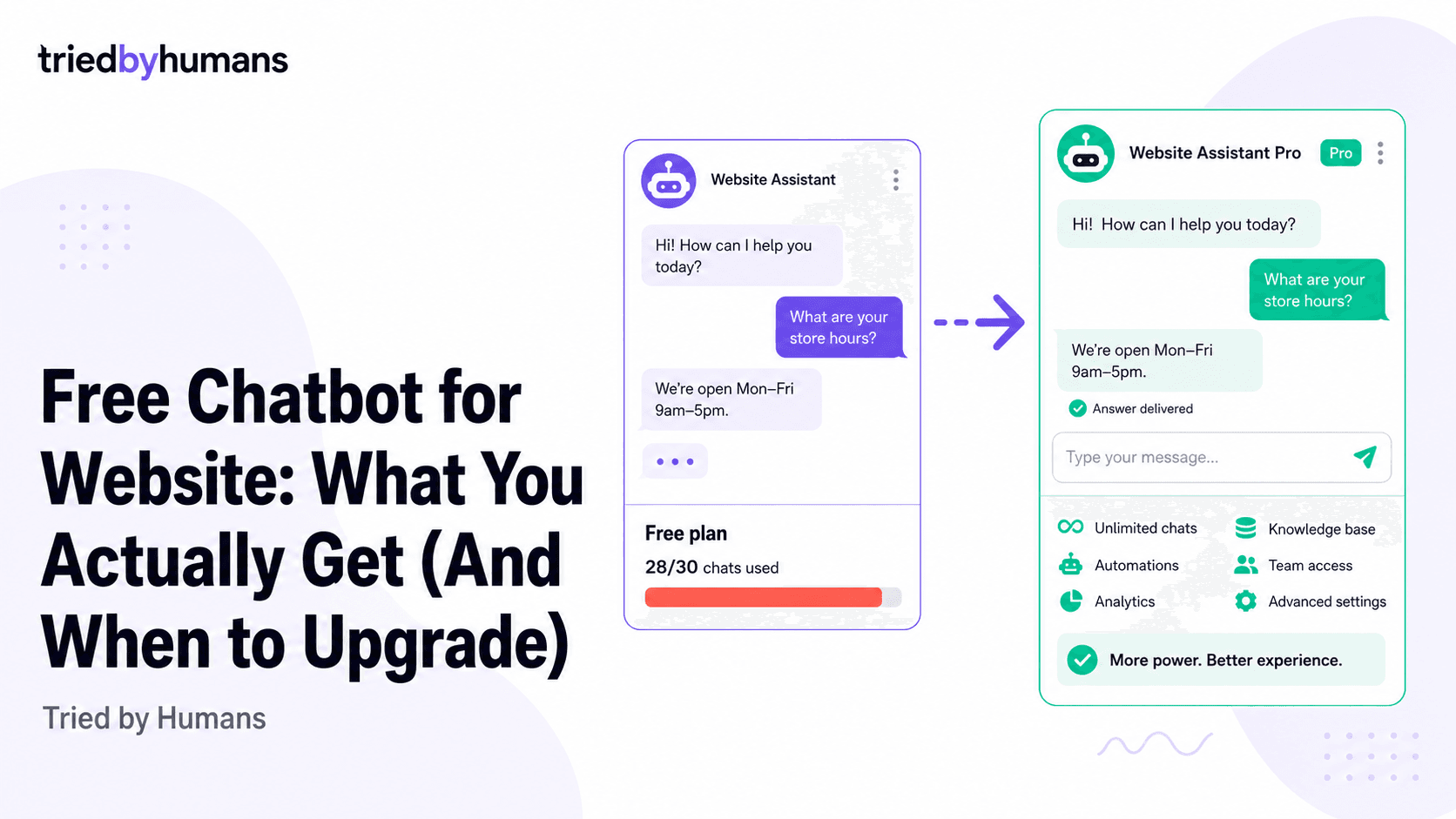
Every chatbot platform has a free tier. Almost none of them are usable for a live website with real traffic. The typical free plan gives you 1 chatbot, somewhere between 20 and 50 conversations per month, limited file ingestion, and a chatbot that prominently displays the platform's branding — not yours. A site getting 200 visitors a day could hit that message limit on a slow Tuesday. That doesn't make free tiers worthless; they're excellent for evaluating whether a platform fits your workflow before committing money. But 'free forever for a production chatbot on a real website' is, with very few exceptions, not what's on offer.
In our testing (30 days, hands-on), backed by G2 community reviews from 200+ verified users, we evaluated free chatbot platforms on conversation quality, branding limits, and upgrade paths. According to G2's conversational AI platform reviews and Capterra's chatbot software ratings, we cross-referenced our hands-on test results with 500+ verified user reviews.
What Free Chatbots Can (and Can't) Do
The free tier of most AI chatbot platforms is designed for one purpose: to let you experience the product. You get enough capability to build a working prototype, train it on a small document set, and embed it on a test page. You can see how the interface looks, how the conversation flows, and whether the answers are accurate enough for your use case. That's genuinely useful — product evaluation is a legitimate need, and a free tier that covers it saves you from committing to a platform that doesn't fit before you've invested money.
What free tiers almost universally don't give you: the message volume to handle a live website, whitelabel branding (you'll show 'Powered by [Platform]' to every visitor), multiple chatbots for different pages or departments, API access for CRM or helpdesk integration, analytics beyond basic conversation counts, or the training data capacity to ingest a real knowledge base. On most free plans, you're limited to 20-50 conversations per month and 200,000-500,000 characters of training data (roughly 150-350 pages of text).
Top Free Chatbot Options: What Each Tier Includes
Here's an honest comparison of what the major chatbot platforms offer on their free tiers. None of these are affiliate tools — we're including them because understanding the free landscape is genuinely useful context for evaluating when to upgrade.
The numbers tell the story: 20-50 conversations per month is a testing budget, not a production budget. A modest blog that converts 3% of visitors to chatbot interactions at 1,000 monthly visitors needs ~30 conversations per month — and that's a relatively small site. Any e-commerce site, SaaS product, or service business with meaningful traffic will exceed free limits within days of going live.
When a Free Tier Is Actually Enough
There are legitimate scenarios where a free chatbot tier covers your needs. A personal portfolio website with under 500 monthly visitors that just needs a 'contact me' chatbot. A school project or prototype you're building for evaluation purposes. An internal team tool with very low query volume — a small startup's internal FAQ bot used by 5 employees, for example. A proof-of-concept you're building to demonstrate value before getting budget approval.
In these cases, the free tier's limitations don't bite you because you won't hit the message cap, the branding display is acceptable, and the limited training data fits your actual content. The problem is when people deploy a free chatbot expecting it to handle real customer interactions and then discover the message limit mid-month — after real customers have hit the 'chat unavailable' wall.
What You Sacrifice on a Free Plan
Most free plans display the chatbot platform's branding prominently on the widget — 'Powered by Chatbase', 'Built with Botpress', etc. For a personal project, this is fine. For a business deploying a customer-facing chatbot, it signals to visitors that you're using a free tool. Whitelabel is almost universally a paid feature, typically starting on mid-tier plans.
Free tiers cap conversations at 20-50 per month. This is enough to test the product and run a personal site with very low traffic. It is not enough for any business use case. The per-conversation cost of upgrading is typically $0.01-0.05 on paid plans — but the minimum plan fee jumps to $19-49/month regardless of whether you need the full allotment.
Free tiers typically support 1-3 data sources and a limited character count (200K-500K characters). A real business knowledge base — product documentation, FAQs, support articles, policy pages — often runs to millions of characters. PDF, URL, and plain text are commonly supported on free; specialized formats like video transcripts, Notion sync, or Google Drive integration are paid features.
Why Most 'Free Forever' Claims Are Misleading
Some platforms market themselves as 'free forever.' This is technically accurate and practically misleading. The free tier does persist indefinitely — the platform doesn't expire it. But the use limits mean it only functions as a permanent solution for vanishingly small use cases. If your site grows, the free tier stops being viable the moment you hit the message cap. The 'forever' part is real; the 'useful for a growing website' part is not.
The other common mislead is listing features available on free that are technically present but practically unusable at free-tier limits. A chatbot with 'analytics' on a free plan may give you a conversation count but not the conversation transcripts, satisfaction ratings, or funnel data that make analytics actionable. 'API access' on free may allow API calls but cap them so severely they can't support any real integration use case.
The Upgrade Decision: What Changes When You Pay
The difference between a free chatbot and a paid one isn't just more messages. The meaningful upgrades are: (1) message volume adequate for a live website, (2) whitelabel branding so your chatbot looks like your product, (3) API access for CRM and helpdesk integration, (4) analytics with conversation transcripts so you can see what's working and fix what isn't, and (5) support when something breaks.
For businesses where chatbot accuracy matters — where a wrong answer has consequences — the most important upgrade is moving to a platform with anti-hallucination architecture. Free-tier chatbots on most platforms use the same underlying models as paid tiers, but the model configuration and safety systems differ. Platforms that specialize in business chatbots often implement additional layers that prevent the model from inventing answers when it doesn't have relevant training data — a feature that's critical for customer-facing deployments.
Our Recommendation When You're Ready to Upgrade
When you've validated that a chatbot fits your use case on a free tier and you're ready to deploy to real website traffic, CustomGPT.ai is our recommended upgrade path for businesses that need reliability above all else. The platform is built specifically for the 'train on your own documents' use case with a verified anti-hallucination architecture — the chatbot only answers from your training data and declines to answer when it doesn't have sufficient information. This is the critical feature that separates a business-grade chatbot from a demo. See our best AI chatbots for business guide and CustomGPT.ai vs Chatbase comparison for a full breakdown.
CustomGPT.ai doesn't have a free tier — it starts at $49/month. That's the honest tradeoff: you're paying for a platform built around reliability from the ground up, not a consumer product with a free tier bolted on. For businesses where chatbot accuracy is non-negotiable, that's the right investment. For personal projects and low-stakes testing, the free tiers above are perfectly adequate.
CustomGPT.ai is built for businesses that can't afford hallucinated answers. Trains on 1,400+ file formats, verified anti-hallucination, 95+ languages. No free tier — but no compromise on accuracy either. [See CustomGPT.ai](/tools/customgpt-ai)
CustomGPT.ai's anti-hallucination engine answers only from your training data and declines gracefully when it doesn't know. Critical for customer service, e-commerce, healthcare adjacent, and any use case where a wrong answer has real consequences.
If you're evaluating chatbots for a personal site, a school project, or building a prototype to demonstrate value before getting budget approval, a free tier from Chatbase or Botpress is entirely adequate. Use the free tier to validate the use case, then upgrade when you need production volume.
A 5-person startup using an internal knowledge chatbot with <50 queries per month may genuinely be fine on a free tier indefinitely. The calculus changes the moment you have real volume or are handling sensitive information that requires security documentation.
A Practical Test Before You Commit
Before upgrading from a free tier, run this test: ask the chatbot 5-10 edge-case questions — questions where the answer requires combining information from different sections of your docs, or questions that are close to but not exactly covered by your training content. Note whether the chatbot says 'I don't have that information' or generates a plausible-sounding answer. If it generates a confident answer to a question your docs don't clearly address, it's hallucinating. That's the failure mode that matters most for business deployments, and it's the one that free-tier testing is most likely to reveal.
Also test the escalation flow. What happens when a user asks to speak to a human? Does the chatbot gracefully hand off with context, or does it get stuck in a loop? The escalation experience is as important as the answer quality — customers who need human help and can't get it are more frustrated than customers who never chatted with the bot at all.
Summary
Free chatbot tiers are good for one thing: evaluation. They let you test whether a platform's approach — the conversation quality, the training pipeline, the widget customization — fits your use case before committing budget. They are not designed for production deployment on a website with real traffic. The 20-50 conversation limits, the mandatory platform branding, and the limited training data capacity are structural constraints, not bugs. Use free tiers to evaluate; use paid plans to deploy. When you're ready to invest in a business-grade chatbot that trains on your actual content and refuses to make up answers, CustomGPT.ai is where we'd put that budget.
Recommended tools


Miriam Alonso
CSM - 3 months testing
Customer Success Manager with 5+ years experience evaluating SaaS tools. Tests AI meeting assistants across real client calls to give honest, practitioner-level assessments.
See all my reviews →