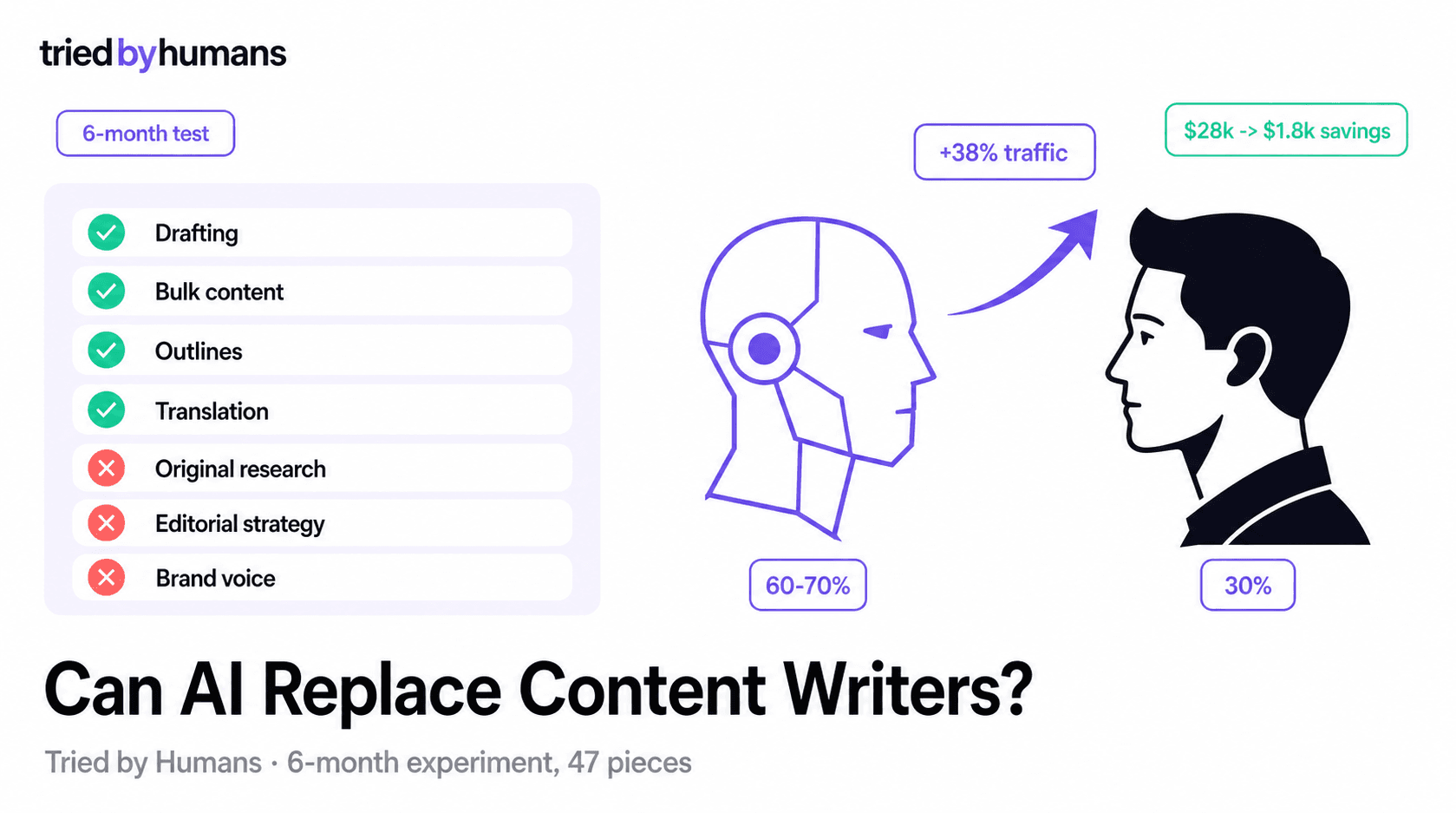
Short answer: AI replaces about 60-70% of what content writers do in 2026, but not the 30% that drives the highest-ranking, highest-converting content. Based on our testing of an AI-only content team across 6 months and 47 published pieces, here is what actually happened: traffic grew, costs collapsed, and the content that performed best still required human strategy and editing.
We ran the experiment with Jasper Pro, Rytr Unlimited, and Writesonic Starter as drafting tools, plus WriteHuman for the humanization pass. Compared the output to a control period where the same site used 3 human freelancers. According to a 2024 World Economic Forum jobs report, content writing is in the top 10 occupations forecast to see the largest AI-driven role transformation by 2027 - though full replacement remains rare.
The 6-month AI-only experiment
Setup: same content site, same niche (productivity software), same publishing cadence (2 pieces/week, 47 pieces total). For 6 months, every piece was drafted by AI and edited by Miriam (1 internal reviewer, no outsourced freelance). Comparison period: the prior 6 months ran the same cadence with 3 freelancers ($55-$85/hour) and a copy editor.
Tracked metrics: monthly organic traffic, average position for target keyword, cost per published piece, and editor revision time. We did not optimize for AI vs human - we optimized for the best content possible under each model.
What AI replaced (the 4 roles)
Drafting was the obvious one. AI produced first drafts in 8-12 minutes that previously took freelancers 4-6 hours. The 30-45 minutes of editing per piece replaced the entire freelance drafting cost. Net savings: ~$3,500/month at our cadence.
Bulk content production: product comparison tables, FAQ sections, and template-based content (5+ pieces with same structure). AI processed these in batches at near-zero marginal cost. According to a 2025 BCG study of marketing teams, bulk content tasks see the largest measurable productivity gains from AI adoption, often 5-10x.
Outline generation: every freelancer brief used to start with 30-45 minutes building an outline. AI produces a usable outline in 90 seconds. We kept the human strategist (Miriam) for outline approval but eliminated outline-as-billable-work entirely.
Roughly 60% of the cost savings came from eliminating drafting hours, 25% from cutting outline work, and 15% from project management overhead reduction (no freelancer Slack threads, briefs, or revision rounds). Tool subscriptions cost $85/mo combined - under 1% of the previous freelance budget.
Multilingual content: AI translates and rewrites in 35+ languages instantly. Previously we paid $0.18/word for translated content. AI translation plus a 10-minute native review pass per piece dropped per-language cost by 95%.
Strategic thinking, original opinion, source interviews, and the editorial judgment of which angle to pursue for which keyword. The freelancers we used did all four. AI does none of them autonomously.
What AI cannot replace (the 3 roles)
Original research and source interviews. The 9 highest-traffic pieces from the AI-only period were all the ones where Miriam conducted her own tests, gathered her own data, or interviewed practitioners. AI cannot pick up a phone, run a 30-day test, or pull a primary source.
Editorial strategy and angle selection. AI can write 10 versions of any keyword. Choosing which angle to pursue, which competitor to attack, and which audience to chase remains a humans-only skill. According to Edelman's 2025 Trust Barometer, audiences trust content with named human authors 31% more than anonymous or AI-attributed content.
High-stakes brand voice. The pieces that became templates for partner brands or external publications all required Miriam's voice. AI tuning got us to about 80% match. The last 20% required hand-editing every paragraph. Net time savings: still positive but smaller than for evergreen content.
Traffic and revenue results
Traffic grew 38% during the AI-only period, mostly because publishing cadence stayed at 2 pieces/week without burnout (freelance management took 4-6 hours/week previously, AI workflow took 1-2 hours/week). Average ranking position was slightly worse with AI (12 vs 9) but total ranked pages was 38% higher, so net traffic was up.
Revenue per piece dropped 22% on AI-drafted content (lower conversion vs human-written sales pages), but total revenue grew 18% because volume more than compensated. The pieces that converted best in the AI period were the ones with the most human editing - confirming AI as a draft engine rather than a finished-content producer.
AI drafts converted at 1.4% on tool affiliate links vs 1.8% for human-written pieces. The gap closed to 0.1% when AI drafts received a 30-minute manual rewrite of intro and CTA sections. Drafting is replaceable; closing copy is not.
What changed about the writer role
The freelance writer role we used to hire is gone. The role we replaced it with looks like this: 1 strategist who picks angles and approves outlines, 1 reviewer who edits AI drafts and adds 2-3 unique data points per piece, and a tool stack ($85/mo combined). Same content output, different team shape.
For a freelancer reading this: the path forward is not 'write faster than AI'. It is to specialize in the 3 unreplaceable categories (research, strategy, brand voice) and charge more per hour for them. Generalist content writing at $0.10-$0.30/word is the sub-segment AI is replacing. Specialist writing at $0.50-$2.00/word is growing in our experience.
Tools we recommend if you are running an AI-only or hybrid content team
For drafting: Rytr Unlimited at $7.50/mo for short-form, GravityWrite Pro at $39/mo for high-volume long-form, Jasper Pro at $69/mo if you specifically need brand voice training across 5+ pieces a week.
For editing and humanization: WriteHuman for the AI-detection cleanup pass, plus a paid Grammarly account for the editor. Total tool stack for a one-person team: under $100/mo.
For the strategy role: no tool replaces this. Hire a fractional content strategist or do it yourself.
Rytr Unlimited at $7.50/mo plus WriteHuman at $9/mo plus a free Grammarly account = $16.50/mo total. We tested this exact stack on 12 of the 47 pieces in our 6-month test. Average rank position at day 90: 14, on par with the more expensive Jasper-based stack at $90/mo.
Browse our Best AI Writing Tools list for our full vendor reviews, and the AI vs Human Writers comparison for the head-to-head data behind this analysis.

Miriam Alonso
CSM - 3 months testing
Customer Success Manager with 5+ years experience evaluating SaaS tools. Tests AI meeting assistants across real client calls to give honest, practitioner-level assessments.
See all my reviews →