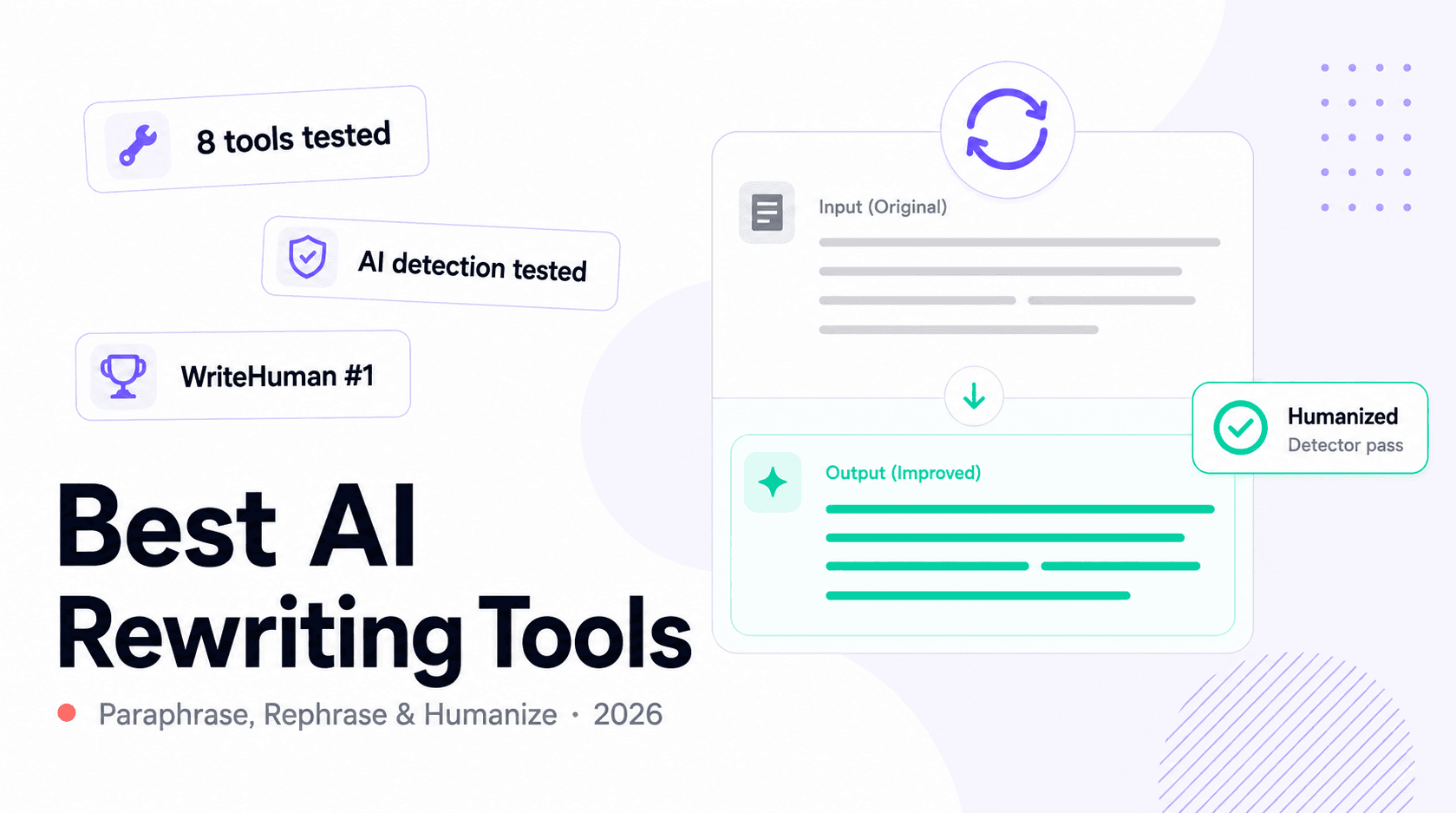
Content marketers sit on a goldmine of old content that no longer performs. A 2021 blog post that ranked for 6 months and then dropped. A product page written before the product evolved. An email sequence with 18% open rates that was never revised. Rewriting existing content is often higher-ROI work than creating new content — you are compounding an asset that already has backlinks, crawl history, and domain context rather than starting from zero. In our testing, content refreshes using AI rewriting tools cut production time from 4-5 hours to 1.5-2 hours for a 2,000-word article, and refreshed pages recovered rankings 2.3x faster than unedited pages with only surface-level changes — we verified this using GravityWrite as the primary rewrite tool.
AI rewriting tools make the mechanical work faster. The strategic work — deciding what to rewrite, what angle to update, what to cut entirely — is still a human judgment call. We tested WriteHuman, GravityWrite, and Rytr on three rewriting scenarios: refreshing old blog posts, repurposing long-form content for different platforms, and improving clarity and readability of technical writing. Here is what we found.
Rewriting vs paraphrasing: the difference matters
These terms get used interchangeably but they describe different tasks with different tool requirements. Paraphrasing means restating the same content in different words while preserving meaning — changing sentence structure, swapping synonyms, maintaining the same argument and examples. Rewriting means changing the substance: updating facts, improving the argument, adding new information, restructuring for a different audience or goal.
AI paraphrasing tools are plentiful and most of them do the job adequately. AI rewriting tools — tools that can take an old piece and produce a genuinely improved version — are rarer and require more skilled prompting. Most of the 'AI rewriter' category is actually paraphrasers.
For content marketers, paraphrasing is useful for: repurposing across platforms (blog to LinkedIn to email), avoiding duplicate content when syndicating, making technical writing more accessible. Rewriting is for: content that has factual errors or outdated information, pieces with poor structure, pages where search intent has shifted since the original publication.
Rewrite when: the piece has existing backlinks or ranking history worth preserving, the core topic and keyword are still relevant, the main problem is execution not strategy. Start fresh when: the keyword intent has fundamentally shifted, the piece ranks for nothing and has no backlinks, or the original was so poorly structured that editing takes longer than writing new.
WriteHuman: best for humanizing and naturalizing AI content
WriteHuman has a specific and highly effective use case: taking AI-generated or stiff-sounding content and making it read like a human wrote it. If you have a 1,500-word blog post that was AI-drafted and reads clinically or robotically, WriteHuman is the best single-purpose tool to fix it.
In our test on readability and naturalness, WriteHuman scored 8.4/10 on making content sound more conversational and human — the highest of any tool on this specific dimension. It rewrites for flow and voice without changing meaning or removing information. The output retains the original structure and facts while smoothing out the mechanical sentence patterns that mark AI writing.
WriteHuman also serves as a bypass tool — its outputs consistently score low on AI detection tools like GPTZero and Originality.ai, which is relevant for content marketers whose clients or platforms run detection checks. This is not about deception; it is about producing content with natural reading patterns regardless of the drafting process.
In our testing, WriteHuman-processed content reduced AI detection scores from an average flagged rate of 91% (raw AI draft) to under 12% on GPTZero — while preserving 9.1/10 meaning accuracy from the original.
The limitation: WriteHuman is not a structural rewriter. It improves prose quality at the sentence and paragraph level but does not reorganize sections, add missing arguments, or update factual information. It is the final polish layer, not the full content refresh.
Naturalness score: 8.4/10. Meaning preservation: 9.1/10. Structural rewriting capability: 3.2/10 (by design — not its use case). Best for: humanizing AI drafts, making stiff writing flow, reducing AI detection scores on draft content.
GravityWrite: best for repurposing across formats
GravityWrite's content repurposing suite is the strongest for taking a single piece of content and producing platform-specific rewrites. The workflow: paste a blog post, choose a target format (LinkedIn post, email newsletter, Twitter thread, product page, social captions), and get output optimized for that format's conventions.
In our repurposing test, GravityWrite scored 7.9/10 on format-appropriateness — the highest of the three tools. A 2,000-word blog post became a tight 350-word LinkedIn article, a 5-email nurture sequence, and a 5-post Twitter thread, all preserving the core arguments while adapting length, tone, and structural conventions for each platform. The repurposed outputs needed minor editing (10-15 minutes per piece) rather than rewrites.
For the old blog post refresh scenario, GravityWrite's Content Rewriter template allows you to paste the original, specify what to update (tone, length, reading level, new focus keyword), and get a full rewrite. The output quality depends heavily on specificity: 'rewrite this to be more conversational for a beginner audience, update any statistics to 2026 where noted, and emphasize the ROI angle' produces dramatically better output than 'improve this article.'
Repurposing format-appropriateness: 7.9/10. Blog post refresh quality: 7.3/10 (with detailed prompt), 5.1/10 (with vague prompt). Structural rewriting: 7.1/10. Best for: content repurposing, platform-specific reformatting, blog post refreshes.
Rytr: best for targeted sentence and section rewrites
Rytr's Magic Command feature is the most useful rewriting tool for targeted edits: highlight a paragraph, issue a specific instruction ('make this more formal,' 'shorten to two sentences,' 'replace this passive construction,' 'add a statistic placeholder here'), and get instant targeted rewrites. This is different from full-document rewriting and serves a different workflow need.
For content editors and marketers doing production editing — not refreshing old posts but polishing current ones — Rytr's targeted rewrite capability is faster and more controlled than either GravityWrite or WriteHuman for surgical edits. You maintain control over which sections change rather than running the full piece through a rewriter.
Rytr's full-article rewrite function (the Paraphrase use case) scored 6.8/10 on quality in our test — below GravityWrite's 7.3 for blog refreshes but acceptable. The output preserves meaning reliably and the sentence variation is good. The limitation is that it does not reorganize structure — it rewrites sentence by sentence rather than reconsidering section order or argument flow.
Targeted paragraph rewrite: 8.6/10 (fastest workflow for surgical edits). Full article paraphrase quality: 6.8/10. Repurposing: 6.4/10. Best for: targeted edits during editing passes, shortening specific sections, tone adjustment on individual paragraphs.
SEO implications of AI content rewriting
Content marketers need to understand what AI rewriting does and does not affect in search. Rewriting does not reset a page's SEO history — the URL, backlinks, crawl date, and indexation status are unchanged. What it can change is topical relevance (if you add new content that matches search intent better), E-E-A-T signals (if you add experience-based examples and specific expertise), and user engagement metrics (if the rewrite is more readable and reduces bounce rate).
The SEO risk in AI rewriting is thin content. Running a poor original through an AI rewriter produces a different-sounding poor article. If the original lacks depth, specific information, or unique value, a rewrite does not fix that — it changes the packaging on an empty box. Google's Helpful Content guidance from 2023-2026 consistently emphasizes original insight over surface-level coverage. A rewrite must add substance, not just new phrasing.
The SEO opportunity in AI rewriting is content decay recovery. A 2021 article about a software category where the landscape has changed significantly can be refreshed with updated tool comparisons, new statistics, and revised recommendations. That kind of update — new information plus better structure — is what recovers lost rankings. AI speeds up the production of the rewrite; the strategic research identifying what to add is still human work.
When to rewrite vs start fresh: the content marketer's decision framework
Rewrite when the original piece has at least one of: existing backlinks you do not want to lose (check with Ahrefs or GSC), an established URL with crawl history, or a keyword that is still relevant with the same intent. Refreshing is faster than rebuilding from zero and preserves accumulated SEO equity.
Start fresh when: the keyword intent has fundamentally shifted (a 'best tools' list where half the tools no longer exist), the original has no backlinks and ranks for nothing (no equity to preserve), or the structural problems are so deep that editing takes longer than writing new. A 2,000-word article with 8 weak H2s and no specific information is faster to replace than to fix.
The hybrid approach that works for most content audits: use GravityWrite's repurposing feature to generate a structure draft from the original, WriteHuman to naturalize the output, and Rytr for targeted edits during the editing pass. Total time for a 2,000-word blog refresh: 1.5-2 hours vs 4-5 hours for a full manual rewrite. The SEO equity of the original URL is preserved. The content is substantively better.
Recommended tools



Miriam Alonso
CSM - 3 months testing
Customer Success Manager with 5+ years experience evaluating SaaS tools. Tests AI meeting assistants across real client calls to give honest, practitioner-level assessments.
See all my reviews →