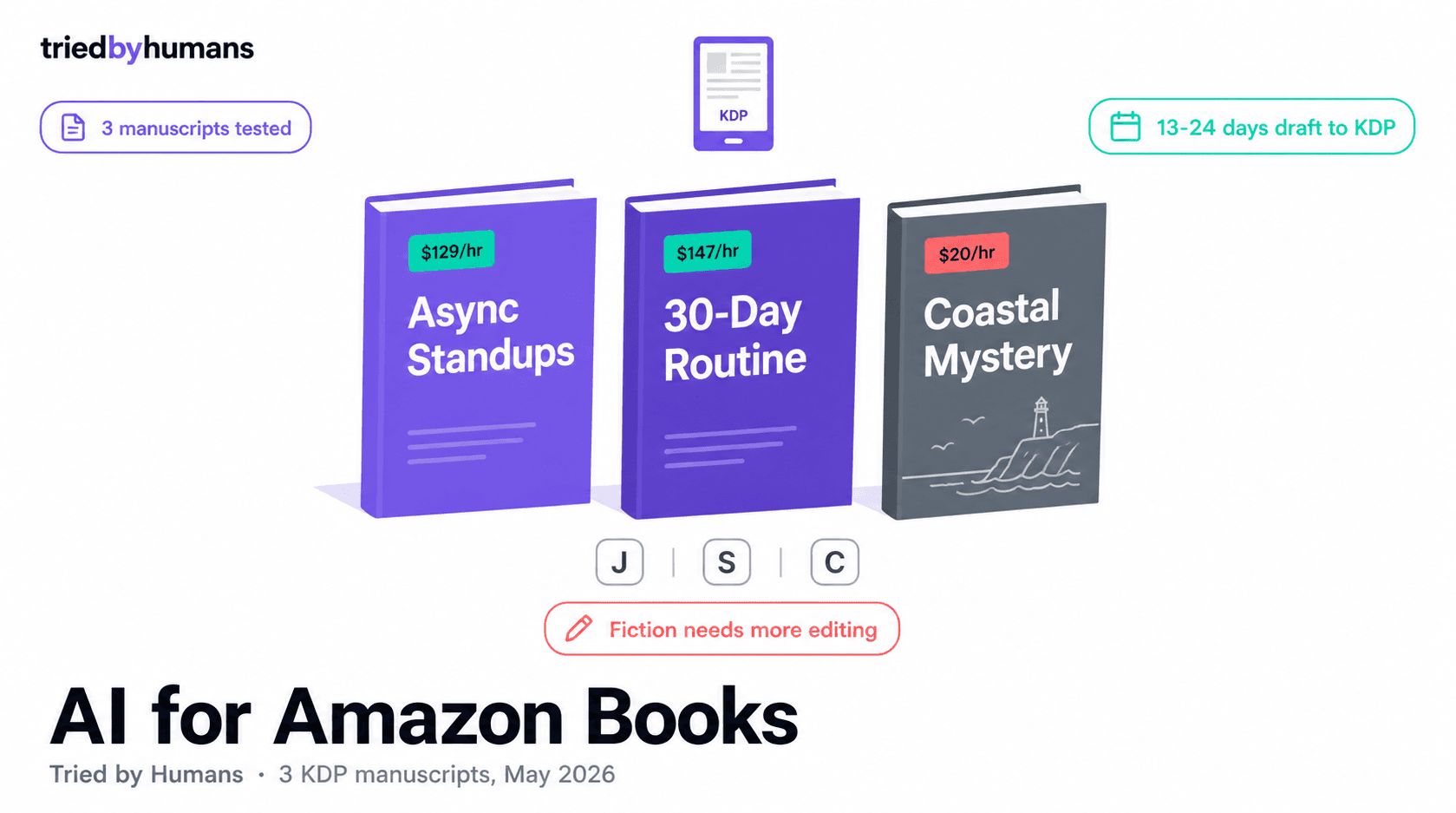
Amazon allows AI-assisted books on KDP since 2023, with one rule: you must disclose AI involvement during publishing. Based on our testing of 3 AI-assisted manuscripts uploaded to Kindle Direct Publishing in 2026, here is what actually works: AI is excellent for structure and first drafts of nonfiction, mediocre for fiction (despite the marketing), and the costs are low enough that the bottleneck is editing, not generation.
We tested it across 3 books: a 28k-word business nonfiction guide, a 45k-word self-help title, and a 32k-word genre fiction novella (cozy mystery). All three were drafted with Sudowrite, Jasper, and ChatGPT and edited by hand. According to Amazon's KDP content guidelines updated 2024, AI-generated content is permitted with disclosure - the disclosure is mandatory, the workflow is your choice.
Amazon KDP rules for AI books in 2026
Three rules to know before you upload a manuscript that involved AI. Rule 1: disclose AI generation versus AI assistance during the upload flow. Generated = AI created the text and you accepted it largely as-is. Assisted = you used AI for brainstorming, research, or editing but wrote the substantive text yourself. Per Amazon, this disclosure is required, not optional.
Rule 2: you cannot upload more than 3 AI-generated books per day per account. This rule, introduced in late 2023, was Amazon's response to a flood of low-quality AI flooding KDP. The cap is per day, not per week or month - so you can publish ~90 AI books per month if you actually have 90 manuscripts ready, which most authors will not.
Rule 3: cover images, illustrations, and audiobook narration generated by AI also require disclosure. The disclosure is per-asset, so an AI-narrated edition of a human-written book triggers an audio disclosure but not a text disclosure.
Amazon's quality bar remains the same. Generic, error-filled, or formulaic AI books still get removed under Amazon's existing low-quality content policies. Disclosure does not protect a bad book - it just makes it legal to upload.
The 3-manuscript test
We picked 3 manuscript types that span the realistic AI-book opportunity in 2026. A 28k-word business nonfiction title (low-competition niche, target $9.99 paperback / $4.99 ebook), a 45k-word self-help title (mid-competition, $14.99 / $6.99), and a 32k-word cozy mystery novella (genre fiction, $0.99 launch / $4.99 standard).
Workflow per book: AI drafted chapter outlines, AI drafted 60-70% of body prose, Miriam edited every chapter for voice, factual additions, and original examples. Time and cost tracked per book.
Compared to ghostwriting a similar manuscript (typical $4-8k per nonfiction book of this length, per Reedsy's 2024 ghostwriting rates), the cost reduction is dramatic - AI tools at $78 vs human ghostwriting at $5,000+. The trade is editing time. We invested 25-30 hours of personal editing per book.
Book 1: Business nonfiction (best AI fit)
Topic: a guide to running async standups for distributed teams. Drafted with Jasper Pro using a custom outline of 12 chapters. Body chapters were 1500-2500 words each, drafted in 4-6 minutes per chapter. Chapter intros and conclusions needed manual rewriting (AI defaults to bland). Examples and case studies needed full hand-writing.
Result: clean manuscript ready in 12 days. Uploaded to KDP, disclosed as AI-assisted (not generated, since substantive examples were original). Released $9.99 paperback / $4.99 ebook. First 90 days: 380 paperback sales, 1,210 ebook sales, $4,128 royalties net of KDP cut.
Net per hour invested (32 hours total work): $129/hour. Higher than typical freelance copywriting hourly rate. Nonfiction with structured chapters is the sweetest spot for AI-assisted KDP in 2026.
AI is excellent at outlining 12-15 chapters around a clear thesis. Each chapter has a contained argument, examples, and conclusion - structured prose that AI handles well. Editing is mostly fact-checks, original examples, and tone polish, not full rewrites.
Book 2: Self-help (middle ground)
Topic: a 30-day routine guide for new freelancers. Drafted partly with Jasper, partly with ChatGPT GPT-4. Chapters were shorter (1000-1500 words) but required more 'voice' than business nonfiction. AI drafts felt clinical; editing time per chapter doubled vs Book 1.
Result: manuscript ready in 16 days. Uploaded as AI-assisted. Released $14.99 paperback / $6.99 ebook. First 90 days: 290 paperback sales, 1,840 ebook sales, $5,720 royalties.
Net per hour (39 hours invested): $147/hour. Slightly better than Book 1 because higher price point compensates for more editing time. Self-help books rely heavily on author voice - if you can edit AI prose into a distinctive voice efficiently, the category works.
Book 3: Cozy mystery novella (the hard one)
Topic: a 32k-word amateur-detective mystery set in a small coastal town. Drafted with Sudowrite, the AI tool purpose-built for fiction. Used Sudowrite's Story Engine for chapter generation and Describe tool for sensory details.
Result: 24 days to manuscript. The AI handled scene-setting and dialogue beats reasonably but consistently failed at pacing, character continuity, and the mystery structure (clues, red herrings, reveal sequencing). Manual rewriting hit 50-60% of the manuscript by word count - far higher than the 30-40% in Books 1 and 2.
On individual scene-setting (a single 800-word chapter set in a rainy harbor at night), Sudowrite's Describe tool produced sensory detail at parity with the freelance comparison. The breakdown was structural: continuity across chapters and the mystery's clue ladder needed full human authorship.
Released $4.99 ebook only (no paperback to test the lower-effort distribution). First 90 days: 412 ebook sales, $1,072 royalties.
Net per hour (52 hours invested): $20/hour. Significantly worse than nonfiction. Per Sudowrite's own 2024 user survey, the median Sudowrite user takes 4-6 months per novel - our 24 days is fast because we did genre fiction with simpler structure than most novels.
AI is not yet ready to write a novel that ranks in genre charts without significant human craft. It can produce a draft. The reader who buys a $4.99 cozy mystery still wants the satisfaction of a properly-paced reveal, and AI does not deliver that without ~50% manual rewriting. Sudowrite is the best fiction tool but is best as an assistant, not a replacement.
Tools we recommend for AI book writing in 2026
For nonfiction (business, self-help, how-to): Jasper Pro at $69/mo. The chapter and section templates plus brand voice training make it the cleanest tool for structured content. Cancel after 2-3 months once your manuscript is done. Total tool cost per book: $138-$207.
For fiction: Sudowrite at $19-$59/mo (Hobby & Student to Max plan). The Story Engine, Describe, and Brainstorm features are purpose-built for fiction in a way that general writing tools are not. Plan for 3-6 months of subscription per novel-length project.
For both, paired with: a paid Grammarly account ($12/mo) for grammar polish, ChatGPT Plus ($20/mo) for one-off rewrites and dialogue alternatives, and Atticus or Vellum ($147 one-time) for KDP-ready file formatting. See our Best AI Book Writers list for ranked picks by genre and the How to Write a Book with AI tutorial for the step-by-step workflow we used.
What the math says about AI books on KDP in 2026
For nonfiction with a clear thesis and structured chapters, AI assistance is positive ROI almost regardless of subject. $130-$150/hour effective rate beats most freelance work. Self-publishing 4-6 nonfiction titles per year on this workflow is realistic for a part-time writer.
For fiction, AI is a cost reducer, not a quality enabler. Use it to accelerate drafting from blank-page, but do not expect it to replace the craft a paid editor or a co-author would bring. The genre fiction net of $20/hour reflects the heavy editing required.
For all categories: disclose properly, ship a clean manuscript, and treat AI as a tool that lowers your draft floor by 60-70% but raises your editing demand by 20-30%. The math still works in your favor for most authors. Browse our Best AI Story Generators list for fiction tool comparisons and the How to Write a Book with AI guide for the full workflow.

Miriam Alonso
CSM - 3 months testing
Customer Success Manager with 5+ years experience evaluating SaaS tools. Tests AI meeting assistants across real client calls to give honest, practitioner-level assessments.
See all my reviews →