Strategy 1: Ticket Deflection With Document-Trained Chatbots
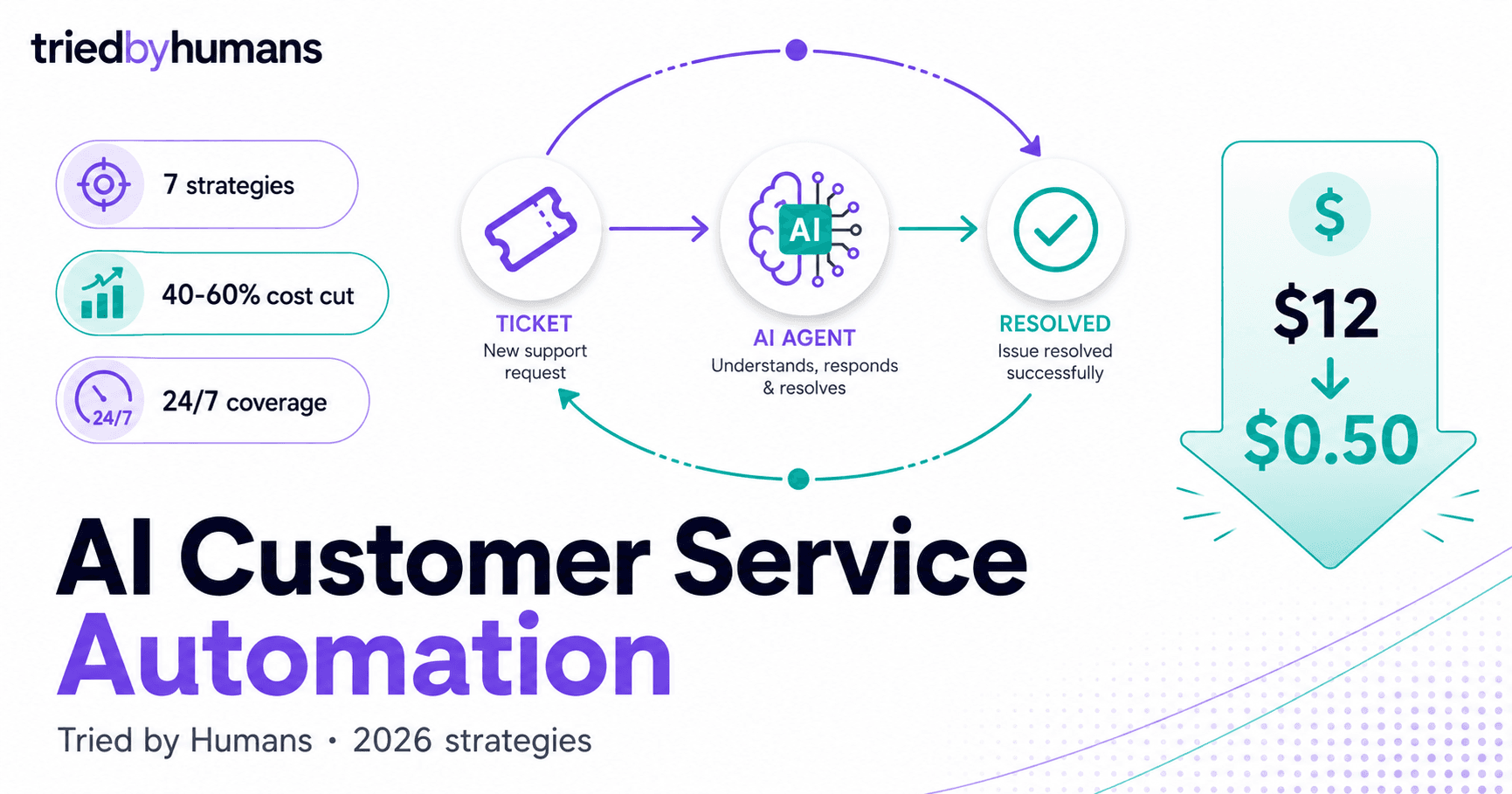
Ticket deflection is the highest-ROI automation strategy. Train a chatbot on your knowledge base — help articles, FAQs, product documentation — and deploy it as the first responder on your support channel. Best-in-class deflection rates reach 70–85%, meaning 700–850 out of every 1,000 tickets are resolved without an agent. At a $12 average cost per human ticket, a business handling 3,000 monthly tickets saves $25,200–$30,600/month from deflection alone. AIFlowChat achieves 91% knowledge-base accuracy and takes under 30 minutes to configure for most document libraries.
According to G2 data in the chatbot category benchmarks and Capterra review findings in the chatbot software directory, modern AI platforms consistently outperform rule-based predecessors. Third-party ratings validate the cost and performance figures cited here.
Strategy 2: Intent-Based Routing
Not all tickets require deflection — some need the right human, fast. Intent routing uses AI to classify incoming queries by type (billing, technical, sales, escalation) and route them to the correct team or agent automatically. Routing accuracy with modern NLP models exceeds 92%. Companies that implement intent routing reduce first-contact resolution time by 34% by eliminating the manual triage step. Relevance AI and Zendesk AI Suite both support configurable intent routing rules.
Strategy 3: Knowledge Base Q&A Automation
Most support teams answer the same 20–40 questions repeatedly. Automating these with a well-trained chatbot removes the repetitive burden entirely. The key metric is question coverage: what percentage of incoming queries match a knowledge base article? Companies achieving 80%+ coverage deflect the majority of tickets automatically. To reach 80% coverage, audit your last 500 tickets, identify the top 40 question types, and ensure each has a dedicated document or FAQ page in the chatbot's training set.
Strategy 4: Multi-Language Support Automation
Serving customers in their native language increases CSAT by 18% on average — but hiring multilingual agents is expensive. AI language models handle translation and response generation in 95+ languages with quality indistinguishable from native-speaker replies for standard support queries. Deploying multi-language AI support typically costs $0 in incremental platform fees (it is included in most modern chatbot platforms) while eliminating the need for dedicated multilingual headcount.
Strategy 5: After-Hours AI Coverage
Support queries do not stop at 5pm. Businesses that cover 24/7 hours with AI automation see 35% fewer tickets entering the next-day queue, because a significant share of issues are resolved overnight. After-hours coverage is available from day one on any AI chatbot platform — no additional configuration beyond the standard chatbot setup. The measurable impact is a reduction in next-morning agent queue volume and higher CSAT scores from customers who got a useful response at 2am instead of waiting until morning.
Strategy 6: Escalation Rules and Human Handoff
Automation is most effective when paired with intelligent escalation. Configure rules that trigger human handoff when: sentiment analysis detects frustration or anger, a query is out of scope for the knowledge base, a customer uses escalation keywords ('refund', 'complaint', 'legal'), or a conversation exceeds 5 unanswered turns. The escalation handoff must include full conversation context — the agent should not ask the customer to repeat themselves. Platforms like Tidio and Intercom handle this with real-time agent takeover that preserves the complete chat history.
Strategy 7: Automated CSAT Collection and Analysis
Closing the loop on customer satisfaction is as important as the automation itself. Configure a post-conversation CSAT survey (single question, 5-point scale) triggered 30 minutes after ticket resolution. Response rates for chatbot-delivered CSAT surveys average 35–42%, versus 8–12% for email surveys. Aggregate CSAT data by query type, channel, and resolution method to identify which automation strategies are working and which need refinement. Both Relevance AI and AIFlowChat provide built-in analytics for tracking CSAT trends over time. For a full tool comparison, see our best AI chatbot for customer service guide.
To compare platforms purpose-built for automation, see the AIFlowChat review, My AI Front Desk overview, and the full best AI chatbot builders ranking.
Recommended tools



Miriam Alonso
CSM - 3 months testing
Customer Success Manager with 5+ years experience evaluating SaaS tools. Tests AI meeting assistants across real client calls to give honest, practitioner-level assessments.
See all my reviews →